The consequences of IMSA adopting WEC's 'gag order' policy
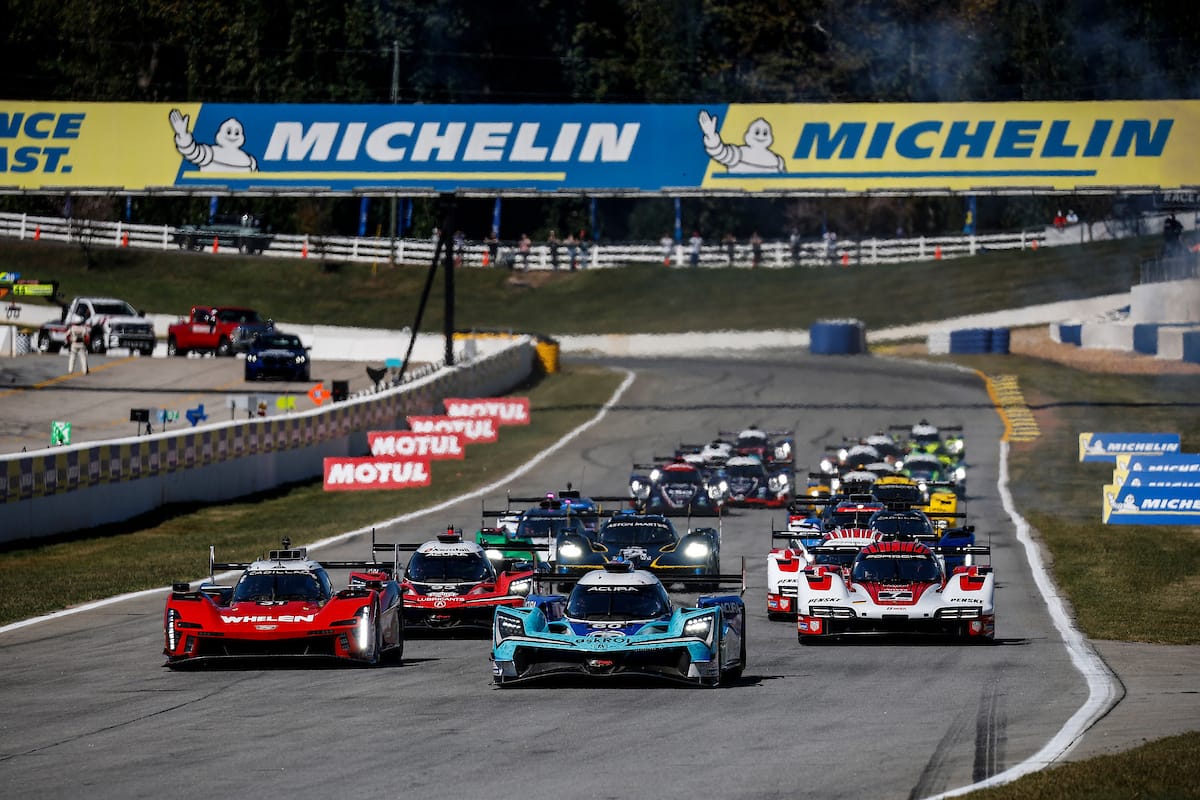
The IMSA SportsCar Championship has followed the World Endurance Championship's lead by cracking down on public discussion of Balance of Performance. From now on, competitors will no longer be free to speak openly about BoP to the media.
The move mirrors a policy introduced by the WEC in 2023. And while IMSA has largely avoided major BoP controversy so far, the timing - just weeks before the Daytona 24 Hours - has raised eyebrows.
A quietly significant rule change
IMSA released its 2026 sporting regulations just over two weeks before the 64th running of the Daytona 24 Hours. Buried within them was a clause that immediately caught the paddock's attention: Article 2.2.3.
It states that: "Manufacturers, competitors, drivers, constructors, and any persons or entities associated with their entries must not attempt to influence the establishment of the Balance of Performance or make any public comments regarding the BoP process, methodology, data, or outcomes, including but not limited to statements made through traditional media, digital media, or social media platforms."
It further adds that: "The determination of whether any conduct or communication constitutes a violation of the above, regardless of intent, shall be made exclusively at IMSA's sole discretion. Any infringement may be penalised by IMSA officials at any time before, during, or after an IMSA competition."
In other words, IMSA now reserves full authority to judge both intent and wording, and to impose sanctions at any point.
Has BoP been controversial in IMSA?
After the first four races of the 2025 season, IMSA took a decisive step to counter the ultra-dominance of Porsche Penske Motorsport. Just over a week before the Detroit Grand Prix at the end of May, the series announced a change to the way its BoP adjustments would be applied, with the aim of accelerating performance convergence across the field.
"Changes come following a transparent process that takes in all performance factors," IMSA president John Doonan explained at the time. "It should enliven the field and potentially increase the variety of winners - not only podium finishers - for subsequent races."
"All of these changes are based on a data-driven process," Doonan added. "We've realised that the rolling process hasn't reacted fast enough in equal and fair competition. When things are somewhat diverging in terms of competition, when you've got a couple of cars outside the performance base band and a couple of cars below it on the low side, you want to bring everybody together."
The irony is that Porsche's early dominance was clearly credited to execution rather than BoP. Strategy, consistency and race management - not regulation - were the differentiators. As a result, IMSA's intervention raised eyebrows - particularly as no major scandal had erupted beforehand.
That said, Porsche did on one or two occasions hint that BoP was a key factor behind its subsequent struggles. After the Watkins Glen race in June, Porsche Penske Motorsport managing director Jonathan Diuguid remarked: "Eighth and 10th place are clearly not what we were aiming for. But unfortunately, it's out of our hands."
Carefully phrased. But unmistakable. Is this precisely the kind of messaging IMSA is now looking to prevent?
WEC and IMSA: same fight, different cultures
While IMSA and the WEC do not rely on identical methodologies when setting their BoP, it is the WEC system that has generated far greater controversy in recent years.
That may be a matter of culture as much as competition format. American-style racing, with frequent cautions and restarts, naturally dilutes pure performance gaps. In WEC, where races tend to flow more organically, BoP decisions have a much bigger impact on the results.
Regardless, the WEC did not wait until 2026 to act. Since 2023, its sporting regulations have explicitly prohibited competitors from influencing or publicly commenting on BoP, with sanctions provided for any breach.
"Manufacturers, Competitors, Drivers and any persons or entities associated with their entries must not seek to influence the establishment of the BoP or comment on the process and/or the results, in particular through public statements, the media and social networks," the regulations state.
"Any infringement to the above principles will be penalised by the stewards, at any time during any competition, post-race included."
This article closely mirrors a broader provision in the FIA International Sporting Code, which allows the FIA to sanction: "Any words, actions or texts that have caused moral injury or loss to the FIA, its bodies, its members or its executive officers, and more generally to the interest of motorsport and on the values defended by the FIA."
Several other championships, even where such rules are not explicitly written into the regulations, reserve the right to penalise competitors for public statements deemed detrimental to governing bodies. NASCAR is a prime example - and notably, it is IMSA's parent organisation, from which IMSA has clearly inherited much of its regulatory culture.
Have there been any sanctions so far?
Has this threat actually been effective in the WEC? Not really. Most competitors have instead resorted to implication and euphemism when criticising BoP, sometimes referring to it ironically as "she who shall not be named", a tongue-in-cheek Harry Potter reference.
To date, only one official bulletin has been issued. In July 2024, Toyota Gazoo Racing team director Rob Leupen was sanctioned after responding to journalists's questions about BoP in the WEC.
"The competitor responded to questions from a journalist concerning the topic of BoP in the WEC championship." The official document stated.
The penalty was a €10,000 fine, suspended for the remainder of the 2024 season, pending any similar infringement. Since then, silence...