The F1 fears that closed off first 2026 test
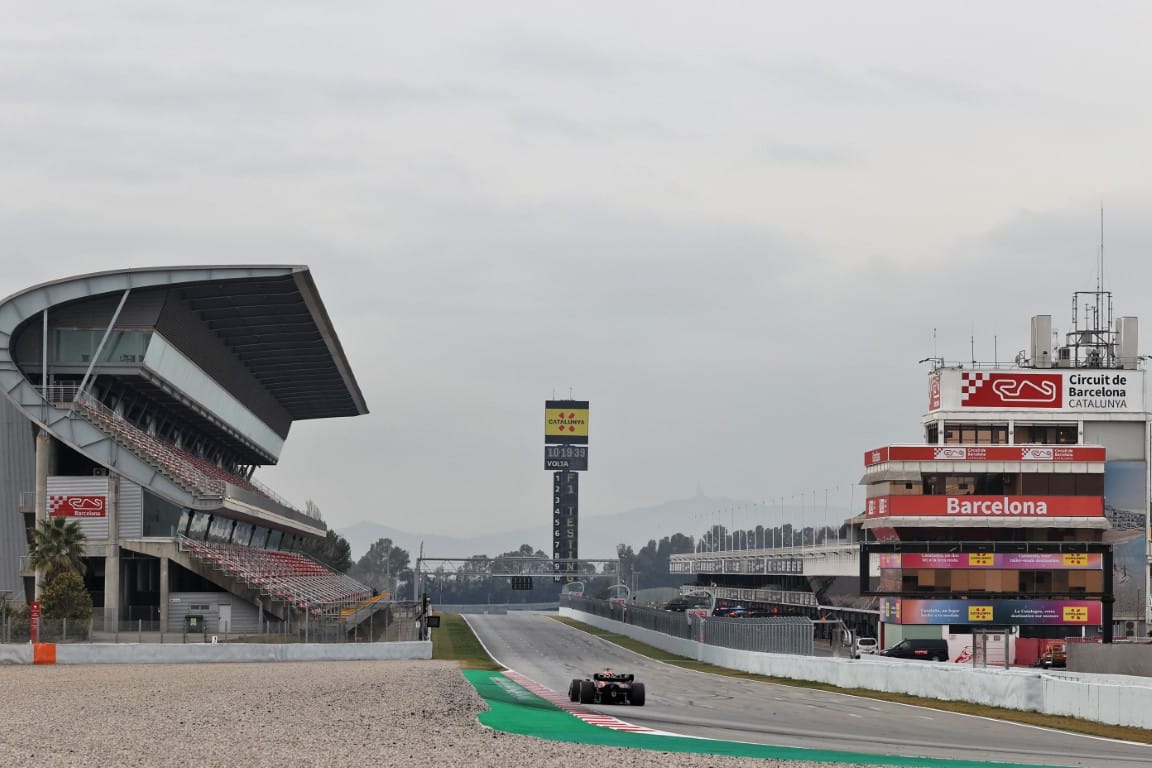
Instead of being a highly anticipated first proper look at 2026, capitalising on interest in brand new cars and engines, Formula 1's opening test is a closed affair.
Teams are not obligated to run at Barcelona at the end of the month but all should, with a maximum of three days of running for each team permitted across Monday, January 26 to Friday, January 30.
The first test is a major moment in any new season, let alone one where the cars are changing so much, so there is huge anticipation to see how they look and sound, and get the first clues of who might be on top and who is in trouble. But cold water has been poured on that excitement.
Fears of reliability problems at the start of the new rules era prompted the teams to want that opening test to be held in private. No live broadcast, no media access at all.
The line is that the teams organised it themselves - although as pre-season testing is part of the regulations, obviously the rulemakers and key stakeholders have a significant influence, too.
A middle ground of sorts was struck. It is a 'closed' test but with a small F1 contingent set to attend to film brief conversations with drivers and senior team and technical personnel. Teams are also encouraged to issue their own updates from the test although how many do, and how much information they share, will have to be discovered.
The upshot is something more extreme than even just the stripped-back testing offering that was actually the norm until fairly recently. The last time F1 rolled out brand new cars, in 2022, there was a version of what's happening this year - but it was not so secretive.
Four years ago, the first test at Barcelona was framed more as a three-day shakedown, with Bahrain hosting the official pre-season tests. Most people thought this was just because Bahrain wanted and paid for the honour of the real tests but the reason didn't really matter.
There was a key difference in how they were managed as the Spain test only had basic media access and timing available on-site whereas Bahrain was the more common offering in the modern era: hosted as a full F1 event with extensive broadcast coverage and live timing.
The reason why something similar is not being done in 2026, and the privacy is being taken a step further, is unconvincing. The main argument seems to be that testing is meant to be just that: testing. So teams should be able to go about their business in private, as they once did back in the day of in-season testing and private tests being the normal.
This isn't necessarily wrong in principle, but doesn't really stand up to scrutiny.
Many teams will probably shake down their cars in advance anyway, so there is an opportunity for private running. Audi ran its car for the first time on January 9, for example. And there's the established 'old' way of doing the test to minimise the coverage: not having every single moment televised live and reducing what data all media have to work with.
Speaking selfishly, back in 2022 the Barcelona test was not closed like this. So we didn't miss out - but neither did the fans as we could still provide independent coverage.
Limiting testing access is not necessarily a bad thing given extensive, round-the-clock live broadcasting can be excessive and while many like to have the option of watching testing, it gets boring very quickly.
Taking away the option to follow a test almost entirely, though, is driven by teams wanting to avoid embarrassment in case things go wrong and an ecosystem that wants to control the message.
Ghosts of 2014
The ghosts of F1's last massive rules change are a potential factor here. Most teams and manufacturers don't have happy memories of the last time they headed into pre-season testing with all-new engines.
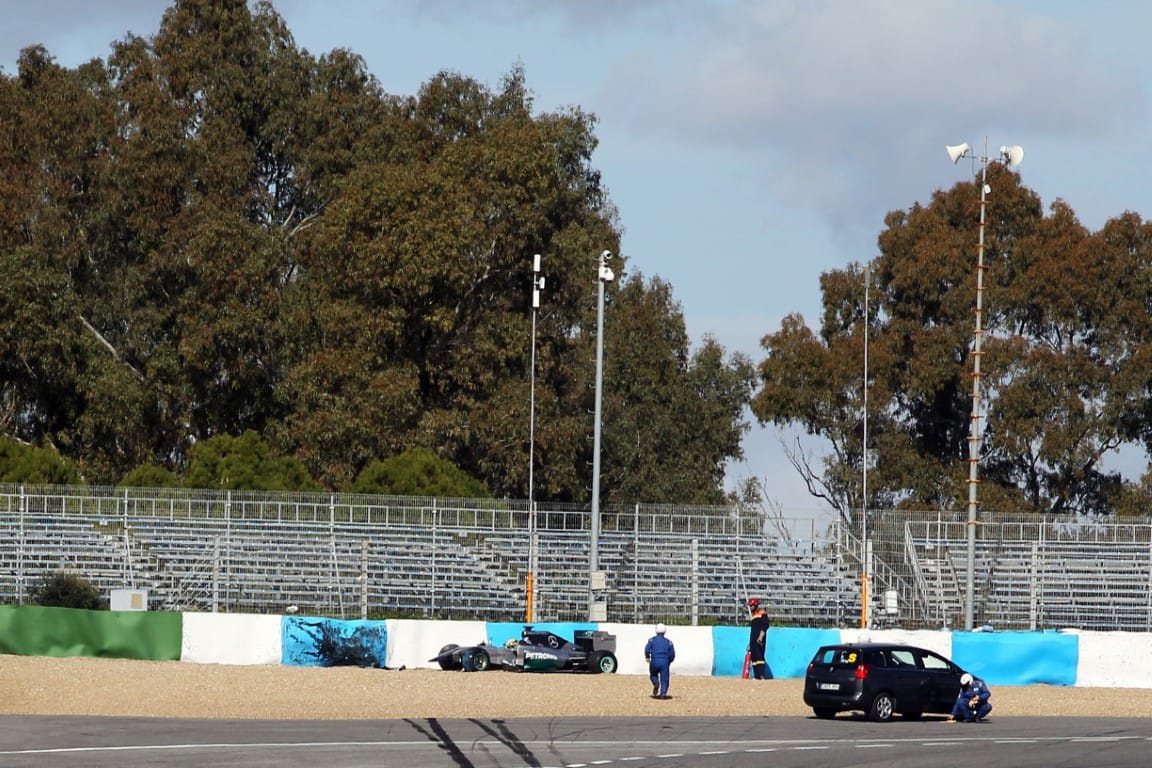
On the first day of running at Jerez 12 years ago, the teams managed a grand total of 93 laps between them. McLaren didn’t even get out of the garage, Marussia was in transit to the circuit after completing its car late, and Lotus didn't even attend the test.
A total of 2 hours and 20 minutes passed before someone completed anything other than an installation lap. That was Lewis Hamilton in the Mercedes, which ended up in the wall at Turn 1 thanks to a front-wing failure after logging 18 laps.
Even day-one pacesetter Kimi Raikkonen caused a red flag when his Ferrari stopped on its very first lap, while Red Bull-Renault's struggles were very clear as it managed just three slow laps.
F1 2024 Jerez test, opening day
1 Kimi Raikkonen, Ferrari 1m27.104s (31 laps)
2 Lewis Hamilton, Mercedes +0.716s (18 laps)
3 Valtteri Bottas, Williams +2.978s (7 laps)
4 Sergio Perez, Force India +6.057s (11 laps)
5 Jean-Eric Vergne, Toro Rosso +9.426s (15 laps)
6 Esteban Gutierrez, Sauber +15.153s (7 laps)
N/A Sebastian Vettel, Red Bull - no time (3 laps)
N/A Marcus Ericsson, Caterham - no time (1 lap)
Things did improve as the test progressed, but it seemed inconceivable that just six weeks later it would be possible for this group of cars to run a credible grand prix.
Even once pre-season testing was completed, there were major doubts. Renault's problems were so bad that neither Red Bull nor Toro Rosso had pulled off a successful practice start prior to heading to Australia.
To make matters worse, there was widespread criticism of the perceived lack of engine noise. This all added up to the new rules era making a very unconvincing start.
And yet, come Australia, 15 cars crossed the finish line - albeit one of them, Marussia's Jules Bianchi, was not classified as a finisher. Even Red Bull managed to get second place with Daniel Ricciardo, although he was later excluded for fuel-flow irregularities.
Still, the pre-season struggles were a PR disaster, and F1 as a whole didn't do a good job of telling the technical story of this remarkable turnaround as teams and manufacturers quickly got on top of the new power units.
It's not clear whether lessons have been learned. Maybe that fear prompted the overcorrection we see now. There is a lot more attention on F1 now than in 2014. So a humiliating first test would be exposed to far greater scrutiny and ridicule.
But is such a repeat even likely?
The 2026 fears
There have been rumours for a long time that one engine manufacturer - Mercedes - is in a really good place for the new rules. Then came the news that Mercedes and Red Bull Powertrains were exploiting something in the rules that others aren't, potentially locking in an advantage in that area over the others.
There haven't been horror stories of multiple manufacturers struggling to get their engines to work reliably on dynos, though. The new engines are a big challenge but this isn’t the same kind of unprecedented technological F1 challenge as before.
There are unknowns, certainly. The engines becoming more of a 50/50 split between internal combustion and electric power makes for a fascinating engineering test. The reduction in car weight is something that teams will really struggle to meet at first. New advanced sustainable fuels bring fresh reliability peril as well.
"We don't know where we are synthetic fuel, we don't know where we are on the fuel system working with it, and we don't know where we're out on power unit yet," said Williams team boss James Vowles in December.
"As much as I think Mercedes has done a good job, I still think you're going to find a lot of cars in the garage for a long period of time.
"That's one of my biggest concerns. But we have three tests, so ultimately, let's flush them out at number one."
So it's probable, not just possible, that cars will spend chunks of time in the garage during the Barcelona test. There will probably be on-track stoppages, maybe even the odd slightly dramatic failure.
A team or two in crisis, a major manufacturer with egg on its face, several drivers knowing immediately they're in for a shocking year - it's all possible.
It is understandable teams wouldn't want TV cameras fixated on their cars and garages during peak moments of stress, or people listening out for the sound of electric saws firing up behind a closed door. And F1 would obviously not like the first 2026 narratives to stick to be ones of crises or concern.
There is an argument that by making what happens in Spain more of a mystery, the interest and anticipation for the first 'real' test in Bahrain will be heightened.
How it really lands with fans will be telling. Because nothing hits quite like the first test.