Gary Anderson: What Cadillac's 2026 F1 car has revealed
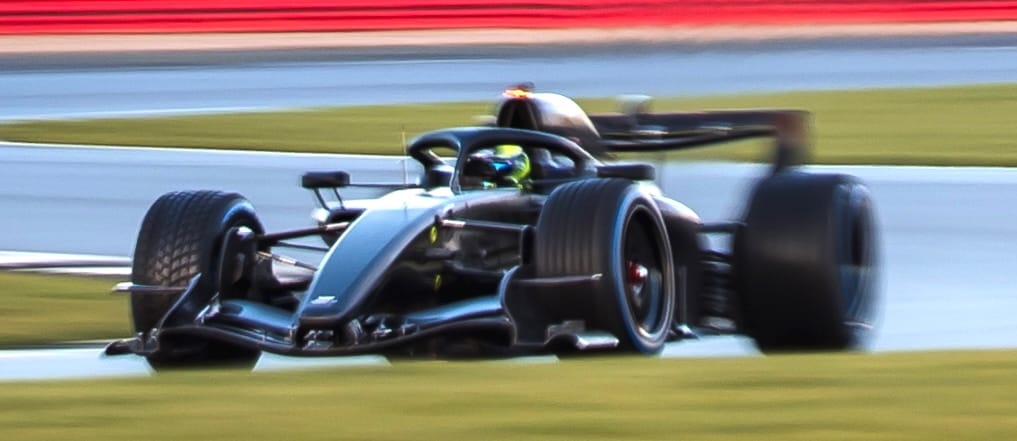
Emerging on a murky January day at Silverstone, we have Formula 1’s long-awaited 11th team - Cadillac, completing its very first F1 2026 shakedown. With its major backer’s background as a car manufacturer, this has to be classed as a works team even though for the next few seasons it will be using a Ferrari power unit while the operation builds up. But everyone has to start somewhere.
Cadillac has been building for this moment for a long time, but the day it actually runs in earnest is a big one. The late nights, the head scratching, the working through short-term and long-term solutions to problems and the knowledge that you will very soon know exactly where you stand in the pecking order will mean it’s now feeling very real for all of those involved.
To the team’s credit, for the new regulations, it is actually a step ahead of most of its rivals, who have yet to turn a wheel in anger.
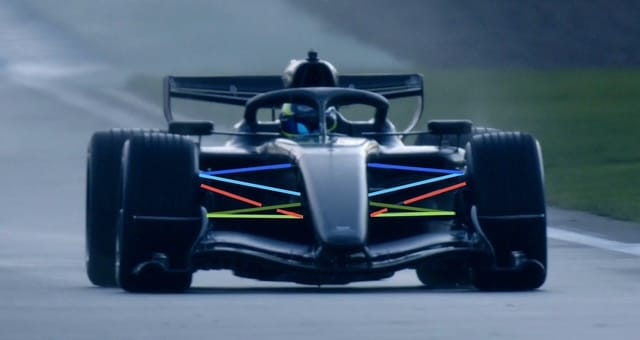
As we can see in the picture above, it has opted for a pullrod front suspension (red highlight). Were I making those decisions, I would have gone in the same direction. The simple fact is that the centre of gravity of all the inboard components is lower and the pullrod can also have a smaller cross section so less aerodynamic blockage.
It also has a reasonable amount of anti-dive on the top front wishbone (dark blue highlight is the forward leg, light blue highlight is the rearward leg). However, some of that anti-dive will be reduced with the fact it has some pro-dive on the lower wishbone (dark green highlight is the forward leg, light green highlight is the rearward leg).
With ground effect cars, even ones with less powerful ground effect than last year’s cars, you still need to control that underfloor area platform as best as possible.
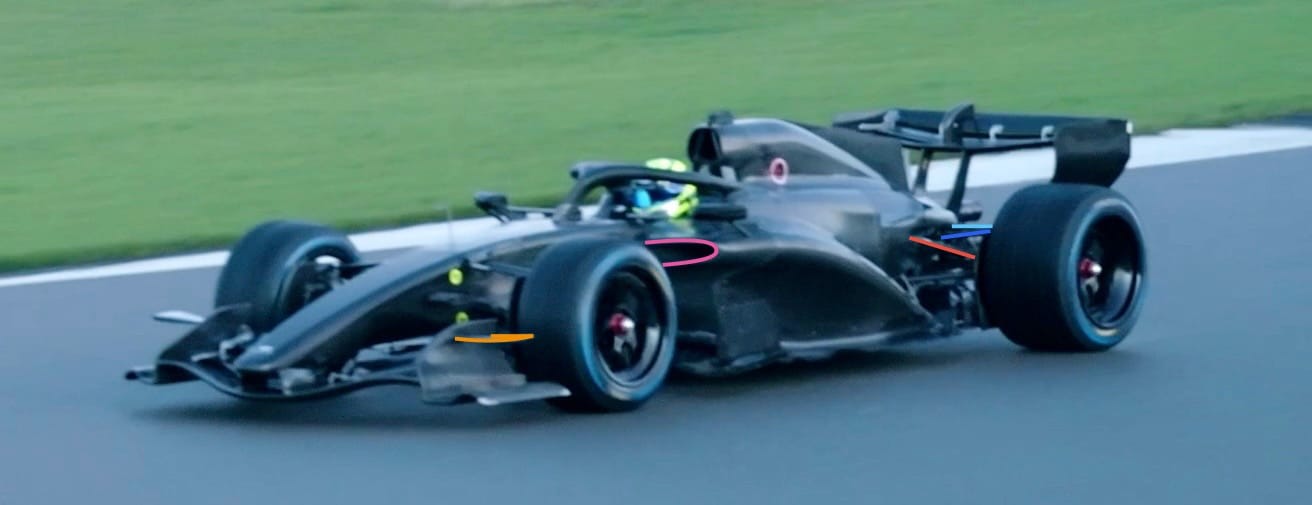
It has a horizontal wing element on the outer upper edge of front wing endplates (orange highlight). This is a new area of development for this year so I’m sure we will see a few interesting interpretations of how best to separate the airflow around the inside and outside of the front tyre before we hone in on the best practice.
Also, the radiator inlet is high and more of a horizontal letterbox with vertical opening (magenta highlight) than we were seeing from the front running cars last year which had an overhung upper surface. This gives it what looks like a huge sidepod undercut. It also has a very steeply falling away upper sidepod surface, again with the reduction in the need to seal the edges of the underfloor to optimise the ground effect, as was common practice last year. This area is also up for initial interpretation. However, sealing the sides of the floor, even when we had the complete flat bottom cars and a very simple diffuser, was never a bad thing.
As for the rear suspension, it has opted for a pushrod-operated inboard mechanism (orange highlight) and has some degree of anti-lift on the rear to wishbone (forward leg dark blue highlight rearward leg light blue highlight). Cadillac uses Ferrari gearbox internals, but manufactures its own casing so it doesn’t have to have the same rear suspension geometry as its supplier.
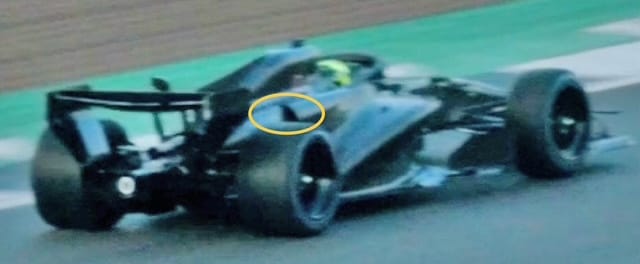
With cooling, what comes in cool must go out hot and is useless at creating downforce. One of its hot air exits is on the upper corner of the chassis shoulders (highlighted with a yellow ellipse).
When looking for these areas, you try to find the position on the body surface that gives the best cooling for the least loss of downforce. Some areas are regulated to stop some of the inherently richer teams plunking a big hole right where a lesser funded team would need to fix a sponsors logo, so that’s why we don’t see so many random hot air out positions.
The all-in-black Cadillac having its first test reminds me of a day that feels like yesterday when we ran the first Jordan at Silverstone in late November 1990. The Jordan 911, as it was originally called, hitting the track with fellow Irishman John Watson behind the wheel, was a big day for Eddie Jordan and myself, not to mention the 25-odd people that made up the team at the time. Actually, a few of them are now among the hundreds of people who now work for Cadillac - so extra good luck to them.
I’m really pleased to see this new team up and running. However, if you thought it was difficult up until now, then you ain’t seen nothing yet! The hard work starts now.