Gary Anderson: How F1 teams are clawing back ground-effect downforce
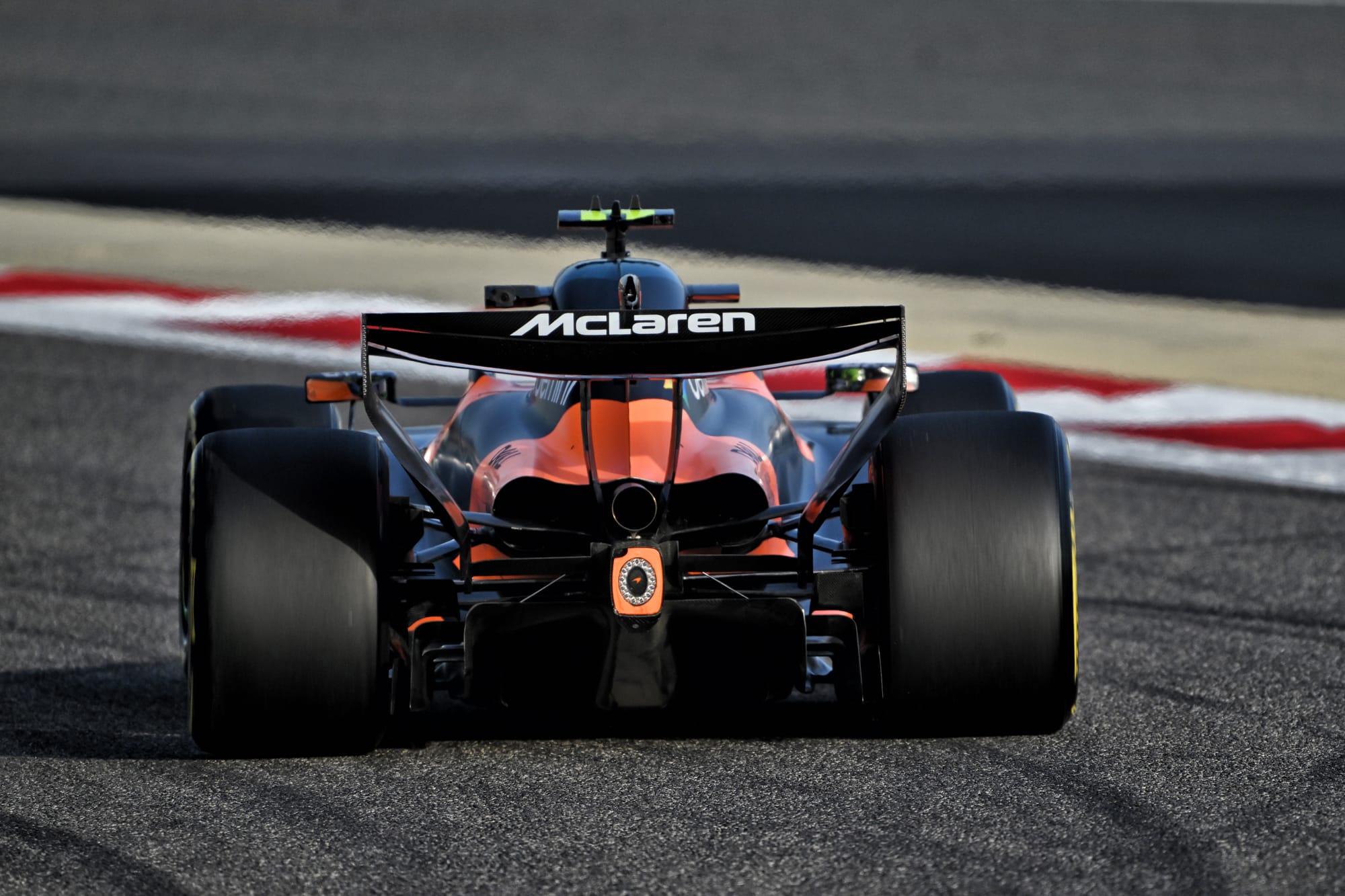
The ground effect downforce generated by the underfloor of the 2026 Formula 1 cars might have been reduced, but the diffuser still makes a critical contribution to the overall downforce.
Not only that, but it's also the prime mover when it comes to aerodynamic consistency and rear end stability, especially under braking.
To understand the design approaches this year, we can take a close look at the cars of big four teams, as well as the aggressive Aston Martin, in the order to which they have maximised the exploitation of this area.
The diffuser is fairly well-defined by the regulations. As you'll see, other than small differences in the geometry of the splitters etc they have all more or less gone down the same route.
But it is in the surrounding areas that we can see some interesting differences.
Ferrari appears to have done the most, which might come as a surprise, and its attention to detail in this area is impressive.
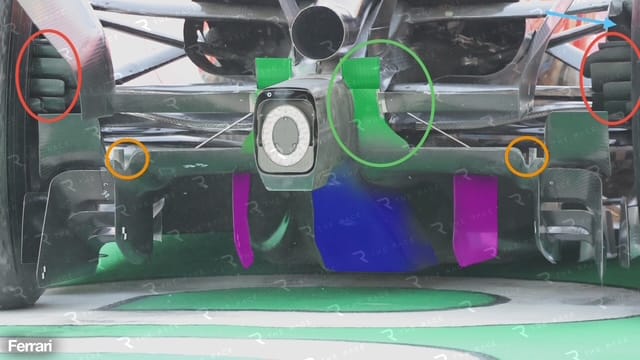
The amount of turning vanes (red ellipse) on the inside of the brake ducts, the diffuser extension (green ellipse) where it goes around the rear crash structure, and the detail where the rear trailing edge meets the outer sidewall (orange ellipse) all show how it is adding up all the small areas of potential performance.
It's the sum of all the parts that produces the overall performance, so leave no stone unturned. The brake cooling exit (blue arrow, top right) is the only area that I think could have had a more aggressive approach.
Rear tyre temperature over a stint length is still going to be a talking point this year, so getting that hot air out of the inside of the wheel will still be important.
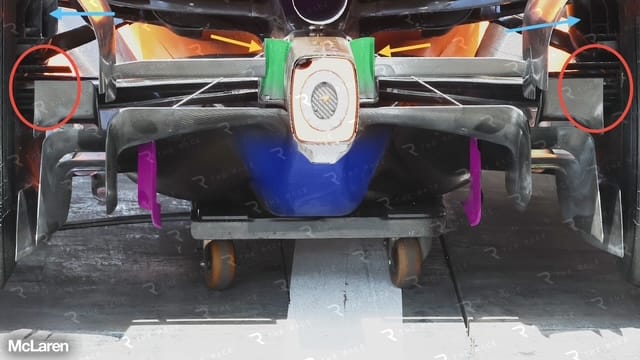
As for McLaren, it doesn't have as dramatic an array of turning vanes on the inner surface of the brake ducts (red ellipse). Instead, it has a more pronounced brake duct hot air exit, (blue arrows). This is not surprising, as it was the trendsetter early last year when it came to rear tyre temperature management.
McLaren also has vanes mounted on the side of the crash structure (yellow arrows), albeit ones smaller than Ferrari's.
These don't connect directly to the diffuser trailing edge, but they will help extract some of the airflow from that boat tail section of the diffuser.
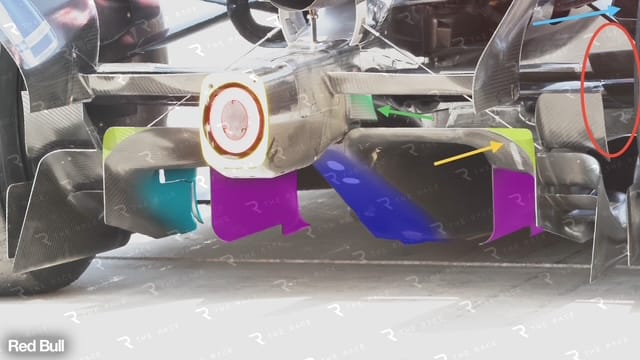
Next up we have Red Bull, which again does not have so many turning vanes (red ellipse) on the inner surface of the brake ducts. Its hot air outlet (blue arrow) is bigger than on the Ferrari, but not as sophisticated as on the McLaren. It also has a small turning vane (green arrow) mounted on the side of the impact structure.
One thing I do like is the large corner radius (yellow arrow) on the upper outer corner of the diffuser.
Even though you give up some diffuser exit area, this large radius is better at managing airflow separation problems where the airflow on the upper surface meets up with the airflow on the side surface.
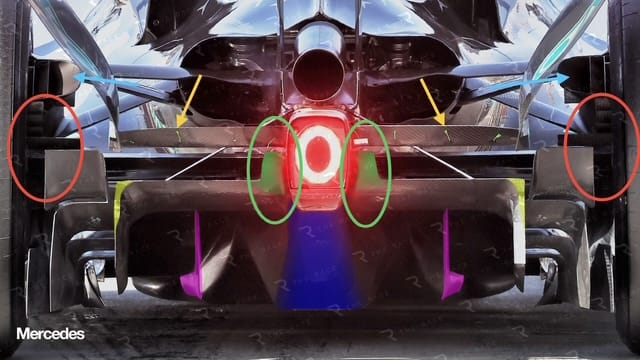
Now for Mercedes. The brake-duct-mounted turning vanes (red ellipse) are there, as are some small diffuser extensions (green ellipse), but not to the extent of Ferrari.
It has a more sophisticated brake duct hot air exit (blue arrow), which is split into various areas of outlet. This gives it that little bit more control of the internal cooling distribution, and is perhaps even more adventurous than McLaren.
I was also delighted to see that even with today's level of technology in F1, Mercedes still resorts to using the tried and tested wool tufts on the beam wing (yellow arrow).
These flow with the direction of the airflow and help you to identify any potential separation problems. Mercedes probably have had a small camera mounted somewhere on the car, or on an earlier aero rake run, to look at these at speed.
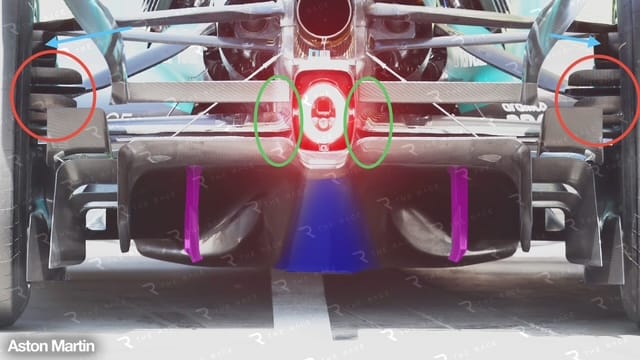
Adrian Newey's Aston Martin has the brake-duct-mounted vanes (red ellipse) and a hot air exit from the brake ducts that's smaller than most. There's also nothing on that inner area of the diffuser-to-rear-crash-structure so what we are seeing in this area is fairly basic.
Its rear suspension looks more adventurous than the others, but I can't yet see enough to understand the linkage arrangement of the lower wishbone. That's something for another day.
Most of these parts are bolt-on goodies, so are not too difficult to re-engineer when you have seen who has gone down what route and understood what direction might be better.
However, as with anything, redesign work costs time and money from your cost cap, so doing it too often can very easily mean that late in the season the well is running dry.
Then, if you have a eureka moment you might not have the money to turn it into reality.