The easy answer to fix 2026 cars would ruin F1 completely
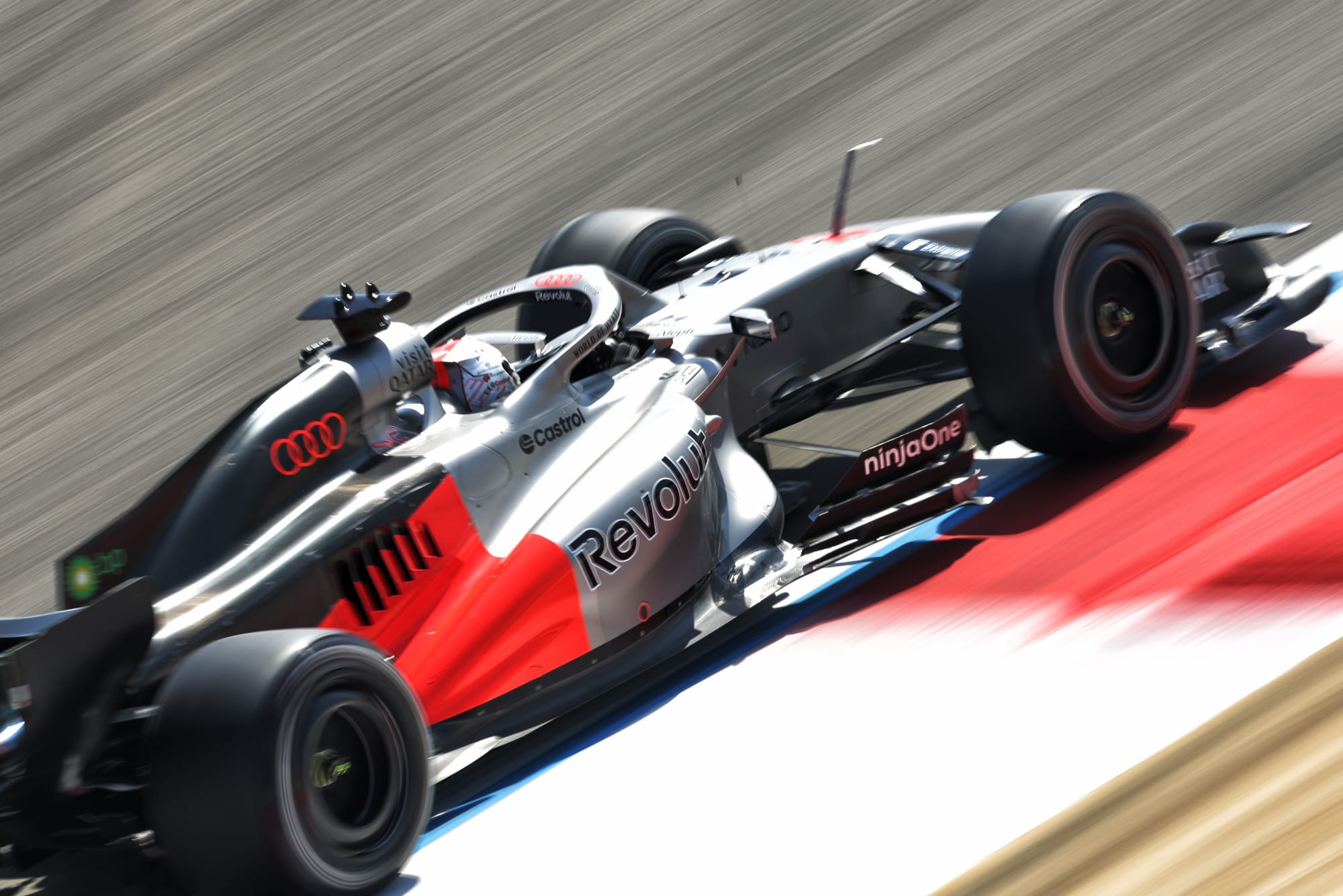
In the wake of the ‘chef could drive’, ‘not racing’ critical comments from drivers about the new generation of very energy-starved F1 cars, it has been suggested that not regulating front axle recovery into these regulations was a dramatic own-goal.
Not only would the battery be fed by the braking energy of two axles instead of one, but the front axle naturally absorbs more braking energy than the rear as the weight of the car transfers to the front once it is being braked. It would not even be new technology, as the Audi R18 Le Mans car introduced it in 2012.
There is, however, a potential problem with using it in F1 and it’s quite possibly why it wasn’t incorporated into these regulations. If you have independent control of the amount of torque each axle is harvesting, you have the perfect basis for stability control. Stability control – far more than traction control - obliterates skill differences between drivers.
The key to being quick, the reason why one driver can intrinsically drive a car more quickly than another, is in the transition from straight ahead to the completion of the initial direction change; aka ‘rotation’. Feeling how much braking can be overlapped with the building lateral grip, having the sensitivity to keep your references of the car’s yaw, not being overly troubled by an aggressive rotation: all these things separate the Max Verstappens and Michael Schumachers from the good but not great drivers.
Stability control essentially makes that distinction meaningless, as it can give you the ideal rotation under perfect – system-monitored – control. Take in a competitive entry speed, begin turning at the right place and the system, once developed fully, could take you through there just like Max.
The cars all have a standard-issue ECU, so in theory, such technology could be avoided. But where there’s a competitive will, there’s always a way. Mechanical systems would inevitably be devised to accomplish the same thing. Stability control would arrive.
This is not the first time two-axle energy recovery has been suggested for F1. In fact, the introduction of KERS technology – for 2009 – was originally conceived for two axles, something that was pushed heavily at the time by Toyota.
At the time of its announcement, sometime in 2008, I wrote a column pointing out the stability control implications. I said that with such a system, there’d be no difference between a Michael Schumacher and an Eddie Irvine.
At some time during the year I, together with colleague Nigel Roebuck, was summoned to a meeting in London by the then FIA President Max Mosley. He wanted to canvas our opinions on what we thought of very quiet F1 cars of the future with hybrid power plants.
But along the way, he mentioned that he’d read my column about stability control and (paraphrasing), he said, “I thought surely that can’t be true. But I wasn’t sure. So I sent the piece to Michael [Schumacher] and after he’d read it, I called him and asked if that would be true. And he said, ‘Yes, absolutely. That’s exactly how it will be’. So I’ve had front axle recovery taken out of the regulations.”
That almost certainly disappointed Toyota, one of Mosley’s major opponents in the fight for control of F1 back then. So I was probably just a convenient harbinger. But you can at least partly blame me for the technology’s absence back in 2009.
Maybe it’s coming anyway. One day. Just not today, thankfully.