Everything we learned from extraordinary Newey/Honda briefing
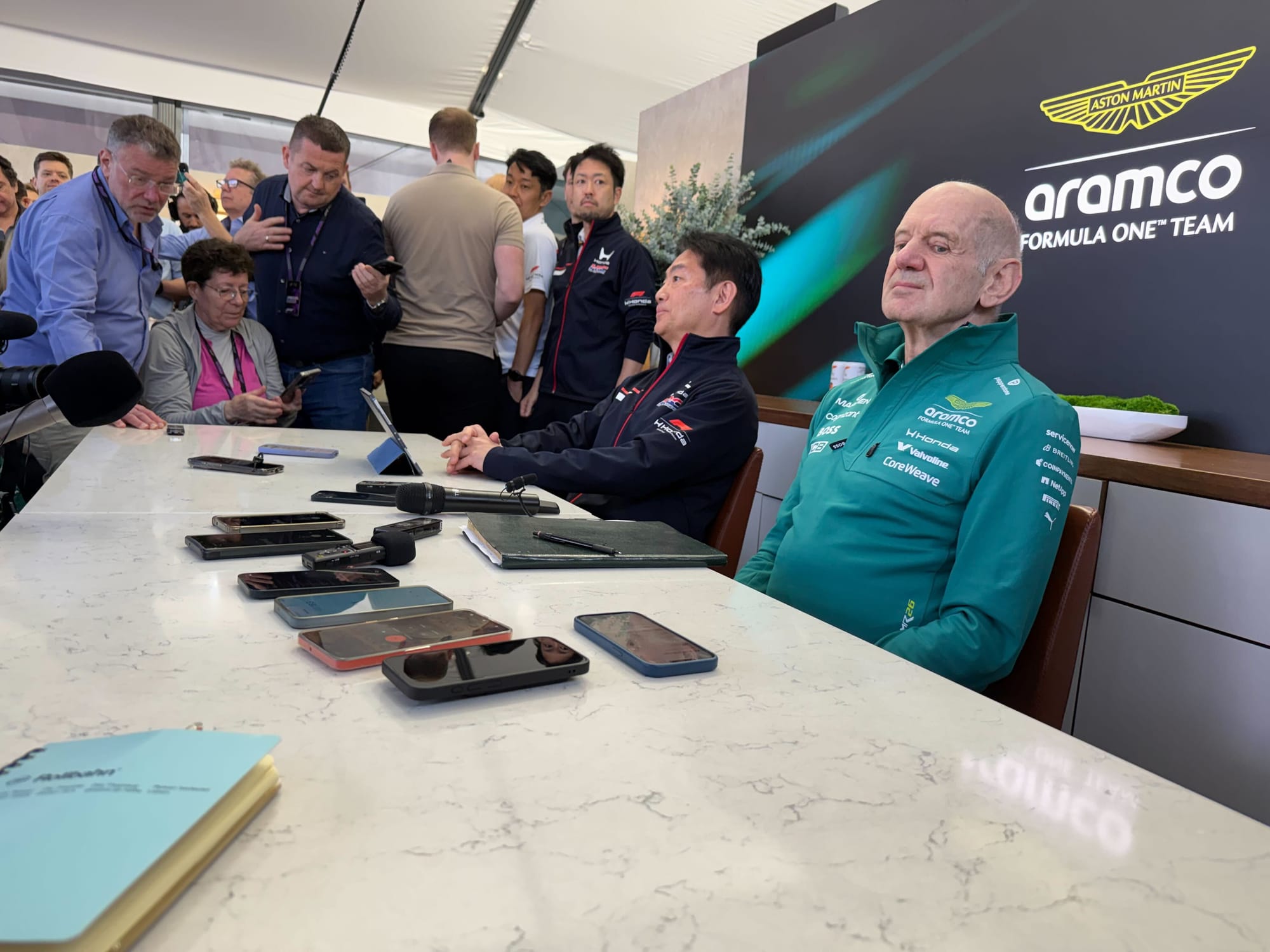
Aston Martin’s Formula 1 leader Adrian Newey claims his team already has a car good enough to be in the top 10 without Honda’s engine problems – which will leave them “heavily restricted” on laps at the season-opening Australian Grand Prix.
A severe vibration issue kept damaging Honda’s battery during pre-season testing and has not been fully resolved in time for this weekend’s Melbourne race.
The lack of mileage in testing left Aston Martin looking very close with new entrant Cadillac to being F1’s slowest team at the start of the season, and managing technical partner Newey has made it clear the responsibility for that lies solely on one side of the new partnership at the moment.
Here's everything we learned from an extraordinary pre-Australian GP press conference with Newey and Honda Racing Corporation president Koji Watanabe.
Bullish car claim puts blame on Honda
The AMR26 did not look like a pleasant car to drive during testing. Aston Martin was the slowest team on both weeks in Bahrain, ending pre-season four seconds off the pace.
This went hand-in-hand with by far the lowest number of laps of the 11 teams, leaving Newey’s first Aston Martin far less understood and optimised compared to rivals’ cars.
Aston Martin has its own problems beyond Honda, given the car is believed to be overweight, and by Newey’s own admission, is “maybe the fifth best” chassis right now with a gap of around 0.75-1s to the benchmark.
But where are the other three seconds from testing? Some of that will obviously be in the car running compromised in various ways. Saying the car is a Q3 contender itself, though, means the blame goes squarely on Honda for being anything less than that.
Newey says Aston Martin’s own issues are a result of not getting a model in the windtunnel until mid-April last year, after he had joined, and prioritising “a good sound architectural package” for the car by making the right choices for parts that cannot be easily changed in-season.
He believes that has been achieved and reckons the car has “huge, tremendous development potential in it” with “quite an aggressive development plan underway” that could make it a frontrunning car this season – at least on the chassis side.
“Already with where we've got to in the factory with that development plan, had we had time to bring it here to Melbourne, we would be significantly ahead of where we will be over the weekend,” Newey said.
“Hopefully at the moment, that's on quite a good trajectory. So, given a bit of time, I see no inherent reason within the architecture of the car why we can't become on the chassis side close to if not fully competitive.”
A fix for battery vibrations…sort of
The problem identified in testing was that the battery pack was being aggressively shaken because of the severe vibrations running through what it was mounted to. This was then causing damage to the battery system.
Honda still has not worked out the root cause, which means the vibrations cannot be stopped (more on that in a moment), but it does seem to have found a way to protect the battery slightly better.
Newey said this was the focus of the work between testing and Australia because it was “the critical item on life”. What’s been achieved on the dyno, and will be used in Melbourne, has “significantly reduced the vibration going into the battery”.
The key words there are ‘on the dyno’, though. As Watanabe said “its effectiveness cannot yet be fully guaranteed in the real track condition”.
Friday’s running will be the first test but regardless “certain conditions will be applied to power unit operation this week”, Watanabe said. Which suggests the engine still cannot be trusted to run for as long as it needs to, or at maximum performance potential.
Another serious vibration problem remains
Even if Honda’s short-term countermeasures are successful enough that the battery can survive running for longer, there’s still a bigger risk that is too great.
Honda cannot trace and therefore resolve the cause of these vibrations being so much more severe than expected. Newey said it was possibly a combination of the engine and MGU-K that is the source – and the chassis is the receiver. And because it is a stiff structure with very little damping, the transmission of the vibration into the chassis is problematic.
It’s also something Newey says “we haven’t made any progress on”. And that has two alarming consequences. One is general reliability in terms of mirrors and taillights falling off, so certain parts need to be reinforced as they are literally being shaken off the car. The other is driver wellbeing.
The most shocking revelation from this media briefing was Newey saying that as the vibration ultimately ends up being transmitted into the drivers through the steering wheel, Fernando Alonso feels he cannot do more than 25 laps consecutively without risking “permanent nerve damage to his hands” while Lance Stroll - who has had wrist injuries to fix in recent years - think he can’t do more than 15 laps.
Laps will be heavily restricted
The upshot is that Aston Martin’s laps will be “heavily restricted” this weekend, one way or another.
This probably explains the speculation that emerged about the team planning to take the start and do the bare minimum before retiring the cars.
Aston Martin was and remains adamant that it is not the case that it plans a premeditated ‘start-and-park’ in Melbourne, but the reality is that the cars will probably not finish as a maximum number of laps will have to be enforced, just to be careful.
Interestingly, Newey claimed he and Watanabe hadn’t had chance to “discuss properly prior to this [media] meeting” the expectations for the event.
But he said “we are going to have to be very heavily restricted on how many laps we do in the race until we get on top of the source of the vibration and improve these vibration at source”.
That leaves Honda on the brink of an embarrassing start to life as Aston Martin’s works partner that would undo all its progress to becoming a title-winning manufacturer with Red Bull and put it back 10 years to the depths of its McLaren woes.
A hint of Honda’s true deficit
Honda has not wanted to comment on what performance deficit it is carrying with its engine, on the grounds that its pre-season programme was so compromised it never ran the engine at maximum RPM so it does not know.
It will have an idea, though. And while all the talk has been about its battery problem, and a claim that its MGU-K was running underpowered in testing, Newey dropped a hint that the real limitation on Honda’s side in terms of performance will lie in the internal combustion engine.
This tallies with some pre-season remarks made by senior Honda staff about not being able to replicate what it did so well with the V6 engine under the previous rules because of how the new generation of engines have to work.
The implication was that Honda felt the V6 would be the bigger differentiator despite the MGU-K being increased to account for almost 50% of total engine power output: and Newey’s comments on Thursday support that.
While he claimed there was “no point in speculating” now because it will be more or less revealed on track this weekend, Newey did say: “One of the problems with these regulations is that the shorter you are on ICE power, the more you have to make up for using electrical energy to cover for that lack of ICE power, which means that by the time you really want that electrical energy on the straights, your battery's gone flat.
“So it becomes a self-fulfilling downward spiral.
“The straightforward sort of calculation of what ICE power means on laptime is compounded by the effect of lack of electrical energy.”
Why would such a specific observation be relevant if not because Honda’s carrying an engine deficit? Newey never says things by accident.
He did make a point of adding that he’d failed to stress his absolute belief in Honda’s ability to improve whatever its deficit is, though: “They have a proven track record and we have total faith.”