Where F1 teams are getting a big strategy upgrade for 2026
We're in the middle of what seems like a gold rush of businesses trying to integrate Artificial Intelligence (AI) into everything they do.
All too often, though, what's promised from AI implementation is not matched by the reality of what it delivers.
Huge investments in expensive technology - for an end product that at best cannot be fully trusted and at worst is subpar slop - has left many thinking we are in an AI bubble that will burst.
But there are some industries where AI's use is delivering tangible change, and there is one in particular where Formula 1 looks set to benefit greatly this season.
Weather forecasting has been revolutionised by AI, allowing for faster, cheaper, more accurate, and super-localised predictions compared to the old physics and numerical models that were relied upon for decades. And that's why the FIA sees big benefits from the partnership it has agreed with weather intelligence company Tomorrow.io, which uses a satellite-backed and AI-driven model for its many clients.
The result should be more accurate, detailed and reliable forecasting than has been available in the past for everyone in F1.
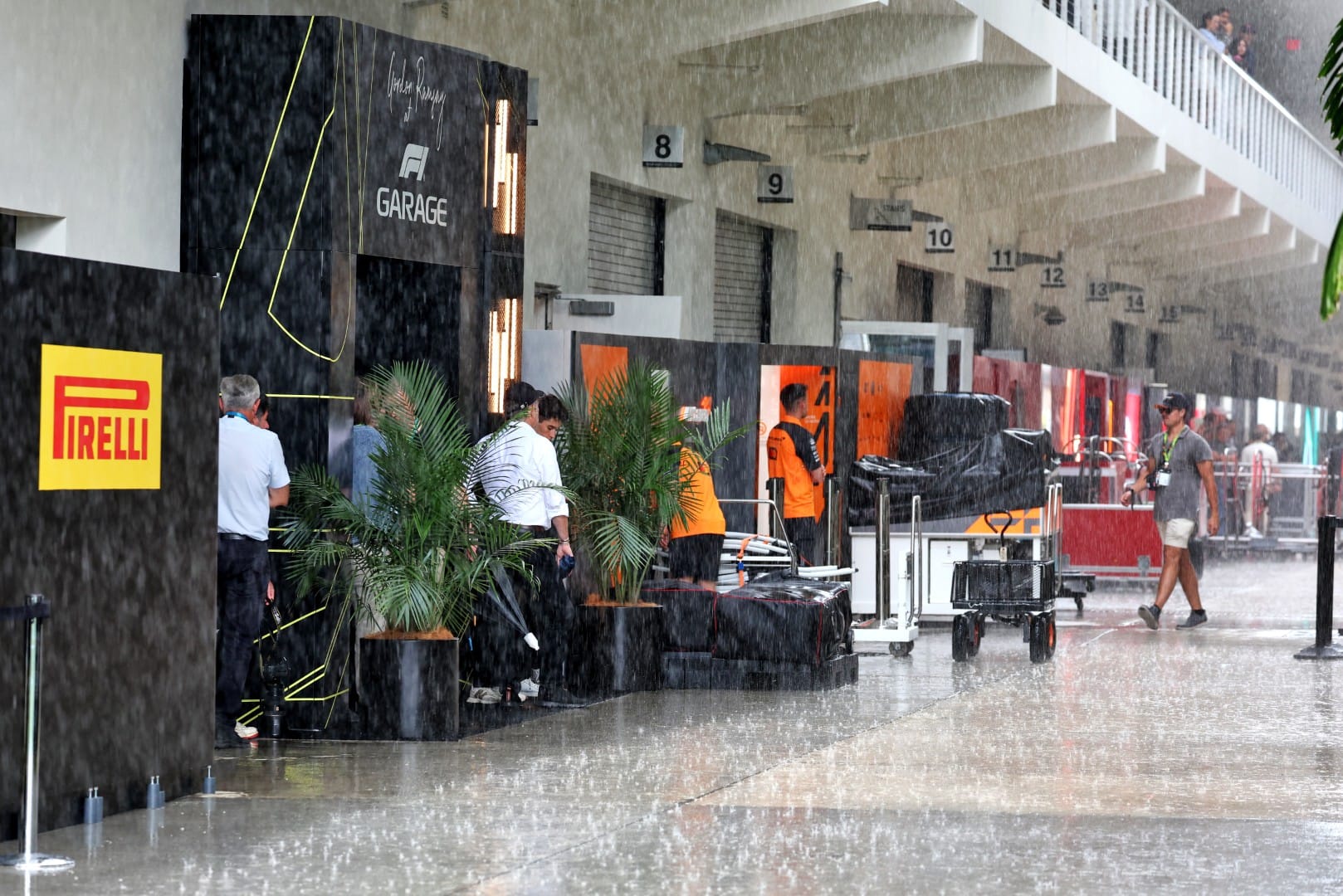
This is not only good for teams in helping them better prepare for races, but it should help the FIA make better informed decisions on those occasions where bad weather impacts running.
As Tomorrow.io's co-founder Itai Zlotnik explained, AI's ability to rapidly crunch huge amounts of data, and review years of historical action to find patterns, has transformed weather forecasting.
"AI puts it on steroids," he said. "And in a good way, not as a buzzword.
"Development cycles are fast. If something is not right and you need to refine it, something that would have taken two years in the past, takes today a week or so.
"And for the models, things that were extremely complex in the past, like the tunnelling effect, AI can help you crunch that very quickly.
"AI did over the last two-to-three years for the atmospheric science world the same stuff that would have taken six years in the past to improve.
"If we had talked three years ago, I would probably say that AI will never replace things. We now see AI outcompete everything."
Helping the F1 ecosystem
Beyond the brand-new weather portals that teams will have available to them on the pitwall this year, the deal between the FIA and Tomorrow.io makes the new systems central in how race control runs grand prix weekends.
This is not only important for helping with formal declarations like Heat Hazards and Rain Hazards that form part of the regulations, but also in hopefully allowing better planning for the running of sessions when the weather is making things more challenging.
If the FIA has faith in a weather forecast that suggests holding off a race restart for 20 minutes will open up a much better window for running, that will make its decision-making process much better.
Chris Bentley, the FIA's head of information systems strategy, said: "They [Tomorrow.io] give us information before a session, during a session and update us constantly.
"We need to know changing conditions, and if there's anything that will affect or delay running. That will allow us to schedule, reschedule and change things.
"It is becoming more and more part of what we do to look at the critical nature of the way the weather is."
Teams will all be able to tap into bespoke portals to get the weather information they want, so more accurate forecasting should allow for better strategy and set-up calls for them too.
The new systems they have available are more interactive and have been developed in close consultation with the FIA to ensure the teams are getting the exact information they want.
"We hope the teams will feel that they're being listened to, and they will have faster updates, start their feedback loops and we can build something unique based on the partnership," said Zlotnik.
"So it's not about why we think Tomorrow.io is great. It's about what they need and what they want."
More accurate weather models are not only useful for in-weekend decisions though, they can help the FIA when it comes to planning things for long-term scheduling.
As Bentley explained: "We moved Japan to a different part of the calendar due to effects of climate change.
"With the data that we have from this, it also helps us in terms of the way we can look at the risks of when certain events are actually held."
Why is the AI model better?
From the FIA's perspective, the combination of Tomorrow.io's satellite-backed system being boosted by the significantly increased data crunching capacity of AI delivers a step change in terms of accuracy and detail.
Bentley added: "It is a major change in terms of the scope of the technology that we have available to us."
What the FIA now has at its disposal is a much more encompassing data model - that is not just calculating things in isolation.
The predictions for a rain-hit Suzuka weekend will, for example, no longer revolve simply about how weather systems have been building up regionally in the days before.
The data delivery is being improved by analysis of things globally from Tomorrow.io's own satellite system - and that helps dramatically increase accuracy because there is so much more data in play.
Zlotnik said: "In the past, 70% of the globe was not covered by observation or it had very latent observation that was anywhere between one to three days old.
"With our [satellite] constellation we can provide a global sub-hourly information stream. And if you connect it to AI decision-making, that makes a difference.
"The unfortunate truth for us as humanity is that most of the world's weather system is derived from the ocean.
"So if you have real-time observation of what's happening in the oceans - and if we think about a race where there is a cyclone nearby - then you have a chance to better predict what's going to happen."
There is very much a two-way process in place, too.
The FIA has years of its weather data stored away - to show how things developed, for example, around the famous typhoon weekends in Japan or the many rain-impacted weekends at Spa-Francorchamps, like 2021 when the race effectively never got going.
This has now all been downloaded and fed into Tomorrow.io's systems.
This will serve to help it better understand the unique challenges that F1 faces, where track running is not just down to how much rain is falling from the sky - it is how much water there remains on the track and what spray is like.
Furthermore, trackside cameras that spot the showers coming down, and even the triggering of those rain signals at marshalling posts when the first drops are detected, can all be fed back into Tomorrow.io's database.
But for all AI's advancement there is also an acceptance that weather modelling is exactly that: it is building a model and not the real thing.
As Zlotnik said: "When you're trying to predict Mother Nature, you need to be humble."