Four takeaways from F1's Melbourne Friday long runs
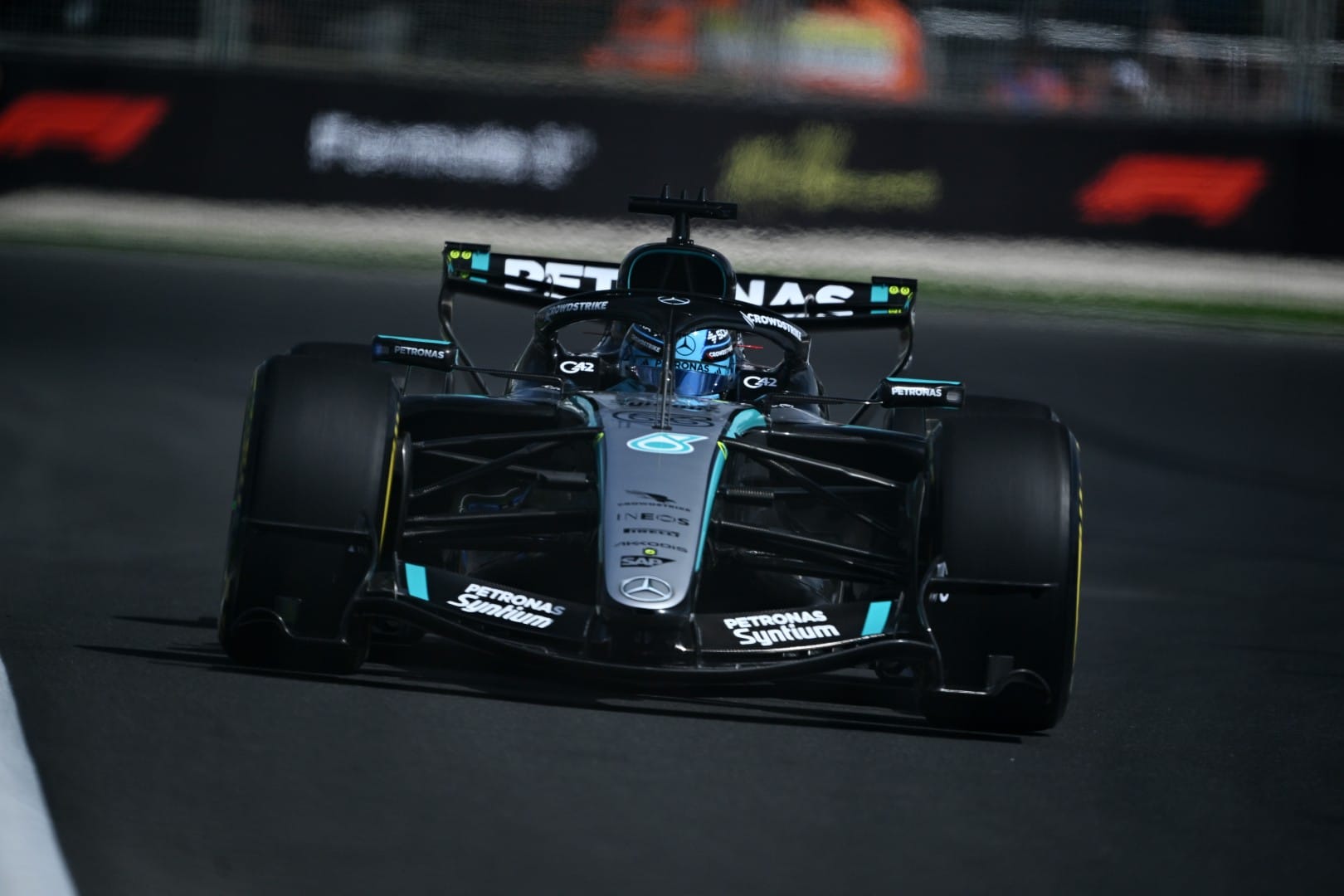
The headline laptimes didn’t show it, but Friday practice in Australia justified Mercedes and George Russell’s tags as title favourites. On a day when everything - aerodynamic and mechanical set-up and tyres included - was at best secondary to the energy management challenges of these new 2026 cars, the competitive picture became that little bit clearer.
Charles Leclerc topped FP1 for Ferrari, with Russell a massive 1.1 seconds down after Mercedes was limited by understeer and surprisingly conservative deployment. Oscar Piastri was quickest in FP2, with Kimi Antonelli in second place and 0.241s slower.
The order based on fastest lap wasn’t too out of whack with the impression built in testing, albeit with Mercedes not in top spot, Alpine underachieving and Racing Bulls moving to the front of the midfield group.
SINGLE-LAP PACE
1 McLaren 1m19.729s
2 Mercedes +0.241s
3 Ferrari +0.321s
4 Red Bull +0.637s
5 Racing Bulls +1.193s
6 Haas +1.450s
7 Audi +1.622s
8 Williams +2.118s
9 Alpine +2.438s
10 Cadillac +3.931s
11 Aston Martin +4.933s
The quick laps revealed the compromises required to optimise the energy regime of these 2026 cars. Even at the end of outlaps on the run out of the first corner, it was clear that maximum deployment was being deferred. Pacesetter Piastri wasn’t at 100% on both V6 and MGU-K power until shortly before the start/finish line in order to start the lap with as much energy in the battery as possible.
With harvesting while on the push lap essential, Piastri was conservative in his approach into multiple corners - albeit still with a premium on carrying speed into and through most, but not all. It’s most dramatic in the run into Turn 6, then along the back straight and through the high-speed Turn 9/10. And that’s the case, to a greater or lesser extent, for everyone given how energy-poor Albert Park is, one of the four worst on the calendar for opportunities to do so under braking. Jonathan Noble’s trackside column captures what this looks like from the outside.
There is a difference between the energy regime for a single push lap and for steady-state long-running. While we can say with certainty that Mercedes looks to have the advantage on race pace, by perhaps just over half a second over Ferrari based on today, the picture is murky owing to the limited data that was partly down to a messy session in which Mercedes got down to its long-running earlier than the other frontrunners.
Russell put together a run of 11 laps that averaged out at 1m23.7s using the hard Pirellis. Antonelli’s run was the same length, but at an average half a second slower.
For the rest, there were only hints of runs, as other than Isack Hadjar’s inconsistent seven laps on mediums a second slower than Russell, it was always samples of five or less. Those put both Ferraris, on hards, seven tenths off Russell, while Max Verstappen’s FP2 yielded very little race-relevant data beyond two non-consecutive laps that averaged out at 1m24.7s and an off-track excursion exiting Turn 10 that damaged the Red Bull. As for McLaren, Piastri’s short run on softs was a second off, with Norris putting in a few laps on the same compound that were similar to Russell’s average on a tyre two steps harder.
The long-run pace also confirmed the clear air between the top four and the rest of over half-a-second. That group was headed by Audi, which carried over the eyecatching long-run pace of late in the Bahrain test, ahead of Racing Bulls and Alpine - all covered by around three and a half tenths on mediums. Then came Williams, another half-second back, the distant Cadillac - and an Aston Martin team for which the idea of a long run seems ludicrous.
The takeaways are clear. Firstly, Mercedes is ahead, certainly on long-run pace.
Secondly, it has a good handle on how to consistently harvest and deploy while on such runs given the regularity of Russell’s run.
Thirdly, it’s joined by Ferrari, McLaren and Red Bull in a four-team lead group with the rest a chunk behind.
But the fourth and final takeaway is that the picture is still unclear. Drivers and teams are still on a steep learning curve and significant work will be done overnight to fettle and tune every aspect of the energy regime to optimise performance and set-up.
Exactly what that will add up to on Saturday and Sunday, and how much the situation could change overnight, remain the tantalising questions. But the best evidence we have yet says it’s looking very good for Mercedes and Russell, for Sunday at least.