Eight things we learned from first F1 2026 qualifying in Melbourne
The fuel came out, the sandbags came off – and here’s what we learned from F1’s first qualifying session of the year at the Australian Grand Prix.
Mercedes’ actual advantage is massive
Throughout pre-season testing and free practice in Australia, everybody in Formula 1 was convinced Mercedes had the advantage. The question was by how much, and how exactly would that manifest in qualifying.
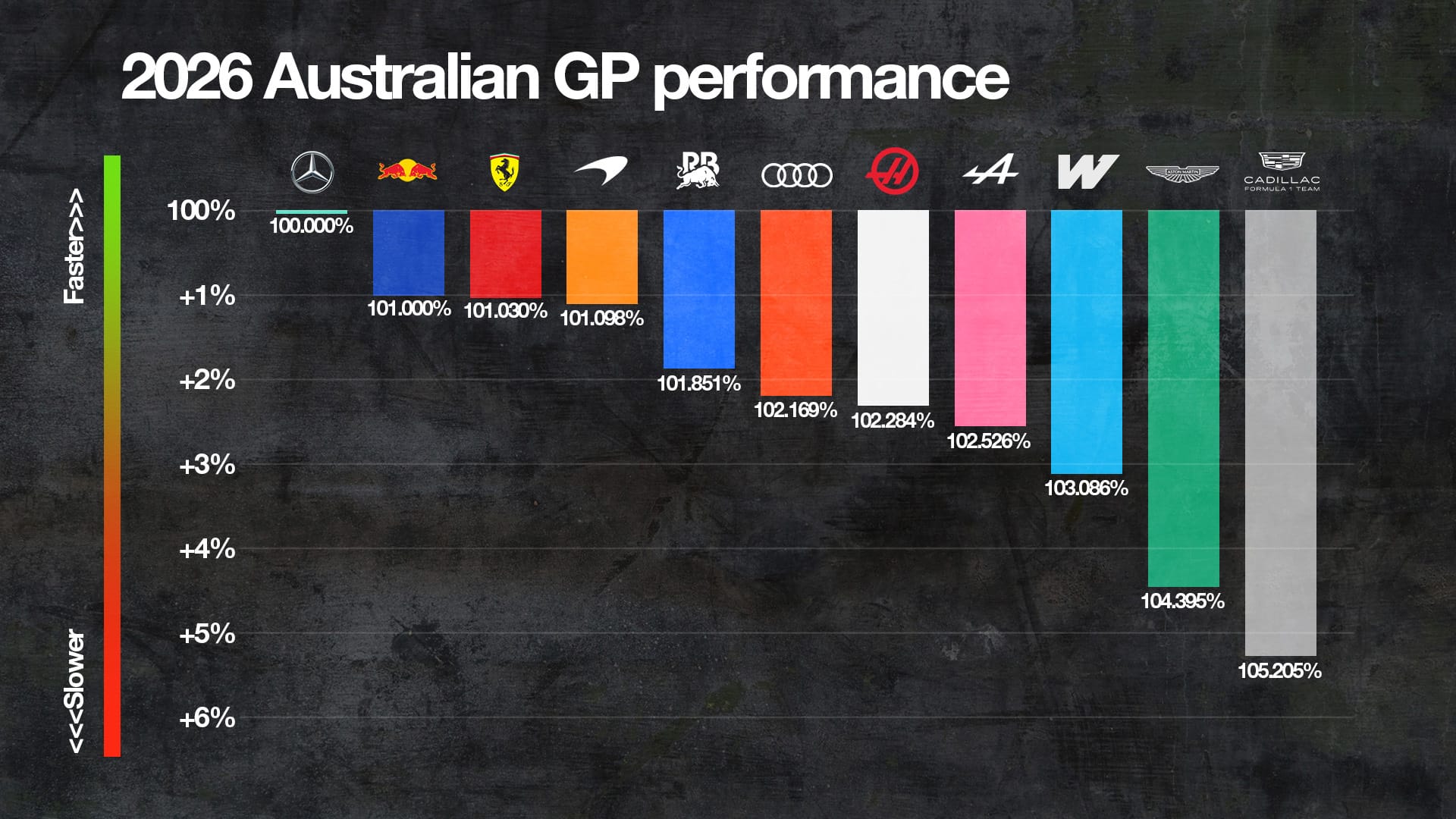
The answer, it turns out, was by just under eighth-tenths of a second given that was George Russell’s margin over the fastest non-Mercedes, Isack Hadjar’s Red Bull.
And the long runs on Friday suggest it will be the same story in the race, to the point where Hadjar stated that Red Bull 'simply doesn’t have the pace to win'.
Where does that advantage lie? The answer is everywhere. Not only is the Mercedes power unit the market leader, as shown by a significant proportion of the advantage over Red Bull and Ferrari, but the team also has a good grasp on how to optimise harvesting and deployment, as well as a genuinely good chassis.
“We’ve got a really great engine beneath us," Russell said.
"We’ve also got a really amazing car beneath us and that probably hasn’t been highlighted enough."
Albert Park may not be the most representative track on the calendar, but Russell and Mercedes have emphatically underlined their status as championship favourites.
But Mercedes’ customers are struggling
If the Mercedes power unit is so strong, then why are its customer teams not up there at the front with the works team – especially reigning world champion McLaren?
It’s a good question, especially given McLaren was almost nine-tenths off Mercedes, the Alpine was two seconds down, and Williams was almost two-and-a-half seconds off.
Some of that will be down to differences in the chassis performance, particularly when it comes to the Alpine and Williams deficit.
But even though the regulations mean all the Mercedes-powered teams have identical specification power units with the same modes available, the works team is far ahead in optimising the crucial energy regime.
"Being a customer team doesn't put you certainly on the fore foot," McLaren team boss Andrea Stella said.
"This doesn't have to do with the hardware, this has more to do with learning about the hardware and identifying the best way to exploit it."
Although Mercedes is quicker than McLaren in some corners, the majority of its advantage is on the straights.
That reflects the knowledge deficit, which is understood to be related to subtle differences in the harvesting and deployment strategy
The good news is that it shouldn’t take too long to work out what Mercedes is doing better. Stella suggests McLaren could have locked out the second row with the lessons it learned during qualifying.
Verstappen’s frustration is spilling over
F1 had been able to keep most drivers on message about the new 2026 rules up until Melbourne because there was an element of everyone being willing to wait to see what the cars were like in competition.
But as the scale of Mercedes' advantage has become crystal clear, and qualifying was compromised by everyone having to slow down at the end of straights to save energy, drivers broke rank and laid bare just how downcast they are about what they will be racing this year.
Things had already got heated in the drivers’ briefing on Friday night, as Max Verstappen led a chorus of disapproval about what drivers had experienced on track.
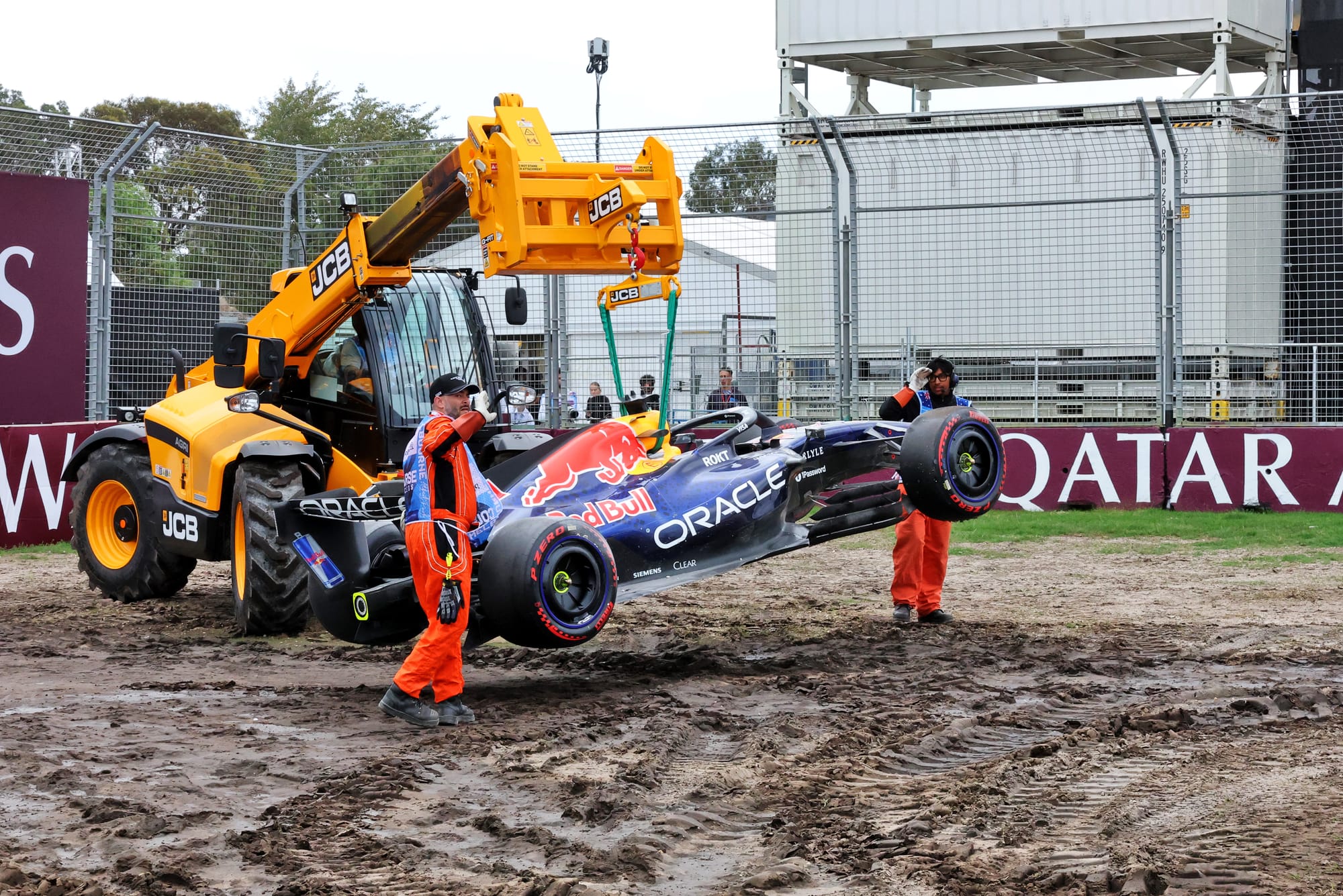
He then admitted after qualifying that he was having “no fun” with the new cars – with his mood worsened by an apparent technical problem sending him off into the barrier when kicking off a flying lap at the start of Q1, leaving him 20th on the grid for Sunday’s race.
But even some of those who had defended things before are now in a different camp - including world champion Lando Norris.
“We’ve come from the best cars ever made in Formula 1, and the nicest to drive, to probably the worst," Norris said.
“It sucks, but you have to live with it and just maximise what you get given."
The FIA almost made it even worse!
F1’s paddock erupted into political theatre on Saturday morning when teams and drivers came together to resist a safety change made by the FIA that would have made the energy management situation even worse.
Following some comments made by a few drivers in Friday’s night’s briefing that the new 2026 cars were a bit sketchy on the high-speed run from Turn 6 to Turn 9 when straight mode was engaged, the FIA moved swiftly to respond.
Fearful about the potential risks of a crash while following closely in low-downforce trim, the FIA sent a note to teams just over two hours before final practice to say it was scrapping the straight mode activation zone in that area on safety grounds.
It triggered a revolt from teams that would have needed to start set-up work from scratch. With no zone there, it would force changes to cambers, tyre pressures, ride heights and energy deployment tactics.
It would make the cars so much slower on the straight because the wings would be in high drag mode and need to save more energy because of the lack of efficiency – one team’s simulation reckoned they would be approaching Turn 9 50km/h slower than F3 cars!
A unified push from the majority of teams and drivers prompted an FIA U-turn, but the whole affair has further fuelled thoughts that the new rules are too complex and compromising.
Red Bull finally has a worthy back-up
Even though this turned into a qualifying to forget for Verstappen, Red Bull still goes into Sunday’s race with a real chance of a podium.
For the first time in what feels like forever, it has been able to rely on its second car to step up in Verstappen’s absence.
Isack Hadjar will line up for his Red Bull Racing debut in third place on the grid having picked up the pieces brilliantly in Melbourne.
Having been a solid top-five threat in final practice and the first two segments of qualifying, Hadjar took a further step when it really counted in Q3.
He pipped Ferrari’s Charles Leclerc and McLaren’s Oscar Piastri by less than a tenth of a second, getting Red Bull ahead of its two immediate rivals in the process.
Hadjar said he was only in the top three because of Verstappen’s problem, but that’s the point. When Verstappen’s not there, Red Bull needs his team-mate to be.
And Hadjar’s shown at the very first attempt that he is capable of doing that.
Ferrari’s early promise fades
Ferrari’s early promise once again turned into a pretty unremarkable qualifying result.
Strong form in pre-season testing and on Friday, when Charles Leclerc led a Ferrari one-two in practice, never really signposted Ferrari was the benchmark for the start of 2026.
But it seemed it could genuinely be best of the rest. So qualifying fourth and seventh with an even bigger gap to Mercedes than Leclerc’s pessimistic prediction of half a second was a blow.
There wasn’t a huge amount between Leclerc and Lewis Hamilton, who was just under two tenths slower than his team-mate, and both drivers complained about vague issues with energy deployment after qualifying.
Maybe Ferrari execution was behind some of the eight-tenth deficit, then, but there’s clearly performance it simply cannot match.
In fact, Mercedes’ energy deployment is so good in Melbourne that Leclerc thought the car’s data had loaded incorrectly when he checked it after final practice!
Will both Aston Martins start?
After all Aston Martin’s travails in the build-up to the Australia weekend - and how it started on Friday - Fernando Alonso was actually surprisingly close to getting into Q2.
Alonso hacked his deficit to the front to 2.7seconds by the end of the first part of qualifying and will start 17th out of the 22 cars on Sunday.
But that’s flattered by problems eliminating two cars that would have been ahead of him on merit and the fact Cadillac ended up being slightly detached at the back of the grid.
Honda’s seeing signs that the severe vibrations that wrecked its testing programme are more under control, which is encouraging. Still, reliability remains a big uncertainty going into Sunday.
And we’re still not completely sure both Aston Martins will take the start.
Stroll's Australian GP weekend
FP1: 3 laps
FP2: 13 laps
FP3: 0 laps
Qualifying: 0 laps
Lance Stroll is allowed to start despite not setting a time within the mandated 107% limit in any session so far this weekend, as he failed to complete a single lap on Saturday due to a damaged oil line that took too long to fix.
But the stewards gave him permission to race based on Alonso’s speed and Stroll’s experience: so now we just need to see if his car can actually run…
Midfield is closer than expected here
Melbourne might be tightening the field because it’s a relatively short lap with few real corners – but the midfield’s closer to the leading teams here than testing suggested, and more condensed itself.
Fears that the grid would be split into two groups with a second between them were unfounded - for Australia at least - with only half that margin separating the top four teams and the midfield.
Racing Bulls is at the head of the group, and impressively got both its cars into Q3 with Arvid Lindblad excelling until what the team called a “control issue”, which we’re taking to mean engine mapping relating to battery deployment, costing significant performance on his final run.
That left him ninth on the grid behind team-mate Liam Lawson but still well placed to fight for points on his F1 debut.
Audi, Haas and Alpine are all within half a second or so of Racing Bulls, with overweight Williams the same margin further back again - so it’s not as close as last year, but it’s still competitive.
And Aston Martin’s jump forward, in relative terms, meant there was only 1.5s between the fifth and 10th best teams in Q1: bad news for Cadillac, which got cut adrift by another 0.7s and will be relying on other factors to bring it into the mix on Sunday.