Ridiculous or really fun? F1 drivers divided on 2026 after first race
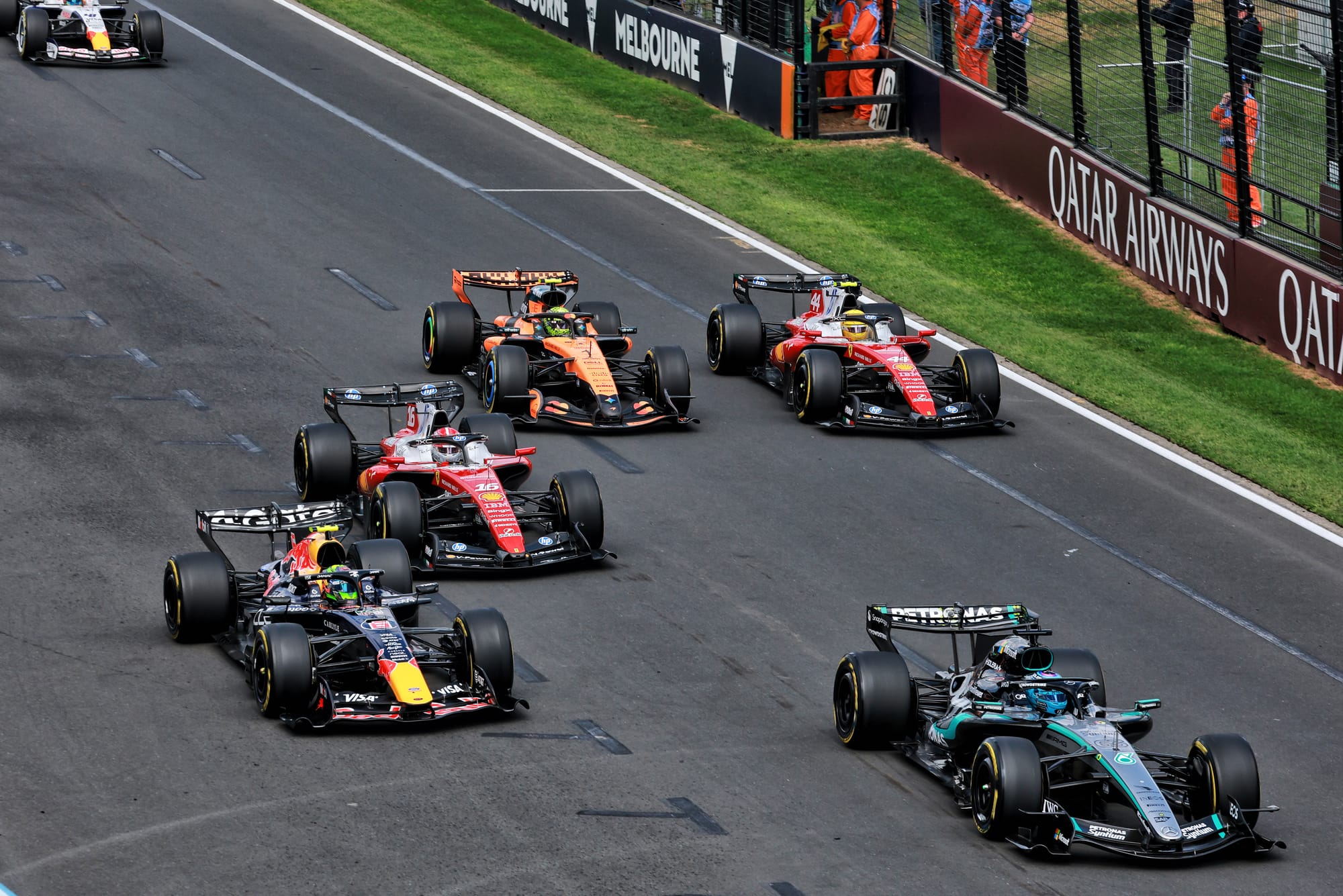
More Formula 1 drivers have joined the chorus of negativity around the new 2026 cars after the first race of the new season in Australia, with Carlos Sainz calling the new active aerodynamics “dangerous”, Esteban Ocon describing the racing as “painful” and Sergio Perez calling it “a lot less fun”.
But this negativity is not universal among those who sit inside the cockpits.
After reigning world champion Lando Norris went on the attack on Saturday after qualifying, calling the 2026 cars “the worst” and saying “it sucks”, it’s interesting to see more drivers join him and Max Verstappen in feeling that F1 has not made a change for the better with these all-new cars and power units.
Verstappen and Norris both had more to say after the race too, with Verstappen calling the Australian Grand Prix “chaos” and Norris saying the cars were “even worse” in race trim than in qualifying, when they were clearly seriously underwhelming to drive - in the high-speed sections, especially.
There are multiple nuanced strands to this criticism too; it’s not like there is just one aspect that’s annoying certain drivers. And of course, there is a good old-fashioned element of competitive frustration at play too.
After all, any F1 driver who is winning or being relatively successful is always going to be more positive than one who is frustrated by a lack of performance in their car.
Midfield victor Ollie Bearman even acknowledged this in giving his answers, admitting “the fact that I finished P7 means that I'm happy, even if the car has not been the most fun to drive this weekend”.
Nevertheless, there appears to be a growing groundswell of opinion that these rules are problematic in multiple ways.
‘Artificial’ racing
This is a word that came up repeatedly when drivers were questioned about how the race played out for those who had proper on-track battles to fight. Both Bearman and Norris had forthright things to say about how battery management now completely dictates the on-track action in a way they find unenjoyable.
“It’s a bit ridiculous to be honest,” Bearman said. “To have that much delta in a button and to lose that much on the next straight. It's also very non-linear, so what you gain on the straight where you use the boost is a quarter as much as what you lose on the next straight.
"So unless you basically complete the move at the start of the straight - as in, you exit the corner, you complete the move - and then you harvest, harvest, harvest, the next straight they're gonna get you back.
“That's not racing, that's Formula E.”
Bearman and his Haas team-mate Esteban Ocon both offer valuable perspectives, because they were in the thick of almost race-long midfield battles: Bearman with Arvid Lindblad’s Racing Bulls and Ocon with Pierre Gasly’s Alpine. So they were trying to race closely for long periods rather than simply driving their own races or relying on pit strategy to move forward.
“It's painful because you can't really do much as drivers,” said Ocon. “Once you use the boost button and you haven't managed to overtake - or even if you overtake actually, you are just vulnerable again on the next straight.
“The other guy is going to overtake you again. Which happened with Pierre, like, three times, happened with Gabi [Bortoleto] as well when I was fighting him, two times. I just overtook and got overtaken again.
“It's very frustrating. It feels like it's very artificial in the way you have to drive.”
This is something Sergio Perez also said about his first race back in F1 after a year away, calling it “too artificial”, while Gasly went as far as calling it “not natural” (while also being at pains to defer any real criticism until the sample set of races is bigger).
“It’s very hard to understand what’s going on,” Perez explained. “Sometimes you do a small lift and it changes more than you would expect. Sometimes I was arriving 30kph quicker into Turn 3 because of a different lift or a different throttle pick up, some things honestly, I don’t understand.
“It’s a very different Formula 1 to what I was used to, it’s a lot less fun, definitely. It’s not as fun as it used to be on the racing side, not great to be honest.”
A ‘dangerous’ game
Norris was another to jump on the ‘artificial racing’ theme after the race, calling it “way too much”, albeit in quite measured and philosophical tones.
But he also used it to raise concerns about safety - particularly around the rapid closing speeds that happen when one car suddenly runs out of battery energy deployment.
“It's chaos, you're going have a big accident,” he said. “We're just waiting something to go quite horribly wrong and that's not a nice position to be in.
“Depending what people do, you can have a 30, 40, 50kph speed [difference] and when someone hits someone at that speed you're going to fly and you're going to go over the fence and you're going to do a lot of damage to yourself and maybe to others, and that's a pretty horrible thing to think about.
“But there's nothing we can really do about that now. It's a shame, it's very artificial. Depending on what the power unit decides to do and randomly does at times, you just get overtaken by five cars or you can just do nothing about it sometimes.
“There's nothing we can change about it so there's no point in saying any more. [It’s] not for me.”
There was a terrifying near-miss at the start of the race, when Franco Colapinto somehow avoided Liam Lawson’s stationary Racing Bulls on the grid, but it should be said this is something that could happen in any era of F1, when one car stalls at the start and another comes rapidly and unsighted from much further back.
But for Williams driver and drivers’ association representative Carlos Sainz, there is a wider safety issue for this new era of F1 with regards to how the active aerodynamics work.
“The biggest worry for me about the racing was lap one,” he said. “I feel like it was really sketchy with SLM [straightline mode] on, everyone on the back straight. It felt really dangerous, and very difficult to control the car in the slipstream.
“And then when racing someone else... the same. If it's straight line, it's not bad, because it's like DRS last year. But when there's a bit of cornering and both cars are using SLM, it becomes - like there's cornering in Turns 7-8, on that back straight, it feels sketchy also.
“For sure lap one and overtaking doesn't seem to be very safe at the minute with the SLM active.”
And from there Sainz’s criticism drifts from pure safety to the fact the cars now are having to use these potentially dangerous active aerodynamics because of how power-starved the new engines are.
“The issue is not the SLM, the SLM we need, if not - you guys saw we were doing lift and coast like crazy yesterday in qualy, all teams,” Sainz added.
“We should not need to have active aero for racing, in my opinion. I think the active aero and the SLM is a plaster on top of the issue of the engine.
"And then when you come to circuits like these, that you're energy-starved, you end up having to use SLM in places where we shouldn't, to protect the thing, the deployment, so in the end you end up having a dangerous situation like we had in lap one and racing in general.
“If you now remove SLM, we cannot even race with the deployment we have. So we kind of need SLM. But it's a plaster to a solution to an engine formula that for me just doesn't seem to work very well right now.”
Criticism not universal
Criticism of the new regulations is growing among the 22 drivers, but is not universal, and it’s perhaps no surprise that the winner of the first race of F1 2026, George Russell, is probably the most vocal advocate for the changes right now.
“Everyone's very quick to criticise things,” said Russell, who perhaps predictably characterised Norris’s misery as being more related to McLaren’s new competitive position than a genuine hatred for new-look F1.
“You need to give it a shot. We're 22 drivers, when we've had the best cars and the least tyre degradation and when we've been happiest, everyone moans the racing's rubbish.
“Now, drivers aren't perfectly happy and everyone said it was an amazing race. So you can't have it all, and I think we should just give it a chance and see after a few more races.
“The only thing I would request from the FIA is that with the straight mode, the front wing doesn't drop as aggressively when we open straight mode.
"We all have lots of understeer and when I was behind Charles [Leclerc] and I was trying to duck out of his slipstream it was like my front wing wasn't working.”
Russell is not a lone voice in his positivity, but it’s probably fair to say there’s a pretty obvious sliding scale at play here.
The Mercedes drivers are very pro the changes, and they so happen to have the most competitive car right now.
The Ferrari drivers are quite positive, and they so happen to have the second best car right now.
The Audi drivers are positive, and it just so happens the rules were designed to entice their current employer to join the championship in the first place.
And then you have drivers like Valtteri Bottas, who is just pragmatically happy to be back on the grid and take things for what they are!
But even then, there is some nuance at play. Lewis Hamilton finished off the podium, but had nothing but positive things to say about the new rules.
“I personally loved it,” he said. “I thought the race was really fun to drive. I thought the car was really, really fun to drive. I watched the cars ahead and there was good battling back and forth.
“I thought it was awesome. With 20 cars ahead of you it may have seemed different. But from my position I thought it was great.”
Now is that positivity simply because Hamilton hated the last set of rules so much, or is it down to him being personally determined to shut out any negativity come what may? Has he drunk the F1 Kool Aid or is he genuinely truly loving F1 2026?
His Ferrari team-mate Charles Leclerc was less enthusiastic, you could maybe say neutral in his stance. But he at least characterised quite well that F1 has fundamentally changed now, for better or worse and regardless of which side of that line you sit.
“It will definitely change the way we go about racing and overtaking,” he said. “Before it was more about who is the bravest at braking the latest, maybe now there's a bit more of a strategic mind behind every move you make, because every boost button activation you're going to pay the price big time after that.
“And so you kind of always try and think multiple steps ahead to try and end up eventually first. It's a different way to go about racing, for sure.”
Qualifying as energy management and racing as chess. This is F1's new reality. It's up to you whether you like it or not. It's up to the FIA to decide if it's safe or not.