How FIM's responded to MotoGP's chaotic Brazil return
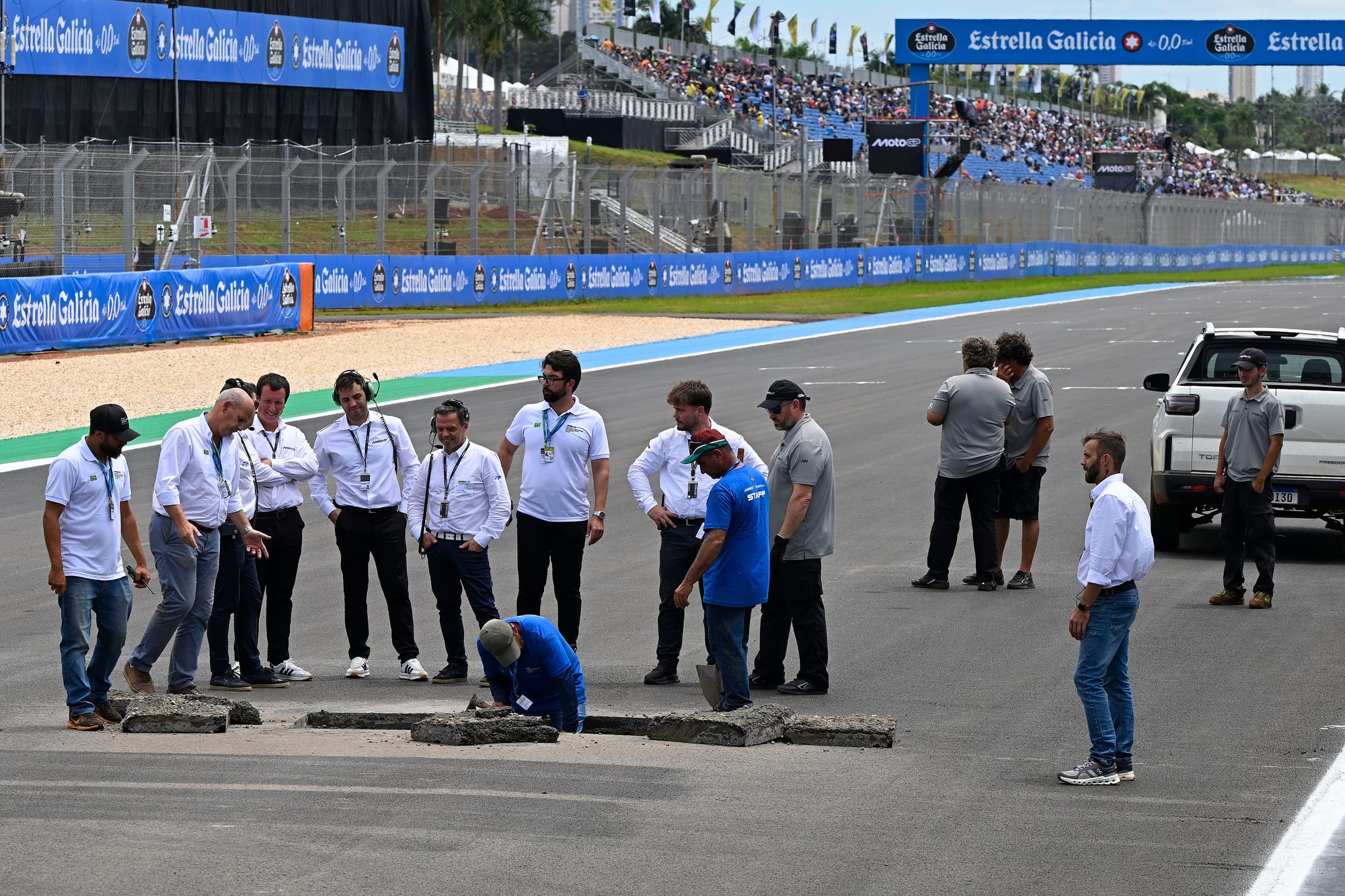
Motorcycle racing's governing body the FIM has responded to the chaos of last weekend's first MotoGP race in 30 years at Brazil's Goiania circuit.
It issued a statement addressing some of the complaints around events that led to racing being significantly delayed on Saturday and then the Brazilian Grand Prix itself cut short at minimal notice on Sunday thanks to problems with the new track surface.
A sinkhole opened on the start/finish straight on Saturday after a drainage pipe underneath it collapsed, with the circuit forced to cut out a section of track and fill it with concrete, delaying the sprint race by over two hours.
"On Saturday a significant defect in the track emerged due to the collapse of an undocumented old sewage system beneath the surface," the FIM statement explained.
"The problem, which was fortunately off the racing line, was immediately attended to and repaired following a quick response from the circuit, which allowed track activity to continue later in the day."
On Sunday, the main race was cut from 31 laps to only 23 mere minutes before the lights went out, after significant track delamination was discovered following the Moto2 race, conditions that resulted in a number of MotoGP riders ending the race with injuries after stones ripped out of the track were fired back at them by rivals' rear wheels.
The situation was made even worse by the manner in which the FIM and series bosses MotoGP Sports Entertainment Group notified both teams and fans, with the initial information coming haphazardly to teams down the grid only minutes before the start of the race, allowing some competitors to change tyre compounds but leaving others without enough time.
The FIM said the late notice was due to the organisers working up to the last moment to try to resolve the problem.
"On Sunday, localised asphalt degradation caused by the significant heat and track activity became apparent following the conclusion of the Moto2 grand prix," its statement read.
"Despite removing all excess aggregate ahead of the MotoGP grand prix, a small risk of continued surface deterioration during the MotoGP race remained.
"Circuit staff were working right up to the scheduled start to prepare the track, but in the interest of safety, Race Direction took the decision to reduce the race to 23 laps (75% of the original race distance).
"Teams were immediately informed of the change by IRTA staff on each row of the grid."
But the situation marks another misstep in ongoing issues with the FIM's circuit homologation procedures. It's carried out by safety officers Loris Capirossi and Alfonso Tome Ezpeleta (a nephew of MSEG boss Carlos Ezpeleta), and they have repeatedly failed to identify problems with circuits prior to riders going out on track.
Similar issues plagued both the first test and the inaugural race at Indonesia's Mandalika circuit, after an incorrect specification of asphalt was used during construction, something not picked up on by the safety team.
But the FIM suggested the surface issues at Goiania were the circuit's responsibility rather than any failure of its inspection process - stating that the assessment of asphalt is a local matter rather than one for the governing body, despite the potential issues that it can cause to rider safety.
"MotoGP's homologation process for circuits is managed by the FIM," the statement added, "and begins more than a year in advance. It includes detailed inspections of all construction areas.
"As each global location will require a different asphalt mix and laying procedure, these are decided by the circuit and presented to the FIM to ensure all safety standards are met.
"Homologation is then confirmed shortly before each grand prix."
That too is an issue, however, with final homologation for the circuit only approved, according to The Race's sources, last Thursday, by which point there was obviously considerable incentive to making sure that the race goes ahead, given that the entire MotoGP paddock was by then in situ and set up ready to go.
The FIM concluded its statement by insisting that this year's issues would be addressed in time for next year's running of the Brazilian event, something that presumably is going to require at least a partial resurfacing of the newly-renovated track.
"The issues faced in Brazil have been acknowledged by the promoter and the circuit and will be rectified before MotoGP returns next season," it concluded.
"The Grand Prix of Brazil welcomed 148,384 fans to Autódromo Internacional de Goiania - Ayrton Senna, demonstrating both the strong appeal of MotoGP in Brazil and MotoGP's opportunity for further global growth."