Gary Anderson: The battery power cut that can save F1 2026
I’m glad to see that finally the FIA, Formula 1 and the teams are going to sit down and discuss the situation Formula 1 has got its self into in a crunch rules meeting on April 9. Hopefully, the solutions will be the right ones.
Let’s not be too critical. I have genuinely enjoyed the ‘entertainment’ value of this season’s racing, but it has gone too far one way and needs to be pulled back to give the driver full control over the car.
The driver has a steering wheel in their hands, and if they want the car to turn right, they rotate it in that direction; if they want it to turn left, they rotate it in the opposite direction. Simple.
As a side note, back in the old days when F1 was F1, at McLaren, in 1977 or '78 we built a bicycle with a gear between the head stock and the handlebars. To turn left, you had to turn to the right and to turn right, you had to do the opposite. I can tell you it was very difficult to ride, and I still have the scars to prove it!
So, taking the principle that the steering wheel puts the driver in control of turning left or right and they're fully responsible, we need to put them fully in control of whether they want to go faster or slower. They have two pedals for that, so give them full responsibility.
If they want to apply the throttle earlier, it’s their decision, if they want to brake harder, so be it, but get away from what Charles Leclerc has been very vocal about (the loss of on-the-edge qualifying laps) and don’t penalise them for putting in some extra effort.
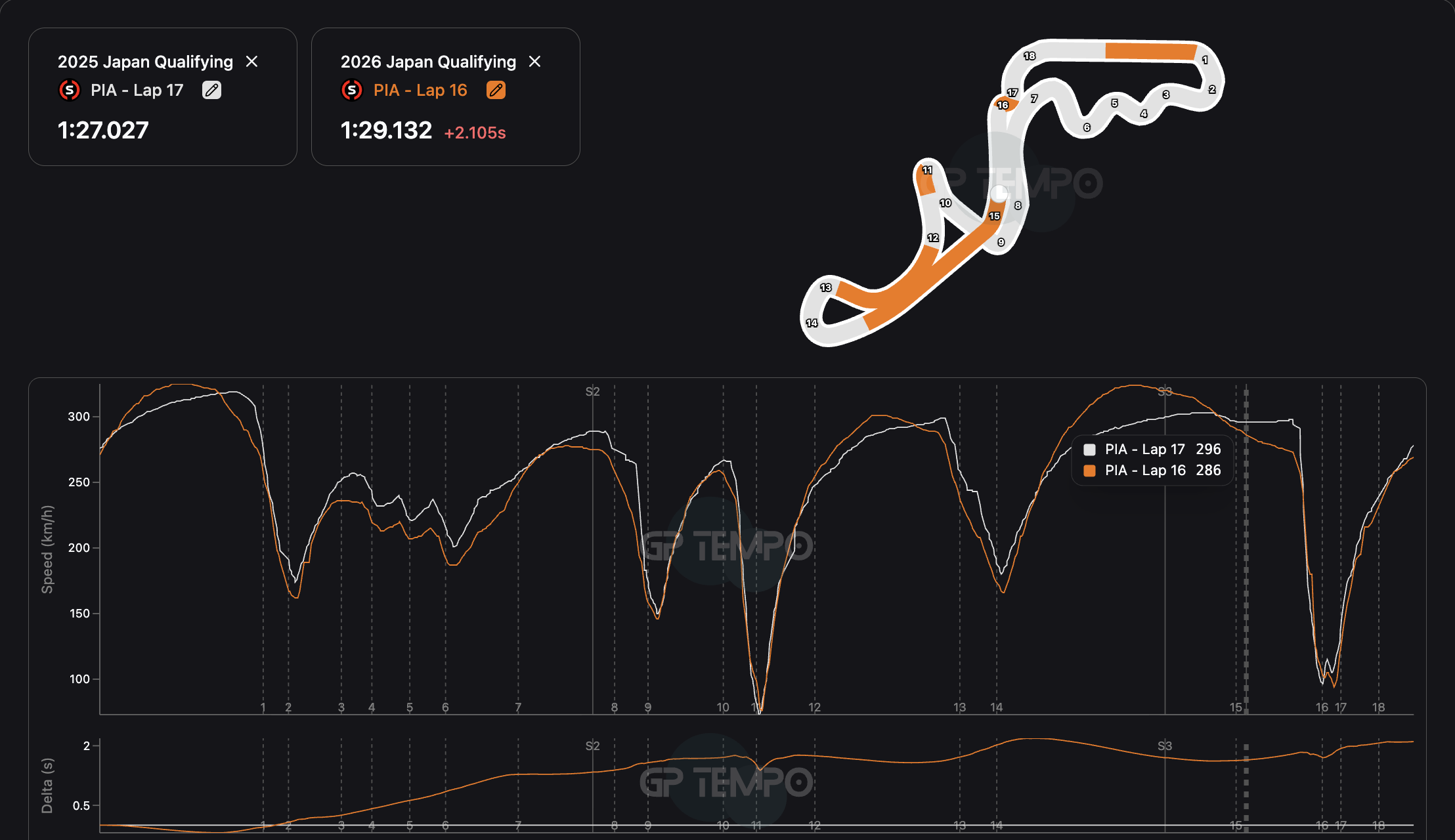
Based on Suzuka, I have worked out some numbers that can be used as the basis of a framework for making changes. I have used Oscar Piastri’s 2026 qualifying lap as the baseline. This wasn’t a pole position lap, but it was a quick one and as he qualified third, which was the same qualifying position as he did in 2025.
This gives us a good comparison point to last year's car performance.
2026 cars at Suzuka
Full throttle: 59s (66% of the lap)
Full braking: 14s (16% of the lap)
Part throttle: 16s (18% of the lap)
Laptime: 89.132s
So, to get into the details, if the driver crosses the start finish line with a full 4MJ battery pack, that will last roughly 11.5 seconds.
Over the lap in Suzuka, the harvesting was reduced to 8MJ per lap, so assuming he can achieve that and if added to that initial 4MJ that he started the lap with that gives him a total of 12MJ on that lap, or 34.5 seconds worth out of the 59 seconds that the driver would like full power for, so roughly 58% of the full power request of a lap.
Added to that, the harvesting is currently at 250kW maximum when you are superclipping (harvesting while the driver is at full throttle, but the car's speed is reducing), but at 350kW for lift-and-coast or under braking.
That means if you had full harvesting for this full braking time of 14 seconds, it would equate to 3.5MJ of charge, giving the driver a total of 7.5MJ over the lap. You might be able to harvest a little during the part throttle period, but it would be small. The rest needs to come from somewhere else, like superclipping.
Looking at this lap’s speed profile, the speed is actually reducing for 18 seconds even when the driver is on full throttle.
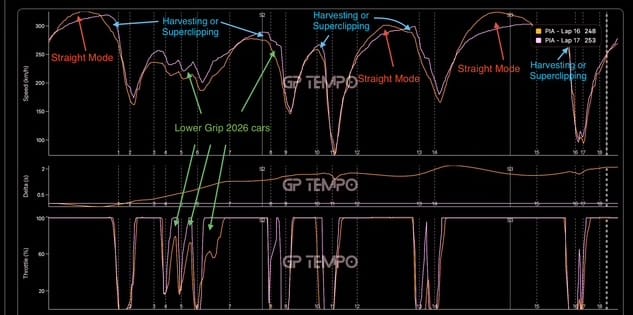
If during that period you were using the ICE power to drive the MGU-K to maximise harvesting, it would leave you with roughly 100kW from the ICE to power the car.
If this was happening, I would expect the speed profile to drop faster.
So, what would be the best way to adjust these parameters for Suzuka?
kW out 350 300 250 200 Electrical Horsepower 469 -67 -134 -201 ----------------------- -------- -------- -------- -------- kW out change 17200 -2457 -4914 -7371 ----------------------- -------- -------- -------- -------- kW in 250 300 350 350 ----------------------- -------- -------- -------- -------- kW in potential 8000 9600 11200 11200 ----------------------- -------- -------- -------- -------- kW in vs kW out (%) 47% 65% 91% 114%Now, there are in-between steps for deployment. I have just looked at 50kW steps, also, braking kilowatt in and super clipping kilowatt in, so it’s a matter of playing with numbers based on past data.
I only used Suzuka data as it was the third race of the season, so most teams will have got on top of best practices. I have also only looked at qualifying, because I believe if you sort this, the race will look after itself and any race data is always confused with the driver looking after other factors, be it potential problems or minimising tyre degradation.
The best solution for Suzuka, and most likely for other tracks, is to make the deployment power of the MGU-K 200KW, and the harvesting from braking or superclipping 350KW.
Now, let’s move on to what F1 is looking at. The first thing I would say on these priorities and solutions is that we are not privy to all of the potential banana skins that are involved in these regulations and their implementation.
So much is from clarifications and technical directives, so we can only comment on what we know.
The priorities
1) Closing speeds
This must be looked at urgently. If a driver exceeds the maximum laptime delta or drives unnecessarily slowly on a lap, the FIA has the right to impose a penalty. With these current rules and their application requiring superclipping, the driver is forced to drive slowly to optimise their harvesting
2) Loss of on-edge qualifying laps
We all want to see the car being driven right on the ragged edge; that’s the spectacle of qualifying. We also want to see the driver reward for his efforts, so by giving the driver control over the energy output and input with the throttle and brake pedal does just that. Forget all this behind-the-scenes assistance that basically the driver doesn’t need and only serves to confuse the viewer.
3) Drivers running out of power before end of the straight
By coming up with a set of numbers that balances the output and input, you will do exactly that. It may need to be different for each circuit, but the responsibility for that should be put in the teams’ hands.
I would do that by requesting that each team put forward their circuit request for the maximum power output 28 days before each event. The FIA then averages that out, issues it to the teams 21 days before each event, and that number becomes the output level for that upcoming event. That means that each team will have 21 days to run various simulations.
The solutions
1) Raise Superclipping limit from 250kw to 350kw (less reliance on lift and coast)
With the above proviso re where and how it’s done, this needs to 350kW as standard. You could also add that superclipping can only come into play when the car is on the straights and that they must leave two car widths on each side of there own car.
Also if the driver has to press a button to instigate superclipping then the rear wing light start flashing immediately and superclipping ramps in at 100kw per second after that button press, this would give any driver following a reasonable warning and allow them to react to a slowing car.
2) Cut back on the 350kw maximum deployment ability. Change ramp down rates so speed profile is changed.
From the information from the first three races and the actual lap data from Suzuka, this needs to be set at 200KW. Anything more would not quite achieve the goal.
Yes, this will be a fairly major reduction in overall horsepower, down from a mythical 1000hp to 800hp, but I think we can live with that.
It would equate to something like two seconds, but that’s better than all this lift and coast business that is going on, which probably looses just as much time.
3) Stricter recharge limits. Could be cut to as low as 6MJ from 9MJ.
They have a 4MJ battery pack, allow 8MJ recharge limit for all circuits which gives the driver the potential of three full battery packs per lap. Stick with this. Don’t keep moving the goalposts.
4) Allow unlimited use of active aero (straight mode whenever you want, rather than only in specific zones)
Again, put this in the driver’s control. If they have more than 95% throttle and less than 5% brakes, then allow the driver to press the button, wet or dry, slippery or grippy, the driver can decide where and when to use it.
5) Increase fuel flow limit for 2027
No. This would be like sending out a clear signal to a world that is trying to reduce emissions that F1 should be exempt from that requirement. Yes, we are using sustainable fuels, but nothing is sustainable forever. I would be reducing the fuel flow limit for 2027 and finding better ways to harvest more energy from speed reduction during braking.
I might even suggest that some small token of harvesting should come from single harvesting motors in the front brake assemblies and even a small MGU-T. I christened it T because it could also spin up the turbo on the startline. The front axle would only be output to increase the harvesting potential, whereas the MGU-T could have a small output and input and both units (two front, one MGU-T) would be from a standard FIA-approved supplier.
6) Simply the rules.
Yes! Please, I beg of everyone who can contribute to simplify the regulations, they are now more like the Encyclopaedia Britannica!