How F1's urgent 2026 rule changes will actually work
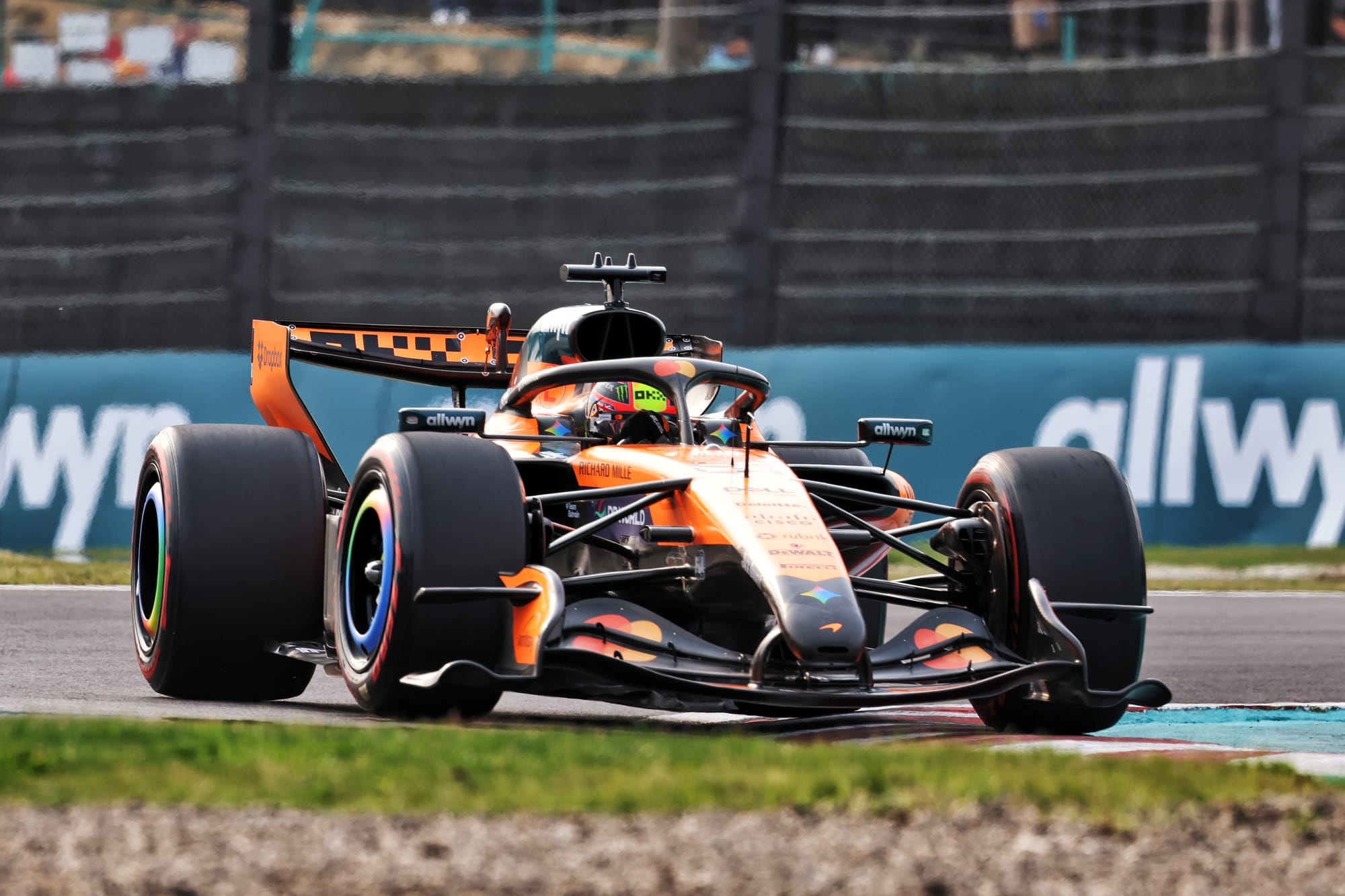
New data has revealed just how much Formula 1’s rule changes, aiming to fix problems with the 2026 cars, should actually change their behaviour in qualifying.
A raft of complementary tweaks was agreed upon earlier this week that, among other things, will address the most extreme elements of battery charging tactics teams have been deploying and in turn, resolve the biggest problems drivers have with qualifying.
This will make the cars slightly slower and trade the fastest theoretical lap for a more ‘normal’ one.
At the same time, stakeholders want to preserve elements of the new style of racing the rules have brought in, because they are adamant that this has largely proven popular with fans.
The FIA’s single-seater director Nikolas Tombazis said “these changes are not revolutionary” and are “not going to fundamentally change the picture you see” – but believes “qualifying will be more flat out for the drivers”.
Thanks to data shared by McLaren simulating the effects of the rule changes, we are able to see exactly what it means, and why it will come at the cost of a little bit of laptime.
The problem being addressed
F1 2026 has been counterintuitive to watch and experience for the drivers, compared to conventional laps from previous years when the cars were not aggressively energy-limited.
Normally, cars would accelerate a long way down a straight and reach their maximum speed at or very close to the end of it.
In the hybrid era, there has always been an element of lift-and-coast to charge the battery, or some ‘clipping’ whereby the battery runs out of energy to keep deploying the electric part of the engine, but so little as to be unnoticeable - and certainly not a relevant factor in qualifying.
That has changed for 2026. The charging demands mean that even a push lap in qualifying was dominated by serving the battery in the opening three races. And in both qualifying and the race, the speed profile of the cars was very different to before.
Led by technical director for engineering Mark Temple, McLaren has produced a combination of speed traces comparing a 2025 lap, the 2026 car as it actually ran in Australia, and a 2026 car running to the new Miami-onwards rules.
The 2026 cars are capable of extremely high straightline speeds – and even higher peaks than before – but these would strangely taper off early on some straights as drivers switched to charging the battery early.
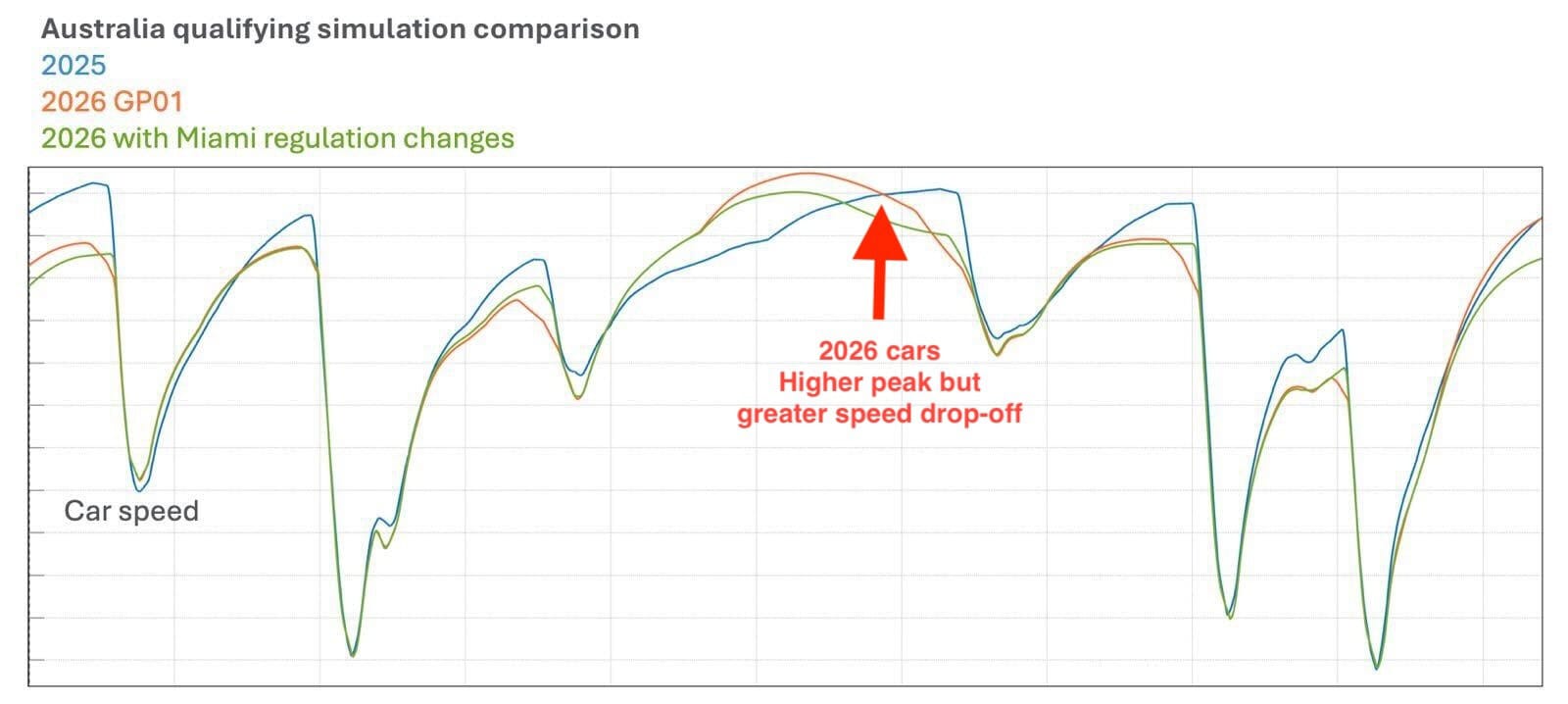
Lifting and coasting had this effect but so too did the new phenomenon to ‘super clip’, where the MGU-K is run in reverse against the engine to charge the battery. This greatly reduced straightline speed even when the driver was still at full throttle.
And because this is an energy-starved formula, the battery still did not have enough capacity to deploy the MGU-K power to full effect for long enough anyway - which is why some straights the 2026 cars were slower than before, even though they clearly had the potential to be even faster.
While this also led to issues in races as drivers dislike having to charge the battery so much, and it had a big influence on what kind of racing would break out, the chief problem being addressed in performance terms right now is the sheer qualifying experience and spectacle.
It is being tackled by a stricter energy harvesting limit from 8 megajoules (MJ) to 7MJ, combined with an increase in the ability to super clip at 350kW instead of only 250kW as before.
The benefit will be circuit-dependent but should be at least halved from around 8 seconds or more to 3 or 4 seconds – basically, there will be a more aggressive super clip when it is used, but the time spent doing it will be less.
“There will be less need, or no need, to deploy funny charging strategies so as to get to the necessary level of energy,” said Tombazis.
How different a qualifying lap will be
Temple says the biggest impact of the changes is “from a driving point of view – the idea is to get rid of some of these things that the drivers don't like doing in qualifying”.
His traces illustrate how this could be the case, how big a difference it will make in what the car does, and what is being sacrificed to achieve this.
McLaren simulated a Melbourne qualifying lap as the rules were back at the season opener - which we’ll call 2026 V1 - compared to the new Miami-onwards rule tweaks (2026 V2).
The broad trends are that the cars will have slightly less peak power and straightline speed but will be able to sustain them for longer. It will not be fully conventional, but it will be closer.
Referencing the Melbourne example, 2026 V2 would be slightly slower along the start finish straight but would keep accelerating until Turn 1 rather than have a late, sudden drop-off (1). They would have similar deployment strategies and speeds to Turn 3, then again initial out of Turn 5 - but V2 can keep deploying more (2) to Turn 6, where previously the speed drop-off was again significant, as this was a key charging area.
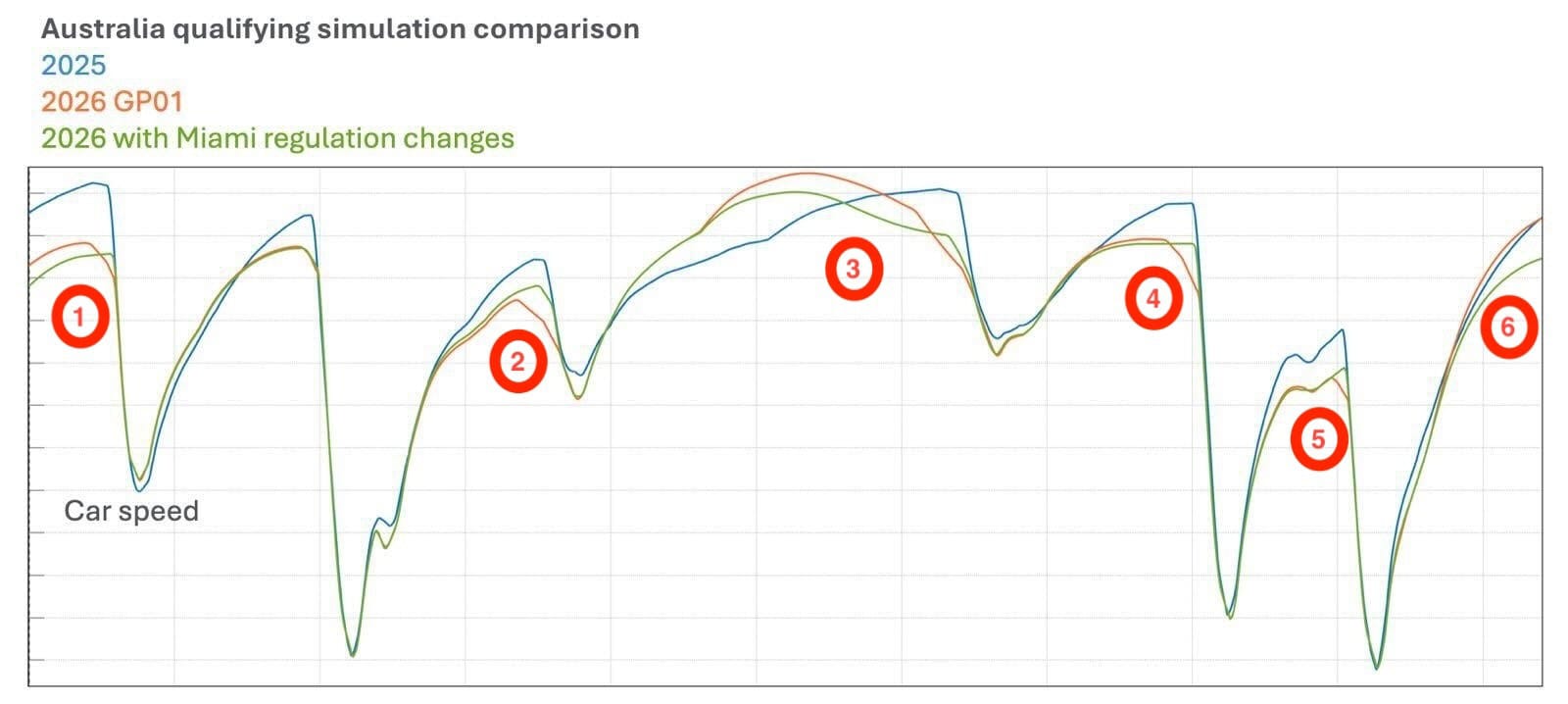
Peak speed is again lower on the long run to Turn 9 and 10, and even slightly lower than 2025. There is also unfortunately, still clear evidence of the cars tapering off because the charging demands are not removed entirely. However, it would be less severe (3) and 2026 V2 would actually be faster than V1 right at the approach of the corner itself.
Similarly, deployment can continue for longer on the straight to Turn 11 (4) with 2026 V2, and the penultimate burst of power is even more in its favour as there is no need to charge into the final braking zone of the lap (5).
As a final example of the trade-off, the energy harvested over the lap with 2026 V1 allows a much stronger deployment (6) through the final corner and onto the start-finish straight.
It adds up to a slightly slower lap, but also a slightly more normal one. Broadly speaking, 2026 V2 will be more similar in profile to 2025 than V1 was, with lower approach speeds.
At least as the 2026 cars have less downforce, though, the minimum cornering speed and the way they are approached - i.e. not gently coasted down to - should mean that 2026 V2 is a more grip-limited formula than 2026 V1.
This would be good news because this means drivers are having to take the car closer to its performance limit rather than being limited by the engine.
And what drop-off for the engine will persist should at least be less exaggerated compared to what was witnessed early on this season.
“Maybe you will perceive that [as a viewer] as you see them on the camera shots from the cockpit and you hear the tone of the power unit for example,” Tombazis added.
“That's maybe one thing you're going to see.”
There are also other changes within the intricacies of the rules to remove some of the other oddities around how much throttle was needed to be used before the MGU-K kicked in and started depleting the battery.
It led to drivers having to delay being on full throttle at the end of their outlap before approaching the start of their qualifying lap, but also even doing that exiting some corners too, and the rule tweaks aim to eliminate this.
“That's now going to be easier for the driver and they won't have to sit at part-throttle waiting and then go to full throttle,” said Temple.
This is slightly different to the issue drivers had where brief lifts on a qualifying lap, when correcting a slide for example, would mean they inadvertently re-engage the MGU-K and drain the battery when getting back on full throttle.
“No doubt there will still be some quirks that we identify we can then address,” said Temple.
“There was a subtlety where you had a region [of throttle usage] where you triggered power limited but not power limited pending – that's been closed up so it's all triggered at the same point so that particular oddity should be gone.”
The impact on racing
There is a belief that the style of 2026 racing is worth consolidating, as it has generally led to more overtakes, even if there is disagreement over how authentic it is. Therefore, F1 has not tried to directly impact how drivers can race each other.
“Fans have by and large been enjoying the new regulations because they've brought closer racing and I think first and foremost we expect that to continue,” said Tombazis.
There will be knock-on effects, though.
While charging limits will not be changed from before in races, other parameters are changing that will impact on overtaking. The shorter but more powerful super clip will also be prevalent in races, for example.
This ties in partly with the other priority in the rule changes, which was safety-related. After Ollie Bearman’s heavy crash at Suzuka, where he was caught out by his closing speed to Franco Colapinto, it was agreed that something needed to be done to mitigate the risks of cars being in very different battery deployment states.
There will now be a boost limit in certain parts of the track that limits MGU-K power from 350kW to only 250kW. This will be tied to where there are straight mode zones – places where the cars are running with their wings open, in low-drag mode.
The idea is this is where overtakes are more likely and therefore it is safer to have speed differentials. So, in straight mode zones, the full 350kW will be available. Otherwise it is capped at 250kW. And to try to limit the speed differentials further, a driver not deploying the MGU-K at all will only be able to use 150kW if they then choose to activate their Boost function.
That might sound a little dense, but such are the regulations being tinkered with. What it means for racing, and the potential for overtaking, is ultimately what will matter.
The jury’s obviously out until there are some real-world case studies, but the expectation is that it could harness some of the more extreme yo-yo racing - where drivers breeze past back and forth fairly easily depending on battery state of charge - in a more strategic way.
McLaren produced the example of how the different boost limits impact how you would benefit from deploying your energy differently in Miami.
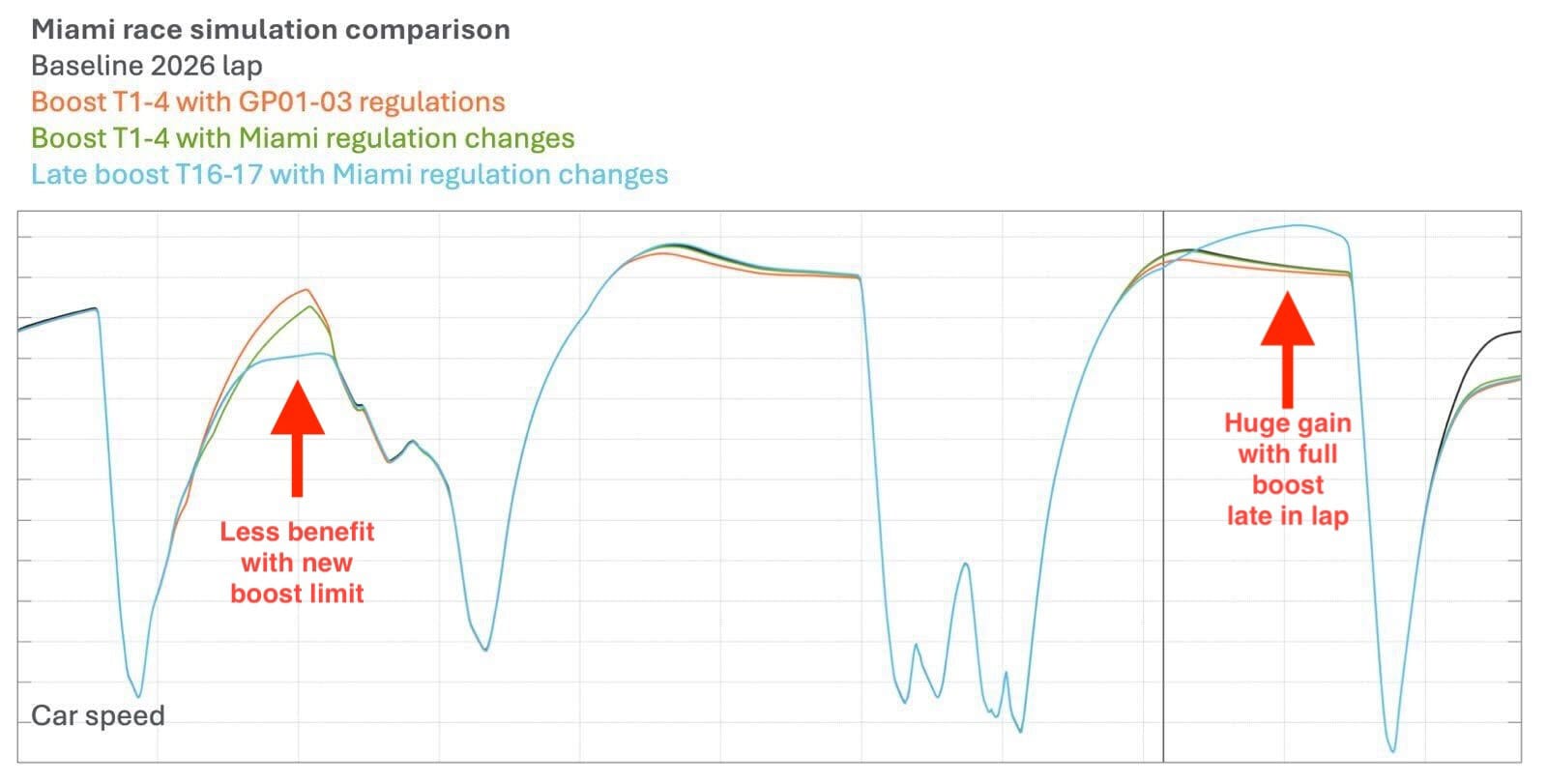
The opening sector will be subject to the lower boost limit, as it is not a straight mode zone. This means the gain there would be modest. Whereas saving the energy for later in the lap would have a massive benefit compared to the alternative.
“If we think about two long straights one after the other, so this kind of long straight into Turn 17 and then down to Turn 1, you could still have a car that is essentially doing a bad job of overtaking and using too much energy and then being repassed in the next straight,” said Temple.
“Which, personally, I actually think is quite a good thing because it forces a little bit more of a strategic element to overtaking, the driver has to think more.
“And will reward the drivers who are thinking about and learning from and optimising what they're doing.”
What will happen with reducing the speed differentials, and where those differentials occur, is that overtaking places will be more limited again. One of the arguments for the new style of racing was that it created new places to overtake, taking advantage of where you could deploy power compared to someone else.
“I think we will see less chance of maybe opportunistic overtakes in some of the more unusual places, but I think that's the right compromise for safety,” said Temple.