Every 2026 F1 team's big weakness
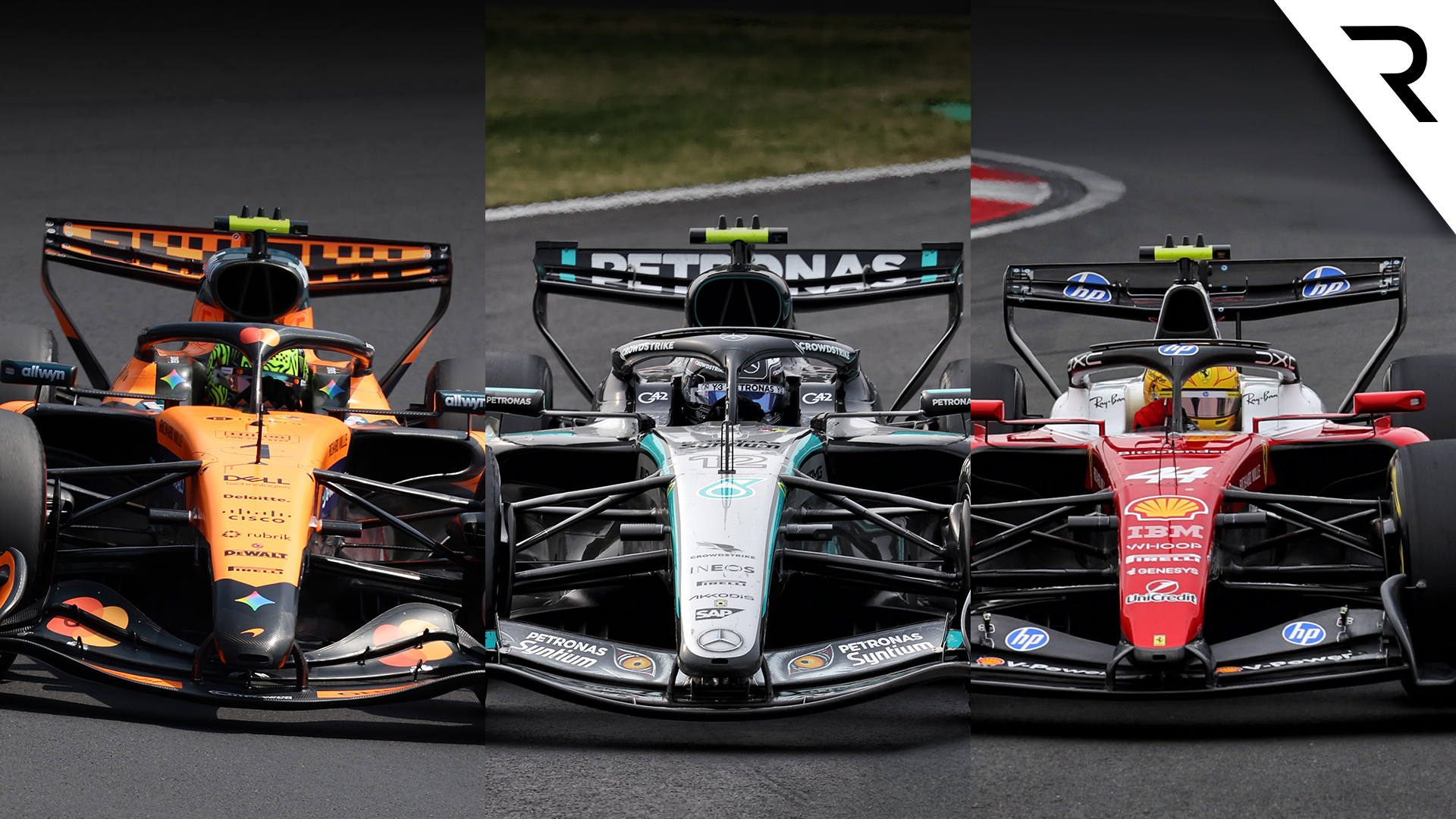
The first three race weekends of the 2026 Formula 1 season have been enough to expose the laptime-costing problems that each team must fix.
The Race has been trackside and in the paddock throughout those opening weekends and at pre-season testing - so based on that, speaking to the drivers and team personnel, and analysing the data, we've picked out the biggest weakness holding every team back.
With the season resumption in Miami now just days away, here's our rundown of who's lacked what so far - and what they might have been able to tackle during the extra April gap.
Ferrari: Engine deficit
No team encapsulates the fact that the 2026 regulations are all about the power unit better than Ferrari. It has what some rivals suggest is the best car in terms of corner performance, but its power disadvantage means it's not at the level of Mercedes.
As Lewis Hamilton claimed in China: "On performance, we're hugely down to the Mercedes engine."
But what does that actually mean? Well, there's reckoned to be a deficit from the V6 engine rumoured to be somewhere in the region of 20bhp. While Ferrari's smaller turbo makes it supremely responsive and outstanding off the line, this potentially plays a part in that power shortfall. Battery energy is also consumed more quickly as a result of compensating for this.
This makes it a raceable car, one that led in both Australia and China, but one that ultimately always falls behind Mercedes. And in Japan, it also slipped behind McLaren.
Team principal Fred Vasseur expects Ferrari to be given the chance to upgrade its engine when the additional development and upgrade opportunities that can be triggered if the FIA deems performance to be at least 2% down kick in. He's gone as far as describing that as "an opportunity for us to close the gap".
But until then - and that system's first checkpoint comes after the Miami Grand Prix - this is a baked-in disadvantage when it comes to laptime, although the cost of it will vary by track configuration.
Audi: Race starts
Most teams, at least those without Ferrari engines, have struggled with starts. But Audi's difficulties are on another level; Gabriel Bortoleto has even declared them "terrible".
This is first and foremost down to the power unit having what is thought to be the largest turbo in the field. That's good for potential peak power, but means far more inertia. That makes it harder work to spin it up and to keep it in the right window to optimise boost pressure for the start.
On the six occasions an Audi has taken the start this year, it has lost places five times. Based on position on the grid versus the end of lap one, there's an average loss of just under four places. Even in the China sprint, where Bortoleto gained a place, that was only because Isack Hadjar spun on lap one and Ollie Bearman briefly went off in avoidance.
While the drivers can improve their getaways, the problems are consistent. The turbo is spun up by applying the throttle to get the boost pressure where it's required. But then, it's necessary to reduce throttle just before the start itself and that pressure drops. This means the car bogs down, then suffers wheelspin in the second phase when the power belatedly kicks in.
This is the primary weakness for Audi because no matter how well you qualify, if you are usually four places worse off come the end of the first lap then you are up against it to score points.
And worst of all, here was Audi project leader Mattia Binotto's assessment: "The reason it has not been addressed is it's not an obvious fix. But it's a top priority for us."
If Audi gets the opportunity to introduce upgrades under the new 2026 rules, maybe things could improve this year. But for now, Audi is stuck with this issue, which is frustrating given the package has shown good pace.
Mercedes: Deployment in combat
Even the all-conquering Mercedes W17 isn't perfect. While its rivals have never managed to beat it, they have troubled it so far this year.
Ferrari in Australia and China, and McLaren in Japan, both managed to run ahead of Mercedes and cause problems for George Russell and Kimi Antonelli in battle. Particularly early in races, it's never been a foregone conclusion that Mercedes will lead.
The Mercedes is outstanding when it comes to the integration of harvesting and aerodynamic characteristics. The ERS is efficient, helped by long gearing, and the engine puts out good power. The chassis generates plenty of rear downforce and is strong on traction and under braking.
However, those strengths are compromised when not in clear air, which can be costly early on thanks to not being the best off the line. That's not only compared to Ferrari, but also McLaren - although when there have been poor starts they have been for varying reasons.
Currently, its weaknesses are an inconvenience rather than disastrous. But as rivals close in, they could exploit them more.
Williams: Weight
Williams's start to the season has been a huge disappointment, slumping to become the ninth-fastest car having finished fifth in the constructors' championship last year.
Its big initial problem is that the car is overweight. That's partly a consequence of having to react to struggles passing the crash test.
The team hasn't revealed the exact figure, but it was by as much as 30kg early on - worth nine tenths of a second even if you use the most conservative rule of thumb of three tenths lost per 10kg.
Fortunately, a good step is expected to be made towards rectifying that with upgrades for the next race in Miami next month. Less encouragingly, as Carlos Sainz has pointed out, there are other problems.
"We haven't done a good job with weight, but we also know that our downforce package is not up there either," he said.
It's not just downforce that there are concerns about. Load transfers through corners are compromising the contact patch of the inside tyres, which is compromising grip and traction - the car isn't three-wheeling as such, but that kind of mechanism. The high-rake design appears not to be working as hoped.
There is at least significant laptime to be gained when the weight is reduced - and progress on this front has been promised for Miami. But weight reduction comes at a cost, and won't solve all of Williams's troubles.
Haas: Qualifying pace
The Haas VF-26 is a strong all-rounder with a good, usable spread of downforce that inspires confidence in the drivers. However, it struggles when it comes to qualifying pace.
Judged by single-lap pace, Haas has the eighth-fastest car. That puts it at the back of the notional four-team midfield group.
A Haas has only reached the third stage of qualifying twice out of eight attempts, on both occasions in the hands of Bearman in China. Yet the race results are far more impressive, with consistent points finishes, meaning Haas sits fourth in the constructors' standings.
Part of the problem is the challenge of optimising deployment for a push lap; Esteban Ocon said as much after qualifying 12th in Japan.
However, this should be improved quickly, which would make Haas even more formidable at the front of the midfield.
McLaren: Downforce deficit
Early on, McLaren's big problem was not being able to optimise the potential of the power unit as effectively as Mercedes. While the works team still has a tiny edge when it comes to that, McLaren has closed the gap dramatically. And that has revealed its true weakness.
"We need to improve the aerodynamic efficiency of the car, and in particular downforce," said team principal Andrea Stella.
The McLaren is at its best in slower corners and the underlying design concept has, according to Stella, significant potential. But while there's no fundamental weakness, it is simply giving away that little bit of time.
Part of this might be baked into the car. It has a shorter gearbox and, as a result, shorter wheelbase, around 10 centimetres less than the maximum allowed. That has made it easier to keep the car weight down, but has perhaps come at the cost of downforce opportunity.
However, the team promises upgrades will significant improve the McLaren for Miami, meaning there's plenty of reason for encouragement after it flirted with victory at Suzuka.
Racing Bulls: Narrow window
Last year, the Racing Bulls was a forgiving car with a wide set-up window. But the change of regulations has made it a trickier beast, particularly on a fast lap.
In pre-season testing, it looked difficult under braking. That's improved, but there have still been occasions, for example in Australia qualifying for Liam Lawson, where hints of that remain.
But generally, as Lawson said: "The hardest thing is it’s very easy to overstep, use too much and make a mistake."
It also suffers from a little understeer on the softer tyre compounds, which isn't helpful for qualifying.
The positive thing is that the car has a good peak, if you can hit it. And that's translated into points finishes in all four races held so far.
Cadillac: Downforce deficit
The Cadillac-Ferrari MAC-26 has exceeded expectations for this brand-new team. But unlike Aston Martin, which it has been faster than so far, there's nothing fundamentally wrong with the package other than the car being on average 4.6% off the pace.
And that all stems from one shortcoming.
"The balance itself is not too bad. It's just that we are lacking the load," said Sergio Perez.
The power units are crucial to performance in 2026, and Cadillac having the Ferrari engine is key to its advantage over Aston Martin, but downforce still counts.
From pre-season testing, the Cadillac has required the drivers to do plenty of work behind the wheel, but not to contain any specific limitation. The car simply lacks grip and therefore ends up moving around more.
There was an improvement last time out in Japan with tweaks both to the fences and the central part of the diffuser. As well as boosting the aerodynamic performance, this also widened the set-up envelope of the car.
Perez's team-mate Valtteri Bottas said Cadillac had "gained a bit of load and stability" as a result and the team is "still lacking [downforce] but the direction is right". And there's an upgrade package described by Perez as "big" coming for Miami.
Still, there's no guarantee that adding downforce allows you to retain the relatively benign handling characteristics, so this is a big test of the team's capabilities.
Alpine: High-speed understeer
Alpine has put its 2025 struggles far behind it, scoring points consistently in 2026. However, the car is dogged by understeer that's particularly costly at high speed.
In Australia, this meant it struggled badly, although Pierre Gasly demonstrated it had good race pace by battling through to 10th in the grand prix. Things then improved in China and that allowed Gasly to pick up sixth at Shanghai, followed by seventh at Suzuka.
Upgrades are coming, and it's hoped that the understeer problem can be eliminated soon. "There's still many little things we need to fine-tune and fix, which are not unfixable limitations," said Gasly.
Once that is ticked off, it will be about making fast enough progress relative to the opposition to close the gap to the leading teams. Because that's what Alpine is now focused on, as leading the midfield is not the limit of its ambitions.
Aston Martin: Engine/chassis integration
The Honda power unit is clearly the first-order problem for Aston Martin, estimated to be worth around two seconds per lap of its deficit.
But it's clear that while Honda has its troubles, you can't entirely separate them from the extent to which the design demands of Aston Martin's technical supremo Adrian Newey contributed to that.
This led to the request to shorten the overall length of the power unit, which Honda delivered but at the cost of redesigning some peripheral parts of the package, although the V6 itself remained unchanged. Integration plays a part, which is why such demands cannot be entirely separated from Honda's struggles.
The priority problem is the vibrations that have led to battery damage. It's unclear when this will be resolved, although Aston Martin tested parts in practice in Japan to dampen those vibrations being transmitted to the driver via the steering wheel.
But that’s just one issue. The V6 engine is down on power, which brings with it a compound disadvantage, as Newey explained: "The shorter you are on ICE [internal combustion engine] power, the more you have to make up for it using electrical energy."
The Honda is also struggling when it comes to energy recovery efficiency.
This means that even if the reliability problems are fixed - and right now this is the priority for Honda, and it will be for some time - the performance simply isn't there.
As for the car itself, aerodynamically Newey claims it can lead the midfield - but until the worst of the power unit limitations are eliminated, there's no way to test that.
Red Bull: Mid-corner understeer
It says a lot about the depth of Red Bull's problems that the power unit isn't its main weakness - even though this is the first F1 engine produced by a brand new powertrains operation.
Instead, the big concern is that the car is, at times, undriveable. And with troubling echoes of both 2024 and 2025, there are big balance problems. We've gone for mid-corner understeer as the main problem, with Max Verstappen complaining regularly about difficulties achieving the required rotation.
But it’s not just mid-corner where things are going wrong. In China and Japan, Verstappen complained of set-up changes failing to cure the car's ailments, with one axle or the other hitting trouble and a resulting lack of confidence behind the wheel.
As team principal Laurent Mekies admitted, the higher-ups at Red Bull are "starting to scratch heads about car balance and characteristics" problems. And that's left the team floundering in the midfield.