F1 sim racing has become a sad missed opportunity
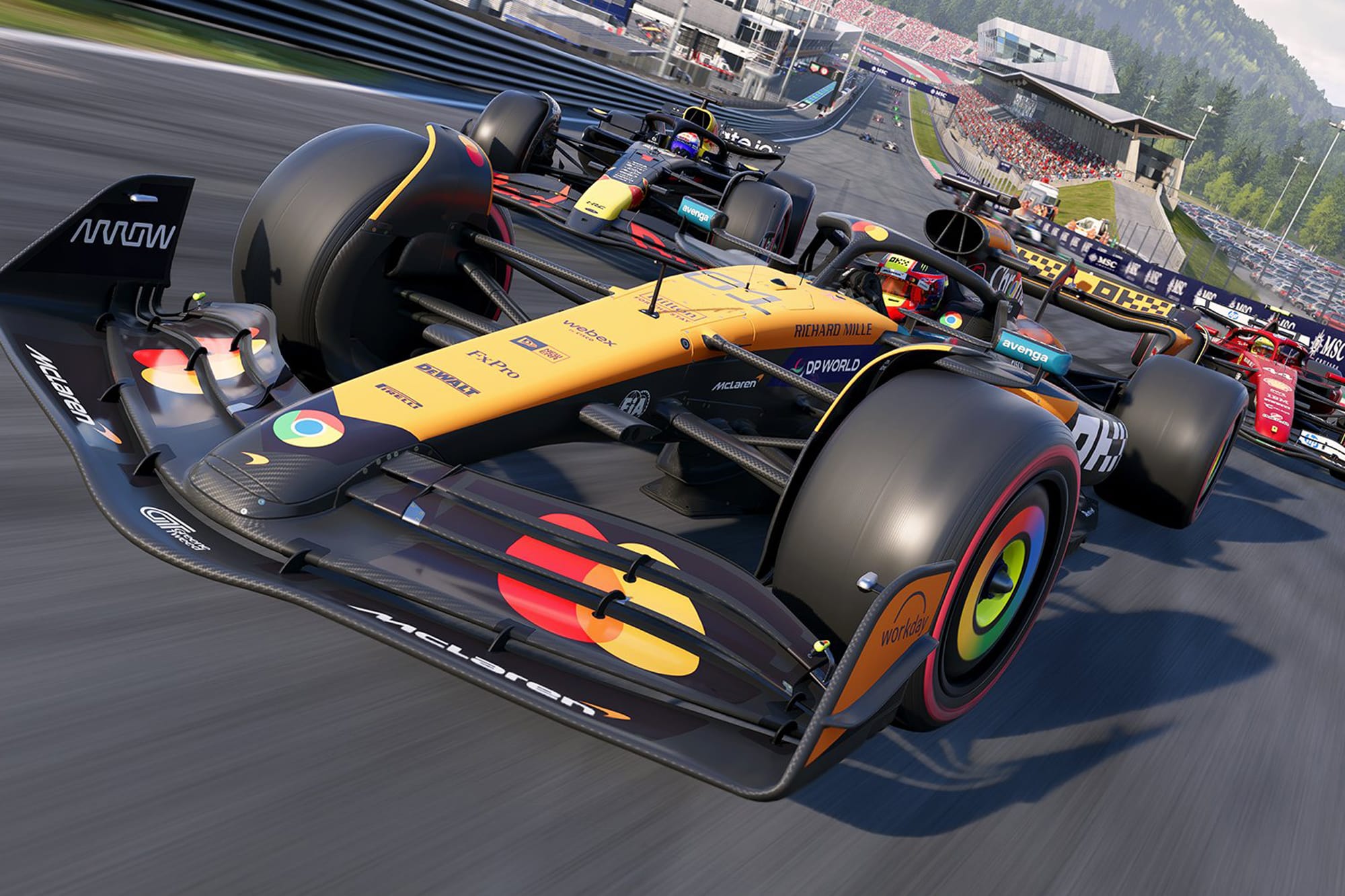
It’s the final lap of F1 Sim Racing’s fifth round of the season. There is a $750,000 prize pool on the line.
Jarno Opmeer, who has won the simulation world championship on three occasions and is a former real-world Formula Renault Eurocup competitor, is going three-wide alongside Otis Lawrence and Ismael Fahssi. Heading into Circuit de Barcelona-Catalunya’s opening corner, this move will determine who wins the race.
This should be the apogee of the entire genre: factory-backed teams and drivers, slick commentary and live coverage on the Formula 1 YouTube channel. Yet, somehow, it isn’t.
Ahead of its time
To fully understand why I think F1 Sim Racing, née F1 Esports, isn’t living up to its lofty status, we must first cover recent behind-the-scenes changes.
Beginning life as a one-off event at the 2017 Abu Dhabi Grand Prix, F1 Esports' popularity exploded well before the Covid pandemic, making inaugural winner Brendon Leigh a household name (well, if you were a keen sim racer, anyway).
That prescient decision to invest in virtual racing paid dividends when 2020 and 2021 came around. The sport already had the infrastructure and production in place to rapidly spin up gaming broadcasts, alongside an official video game that had been in the steady hands of Codemasters for over a decade.
It was a tricky time for the world and a halcyon period for the simulation genre, with Johnny Herbert cutting the first corner to briefly lead the very first Virtual Grand Prix and Charles Leclerc livestreaming on Twitch upwards of five hours per day. The official esports competition of F1 rode this wave of popularity.
The aforementioned Opmeer cleverly leveraged this exposure to pursue a content creation career. The Dutch driver currently has a YouTube subscriber base of over 500,000.
Never one to withhold opinions, his on-track and off-track battle with compatriot Thomas Ronhaar in 2023 was the sort of controversial theatrics that can see a surge in popularity, as viewers tuned in to see their next battle.
Awkward hand-over
Behind the scenes in recent years, however, there is apparent unrest among the F1 Sim Racing teams.
Three years ago, there was a change of organiser for the racing game competition, moving away from embattled esports agency Gfinity and its eponymous London-based arena. The new production partner was ESL, a video game entertainment company purchased by the Saudi Arabian Public Investment Fund’s (PIF) Savvy Games Group in 2022. This changeover process was elongated, and left the competing outfits in a state of flux.
Following a concerning period of silence, and with very little fanfare, it eventually produced an event in November 2023. Behind the scenes, however, this was a particularly fraught meeting.
Ongoing contract disputes meant a calendar featuring on-site appearances at F1 races across the globe was allegedly scrapped. When it did return five months later, it was labelled the 2023/2024 season, and all rounds took place inside a relatively nondescript Swedish studio.
Crucially, momentum was lost and what was meant to be a triumphant return under a new vision became just yet another sim racing competition, perhaps lacking the gravitas expected of a premier sporting event.
The current state of play
There was further turmoil before the current 2026 F1 Sim Racing World Championship, with an air of uncertainty among sim racing entrants as new F1 entrant Cadillac abstained from participating and Sauber (now Audi) withdrew.
It means a somewhat paltry 18-car grid for the current season. Communication felt at an all-time low, too. Teams were announcing their driver lineups in clear anticipation of a 2026 season, but Formula 1 didn’t formally announce its return until just eight days before the first event in late March.
Take this week’s second round as an example. On the day of the event, F1’s official Instagram feed posted a solitary graphic, with no link. This was the only social media post from F1 before the event began, with participating teams taking up the majority of the promotional slack.
This seems like a missed opportunity, especially in light of the cancelled Bahrain and Saudi Arabian Grand Prix.
The newly formed vacuum in the calendar was the ideal opportunity for sim racing to once again plug a gap, as it did six years ago.
In this downtime, Max Verstappen raced at the Nürburgring, while Kimi Antonelli was a guest at World Endurance Championship's Imola season opener. Another current driver could, and probably should, have at least visited the F1 Sim Racing studio to say hello and offer a brief interview.
Such a move could have added a layer of legitimacy and a talking point during this unexpected hiatus.
What’s next?
It’s not just the curious lack of fanfare that disappoints, but some of the in-game racing, too. Despite this being a local area network (LAN) event, during the broadcast, the cars occasionally hop, skip and jump around with more unpredictability than Davide Valsecchi with access to a microphone.
It’s a trait often seen when one driver is on the other side of the world from another, where internet connections vary, but not befitting of an event when all competitors are in the same room.
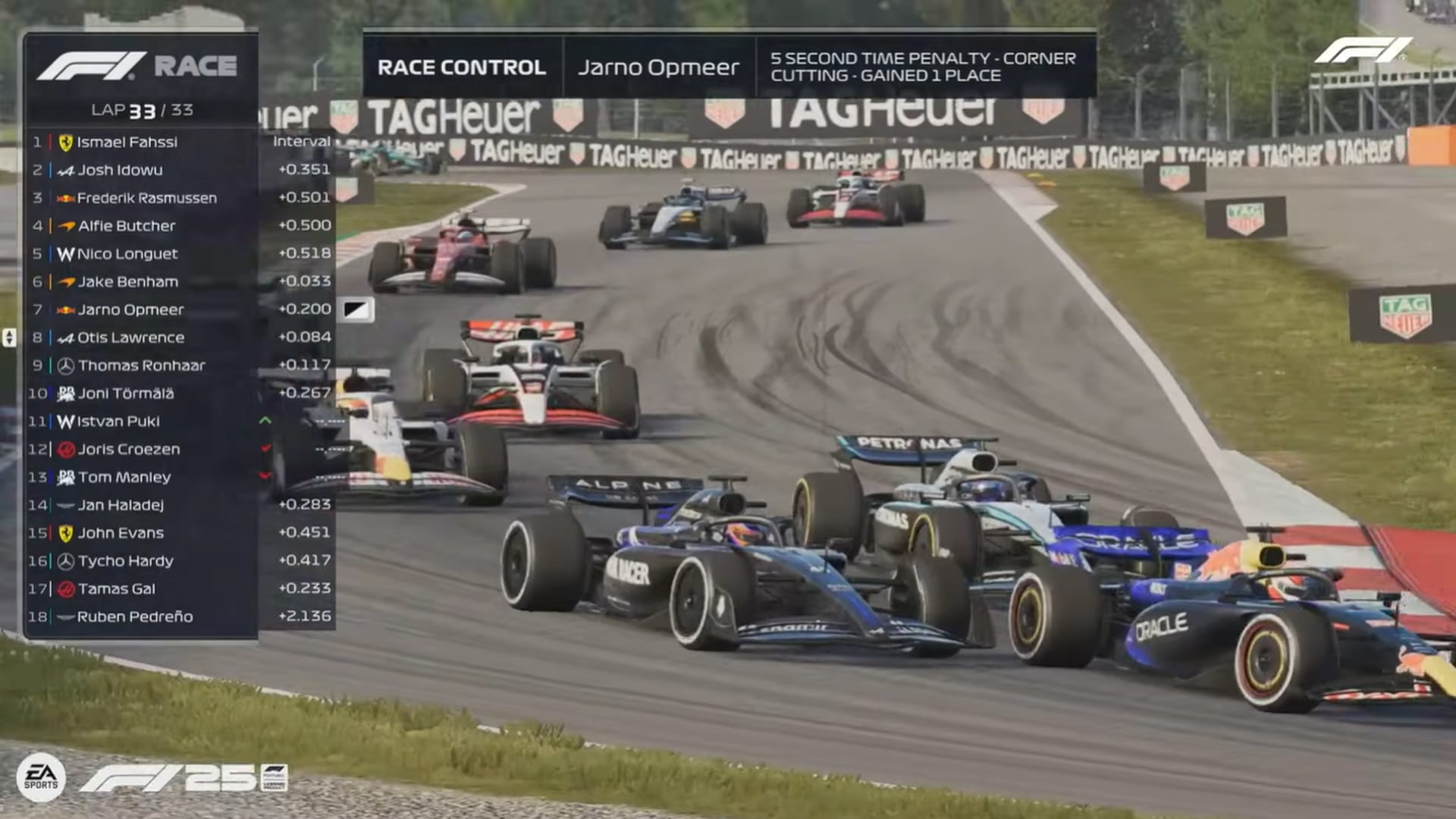
Then there’s the final lap action I raised earlier. After the three-wide move results in contact (quelle surprise), the field is condensed, with multiple drivers colliding in a desperate attempt to gain positions.
This propensity for contact is partly due to a reticence to run with realistic damage settings in the EA Sports F1 25 game. This function is considered too unpredictable to run in a competition, with possible underfloor damage applied inconsistently.
So, reduced damage settings are enabled, which provides an unrealistic level of wheel-banging, in turn exploited by the drivers.
To its credit, Electronic Arts has provided the development team with an additional year to improve the experience. It will release a 2026-season downloadable content pack for the existing game later this year, before a “reimagined” release next year.
“We’re fully committed to the EA SPORTS F1 franchise,” said Lee Mather, senior creative director at Codemasters, last year.
“Our multi-year plan extends this year’s excitement with the 2026 expansion and reimagines the F1 experience for 2027 to deliver even more for players at every level around the world.”
Let’s hope its multiplayer prowess is part of the mix to improve the F1 Sim Racing spectacle.
Irrespective of its foibles, within the virtual racing space, this championship still has the largest viewing figures, averaging over 205,000 views this season. That’s far ahead of eNASCAR (~11,000 YouTube average) or DTM Esports (~51,000 YouTube average).
An improved game in 2027 may not be enough to save F1’s premier virtual competition, though. There’s still a paucity of promotion aside from the occasional article on F1.com; the lack of connection between this and the real-world sport is palpable and the driving standards are at times woeful.
In terms of an in-person driving game event, Gran Turismo’s World Series is peerless by comparison. Expert commentary, live crowds and a globe-trotting tour – F1 could learn a lot from Polyphony Digital’s showcase.
Politicking has seemingly thwarted F1 Sim Racing at every move, and when it should be flourishing, it’s floundering.