F1's options as it tries to get a race back onto the 2026 calendar
Formula 1 says it is "working overtime" to keep abreast of the latest Middle East situation, as it evaluates whether it can get one of its missing races back later this year.
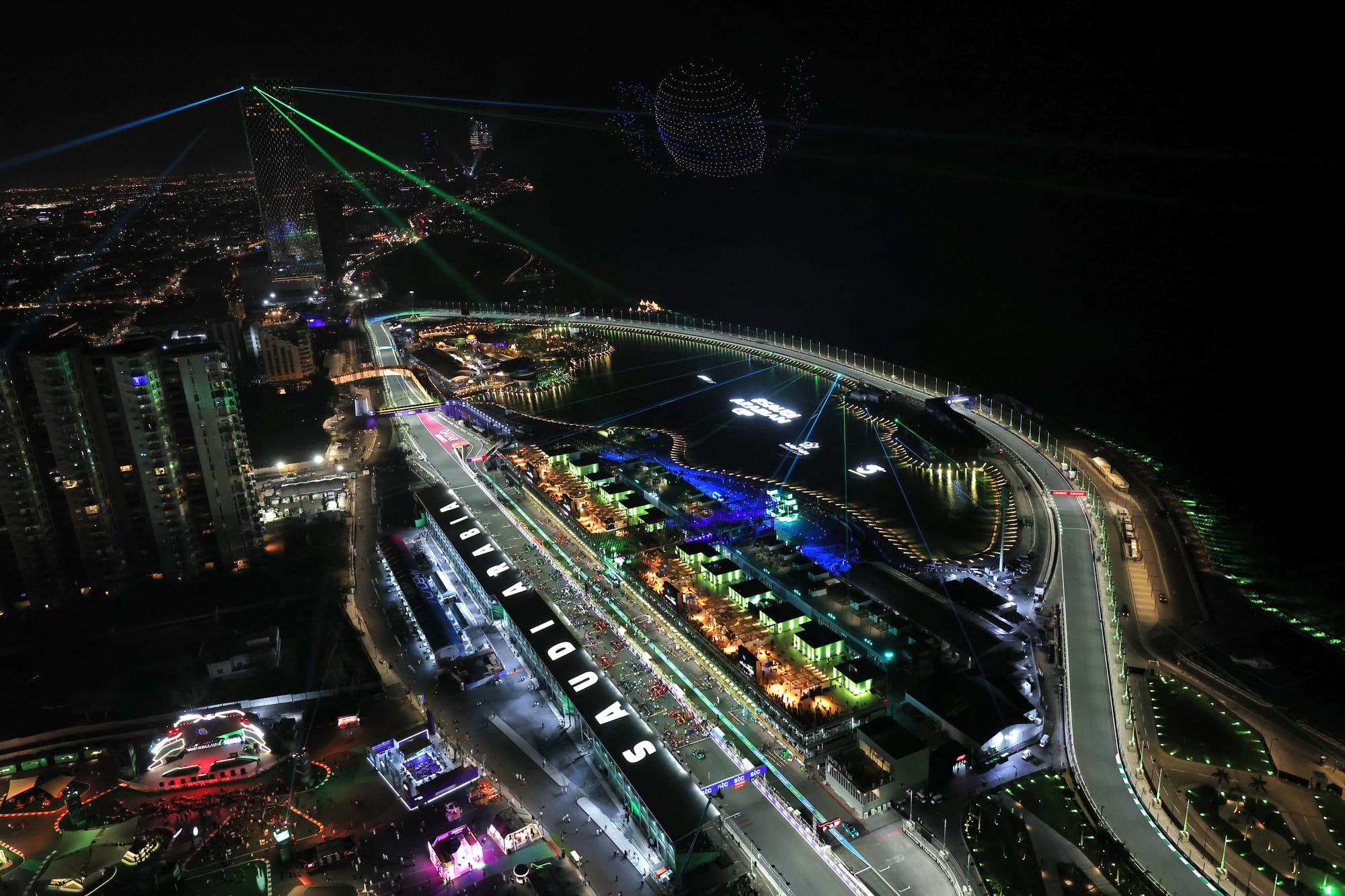
The Iran war that erupted on the eve of the season prompted the Bahrain and Saudi Arabian Grands Prix to be called off from their April slots – leaving a five-week gap between Japan and Miami.
But with F1 careful at the time not to explicitly state that either Bahrain or Saudi Arabia was cancelled, it has always been understood that there was a possibility for their return.
While the current schedule does not offer much opportunity to slot them back in thanks to the run of races late on, that has not stopped F1 contemplating options should a return be possible.
On Thursday, during an investors call to discuss its Q1 results, F1 owner Liberty Media outlined that, while having both back races on the 2026 schedule was unlikely, there was a chance of finding a home for one of them.
Liberty Media CEO Derek Chang said that while "the wellbeing of everyone in F1 comes first and we always manage the calendar with that principle in mind", he was clear: "it might be possible to reschedule one race toward the end of the season."
He added that F1 CEO Stefano Domenicali and his team were "working overtime" to monitor things.
F1 teams were updated on the situation at last weekend’s Miami Grand Prix, with it clear that hostilities in the Middle East would need to calm down properly before action was taken to get a return for either event.
This is why a final call on what happens may likely wait until the summer break, when it should be clearer whether tensions between the USA and Iran have eased into a lasting ceasefire that would give some confidence over the events going ahead.
The best windows
There are two realistic options on the table in terms of getting either of the races back – one of which would not require a shuffling of other events.
The first call would be to see if a race, most likely the Bahrain GP, could be slotted in on the October 2-4 weekend between the Azerbaijan Grand Prix on September 26 and the Singapore Grand Prix on October 11.
This would mean an extra triple header before the three races on the bounce in the USA/Mexico/Brazil, but any extra hardship on teams would be offset by the boost to commercial rights income through the hosting fee that Bahrain can offer.
If that plan falls through because the Middle East situation has not improved, then another more complicated option could be to reshuffle the final run of races.
Right now, the final three events are scheduled to be Las Vegas on November 21, Qatar on November 29 and the season finale in Abu Dhabi on December 6.
One idea that has been mooted, although not advanced so far, would be to hold either the Saudi Arabian or Bahrain Grands Prix on December 6, and then shuffle the Abu Dhabi GP back a week to December 13.
F1’s first quadruple header would be logistically challenging for both FOM and teams, but again the blow could be softened by the rights hosting fee - especially with Saudi Arabia's offering being one of, if not the, highest of the year.
Any movement on this, with a final call needing to be made in conjunction with the teams, would require plenty of notice because of the implications on travel and freight.
Back-up plans
The other scenario that F1 has to weigh up is what happens if the Middle East situation has not improved by December and even the Qatar and Abu Dhabi races are threatened too.
While F1 has been happy to not need to replace Bahrain and Saudi with alternative events for now, it is understood to be eager to not drop the calendar below 22 races if it can help it.
So if Qatar and Abu Dhabi could not take place, then replacements would likely need to be factored in.
Suitable venues to hold races in December, the European winter, are not so easy to find – so could mean some more leftfield thinking.
During the Liberty investment call, Domenicali was clear that F1 had some back-up plans in place should it need replacements on hand – although he ducked answering a question on whether a double-header in Las Vegas was a possibility.
"The only thing I can say is that we have plans, hopefully not to be applied, because we really hope that the situation for the world, not only for the racing, will go back to a normal situation," he said.
"Of course, the lead time, or the cut off really, is different between what we can eventually recover that has not been run in April versus what could eventually happen or not happen in the end of November, beginning of December.
"We are, of course, aligning with the teams and with the promoters, because that's something that has a big chain of reaction.
"In the due time, we will keep everyone informed. But I hope you understand if we just say something that will be a speculation that we want to avoid, because, as I said, the first hope is to make sure that we go back to the place that we should be."
Increased revenue
The uncertainty about the fate of the Middle East races comes against the backdrop of some robust financial figures for F1 in the first quarter of 2026.
F1 increased its revenue by 53% to $617million compared to last year, although this was helped in part by there being one extra race compared to 2025.
The second quarter results may be more challenging as the Bahrain and Saudi Arabian Grands Prix fell into this window, and means that Q2 will hold only five races compared to nine in 2025.