F1 needs to stop chasing road relevance for good
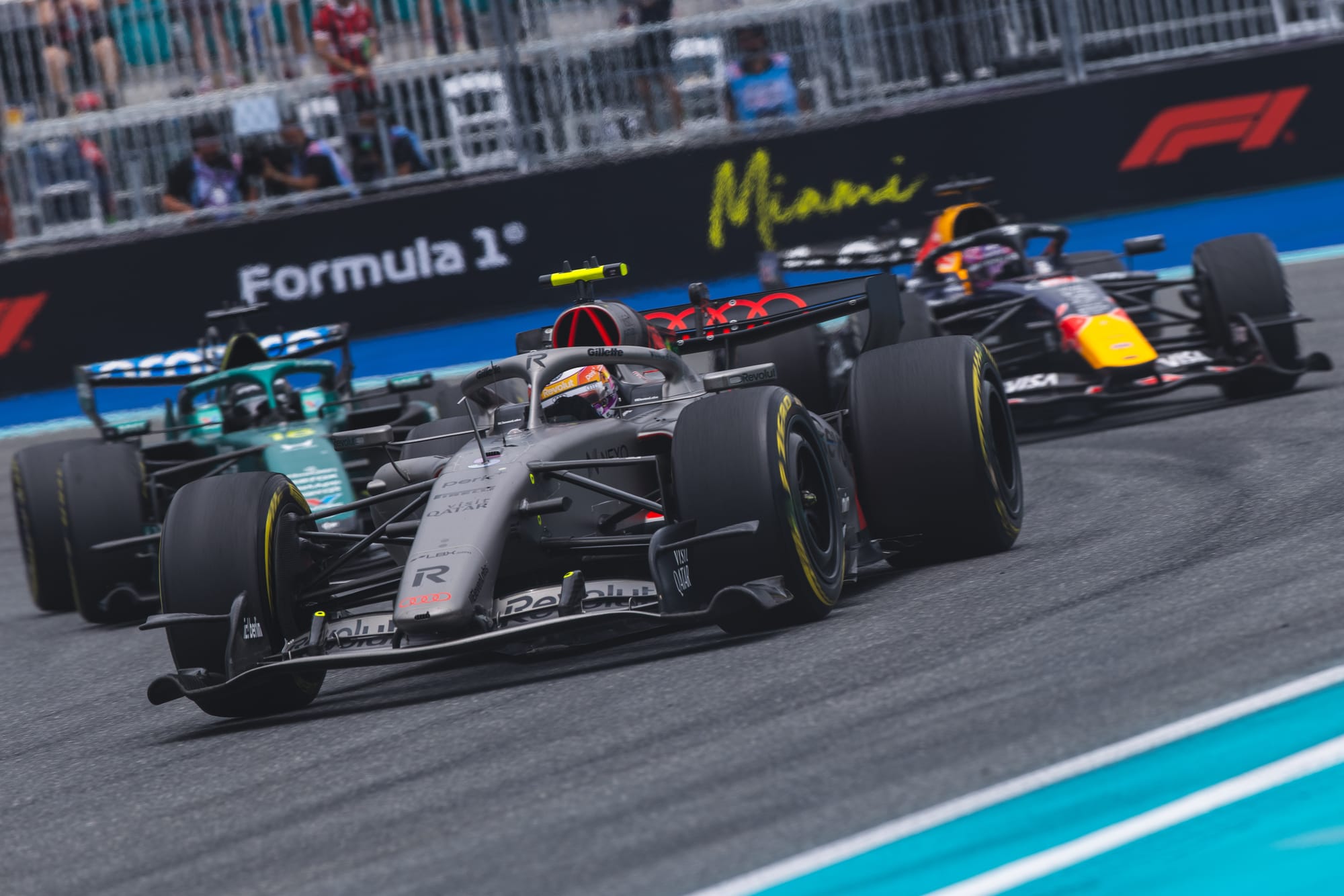
Formula 1 seems to be making heavy weather of getting itself out of the knot it has put itself in with the 2026 regulations.
The underlying problem inherent in having too heavy an electrical contribution to the power unit is amazingly easy to solve - and well understood. The problem is just political and philosophical.
"We cannot be hostage to automotive companies," said FIA single-seater director Niklas Tombazis recently. Single-seater technical director Jan Monchaux followed that up with an acknowledgement that ideally there needs to be a much bigger internal combustion engine contribution to the power unit's output, directly implying that the 50/50 target set by the manufacturers was just way too ambitious.
Electrical power and downforce just do not mix. The energy required to push a draggy, downforce-producing single-seater through the air is inappropriate to the energy density available from battery storage. Petrol is around 50 times more energy-dense.
So the battery can give you a great big boost instantly - but cannot do it for anything like long enough and the most beneficial way to use that limited energy for laptime is to deploy it heavily at the start of the straights. Hence energy management through the corners, unacceptable speed differentials etc - all the concerns the opening races highlighted.
The recent regulation tweaks have helped, as did the energy-friendly layout of Miami (just as in Shanghai for the second round). But F1 is simply managing the underlying problem most apparent in qualifying, which is that fastest way around a lap is to drive significant chunks of it nowhere near the driver's limit. That is a nonsense and strikes at the very heart of the sport's challenge.
So now two senior FIA technical officials have finally confirmed what many of us in the specialist press have been advocating for years (ie too much automotive influence leading to excessive electrification). That was then followed by FIA president Mohammed Ben Sulayem promising that F1 will return to V8s with a much smaller electrical contribution from 2031 at the latest, maybe as early as 2030.
He's confident in saying that because there's a much more receptive response to that idea now that the (predictable) limitations inherent to the attempted 50/50 energy split have been made apparent in real time.
"It's true the political landscape has changed," continued Tombazis, "and back when we discussed the current regulations the automotive companies who were very involved told us they were never going to make another internal combustion engine again. Obviously this hasn't happened...[but at least] we did go for sustainable fuels."
That last point is the important one. Yes, these fuels, whether bio or synthetic, are hugely more expensive (between 12 and 15 times more) than those derived from oil drilling. But that's a) not all that important to a sport with F1's cost base and income and b) not a permanent thing. As production of synthetic fuels in particular is scaled up - and the impetus for doing that has never been greater than since the closure of the Strait of Hormuz, through which a fifth of the world's oil is transported - so the cost will come down.
But whether it takes decades for it to come down to a feasible cost for everyday fuel for cars is hardly relevant to F1. Long term, it's obvious - and has been for a long time - that motorsport is going to be forcibly decoupled from the automotive industry technically.
Quite aside from the fact that automotive's ultimate destination seems to be fully electric and driverless and therefore totally unrelated to F1, so it's also true that while full electric power is suitable for road cars, there are other sectors to which it is totally unsuited. Such as aircraft and ships, where the energy density of liquid hydrocarbons is essential.
A container ship with batteries only as heavy as the fuel which would be required to sail from China to Europe would literally struggle to get itself out of the harbour before its batteries were flat. The limited range of batteries with energy density 50 times less than that of hydrocarbons would obviously be unsuitable for long-haul flights. Just as it's unsuitable for those sectors, so it's unsuitable for racing.
Once everyone gets their heads around that, then the connection between automotive and the sport of motor racing can be properly severed. Just as was the link between transport and horse racing.
The case for increased electrification was of course largely environmental. But based upon the automotive world's contribution to greenhouse gases. Not the pitiful proportion of energy used by F1 cars racing for a couple of hours 24 times a year.
Besides, with synthetic fuel, no new greenhouse gases are being released into the atmosphere. It's simply reusing what’s already there. Yes, it requires huge amounts of electricity and the electric grid is not yet green enough for large-scale production of clean synthetic fuel. But again, that's an automotive problem. Not a problem of F1, which can easily manufacture the relatively tiny amounts needed completely cleanly (if expensively). So the scaling problem is not a bar that F1 needs to clear.
So yes. A move back to largely internal combustion engines which will once more demand that the drivers drive at their limits, thereby reverting it to a sporting contest, will be very positive change. But did we really need to prove the unsuitability of mixing batteries with downforce in F1? Wasn’t it already obvious?
Of course it was. But if F1 felt it was being held hostage by automotive, it could simply have walked away from the knife to its neck. Automotive and F1 share an ancestry but are two completely different entities, now almost unrelated.
Accepting that is at the heart of the long-term health of the category.