Verstappen finally experiences 'supersonic' Nurburgring night driving
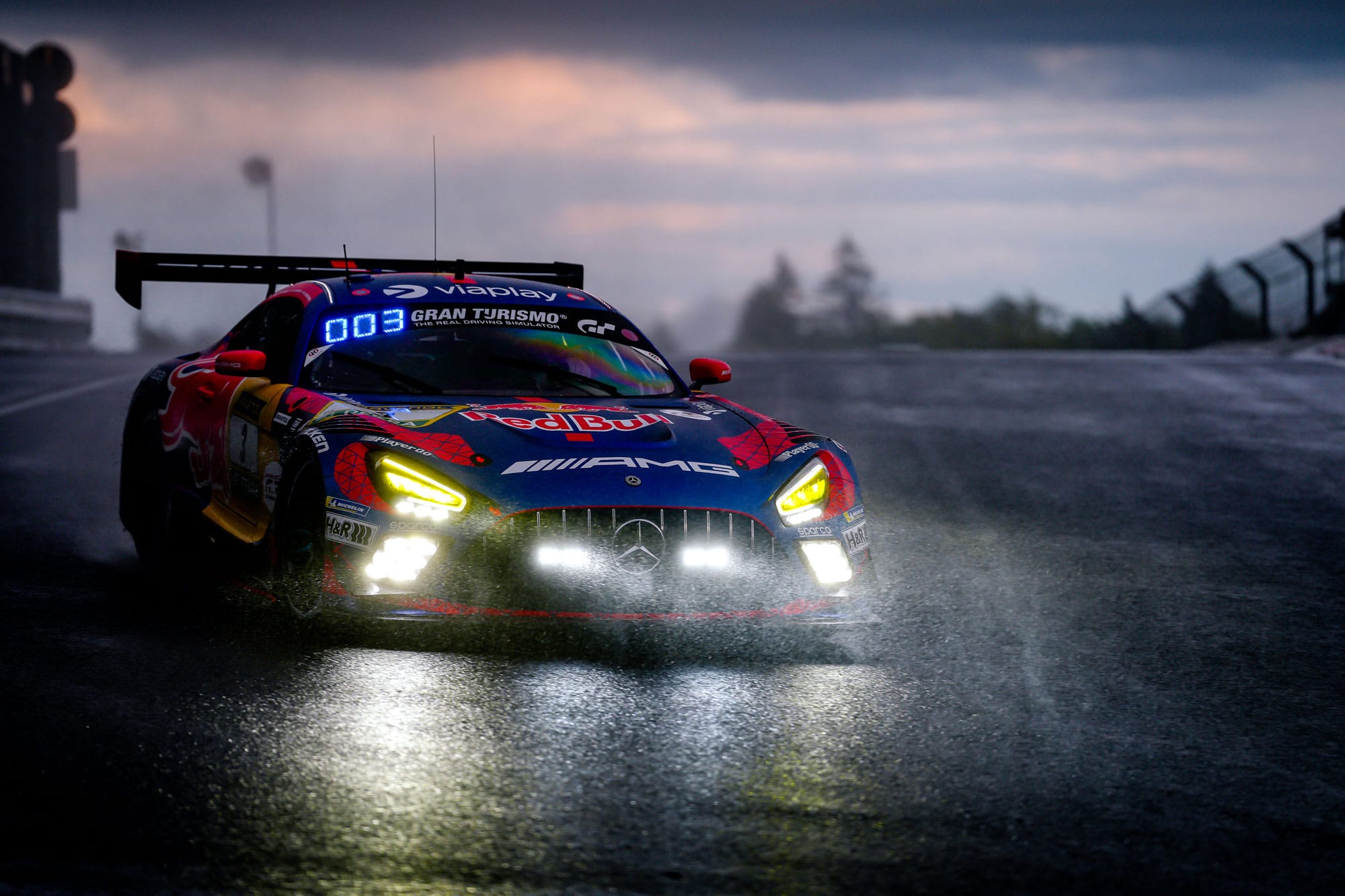
Max Verstappen’s done an awful lot of learning for this weekend’s Nurburgring 24 Hours over the past months, but up until Thursday night, he had yet to experience one key challenge.
Circumstances meant Verstappen’s first taste of driving the Nurburgring Nordschleife in the dark was Thursday’s second qualifying session.
Qualifying isn’t really important for the GT3 cars until Friday in terms of grid positions - Friday's three ‘top qualifying’ sessions will decide those - but Verstappen had an important mission to sample night-time driving.
Watch the rest of Nurburgring 24 Hours qualifying live on The Race YouTube channel on Friday
Not only would it be an important experience gained, but it would prevent any uncomfortable questions of whether Verstappen would be allowed to make his night-time debut during the 24 hour race - given the uniquely strict licence requirements the Nordschleife has.
It was one that rain threatened to ruin, though, as hail and rain intensified just as it was Verstappen’s turn to take to the wheel of the Mercedes GT3 car he’s sharing with Lucas Auer, Jules Gounon and Daniel Juncadella.
Most teams - including Verstappen’s - chose to return to the garage during the worst of the weather. Rain that ensured the fastest times of the day would remain those set in qualifying one, where Verstappen was third quickest.
But the rain did ease enough for Verstappen to take to the wheel to complete his first lap of the Nurburgring Nordschleife in night-time conditions - a truly one-of-a-kind ‘supersonic’ experience, made all the harder by the wet track.
And don’t forget that the Nurburgring Nordschleife at night is unlike any other circuit. At around 25 kilometres long, and only a slim minority of that is covered by floodlights.
So drivers only really have their headlights and lights from spectators to guide the way - it means a lot is based on feel.
Kelvin van der Linde - part of the 2025 Nurburgring 24 Hours winning BMW crew - told The Race it was “definitely” the toughest circuit to drive in the night.
“Especially with the mixed conditions we have here,” he added.
“We have a new asphalt which is very dark, and so when the track is drying up, you don't typically see the wet and dry patches as easily.”
What the simulations miss
The simulator has been a big tool for Verstappen (and many other Nurburgring novices) to learn the circuit, but it has its limitations when replicating night-time conditions.
“What is it missing? It's the characteristics, the senses, the lights from outside, from the camping place, has a big effect on the light in the track. You wouldn't believe it, but it does. It distorts your vision a bit, you distort your peripheral vision a little bit,” van der Linde explained.
“Whereas on a simulator, I find that the darker spots of the track, you don't have this tunnel vision or this 3D vision that you would have in reality. So it's just a very, very different experience.”
Timo Glock - racing a McLaren with a livery inspired by Michael Schumacher’s 1995 Formula 1 title-winning Benetton this weekend - had a similar baptism of fire to Verstappen when he made his Nurburgring 24 Hours debut in 2024.
He said he “felt like a rookie” at 42 years old despite extensive experience across F1 and the DTM.
“You can prepare to a certain amount on the sim in terms of sort of multi-class driving, knowing where you are able to overtake on the Nordschleife,” Glock told The Race.
“But at the end, it's just the reality is different when you are here for the first time with all those cars, because you see with all the guys who have less experience, you never know what they are really doing and you need to sort of know or try to find a way.
“So to try to read them and predict what they are doing is super difficult and on top in the night, even more difficult, so you just need to find a rhythm, don't take super or not too much risk because it can so quickly happen that you have a crash and you're out of the race. So take it easy, let's say.”
Having said that, Glock pointed out that the race has become so competitive that it’s essentially become a 24-hour sprint race.
“There's a reason why the manufacturers pull up with three to five cars because there's maybe one which survives,” he said.
“But you need to go at that sort of all-in pace from the beginning on. And if you're lucky, you get through; if not, you're out. But that's how it is.
“A couple of years ago, it was more like you know take it easy in the night, you survive the night and then from the morning on it's full send to the end. But it turned into a different race now.”
'His brain is 100 metres in front of the car'
It might be a tough challenge, but it’s not an insurmountable one for any top-line driver, not least Verstappen.
“As drivers, we're very adaptive creatures. We tend to get something and within a couple of laps, your mind, your eyes, everything tends to adapt,” van der Linde explained.
“But for sure, those first two laps, all your senses are like working overtime. Like everything feels in supersonic speed.
“After the first two laps, you kind of get into your flow and stuff and I think that is just what makes the difference of having professional drivers here, they are able to adapt.
“But still, when you're trying to find the last bit of laptime, trying to be fast, trying to make no mistakes, it's still very, very difficult.”
Rival drivers have been blown away by what Verstappen’s been able to achieve thus far.
“To me it's absolutely insane what he did,” Glock said.
“The way he raced against Christopher Haase [in previous Nurburgring races] was like the best show for motorsport you can have.
“And it was super impressive to see how quickly he adapted to it, he's reading the traffic and everything like that.
“The most impressive [moment] was last year when he drove in the Ferrari and he overtook on the grass, and he didn't even blink.
“He was just like totally normal for him.
“It feels every time he's like 100 metres in front of the car with his brain. So he knows already 100 metres in front what's going to happen and when he arrives there, it's already happening automatically, and he's already again 100 metres ahead.
“So the way he predicts stuff, the way he's handling that is super impressive.”
You only have to look at the way Verstappen previewed his night-time challenge to know how much he was relishing this - and the longer night-time experience that awaits on the weekend.
"It’s probably going to be the best feeling," Verstappen said.
"You’re by yourself, pushing in the night. The car is normally fastest in the night, so I'm looking forward to it..."