The hidden technique behind Button's extraordinary feel for conditions
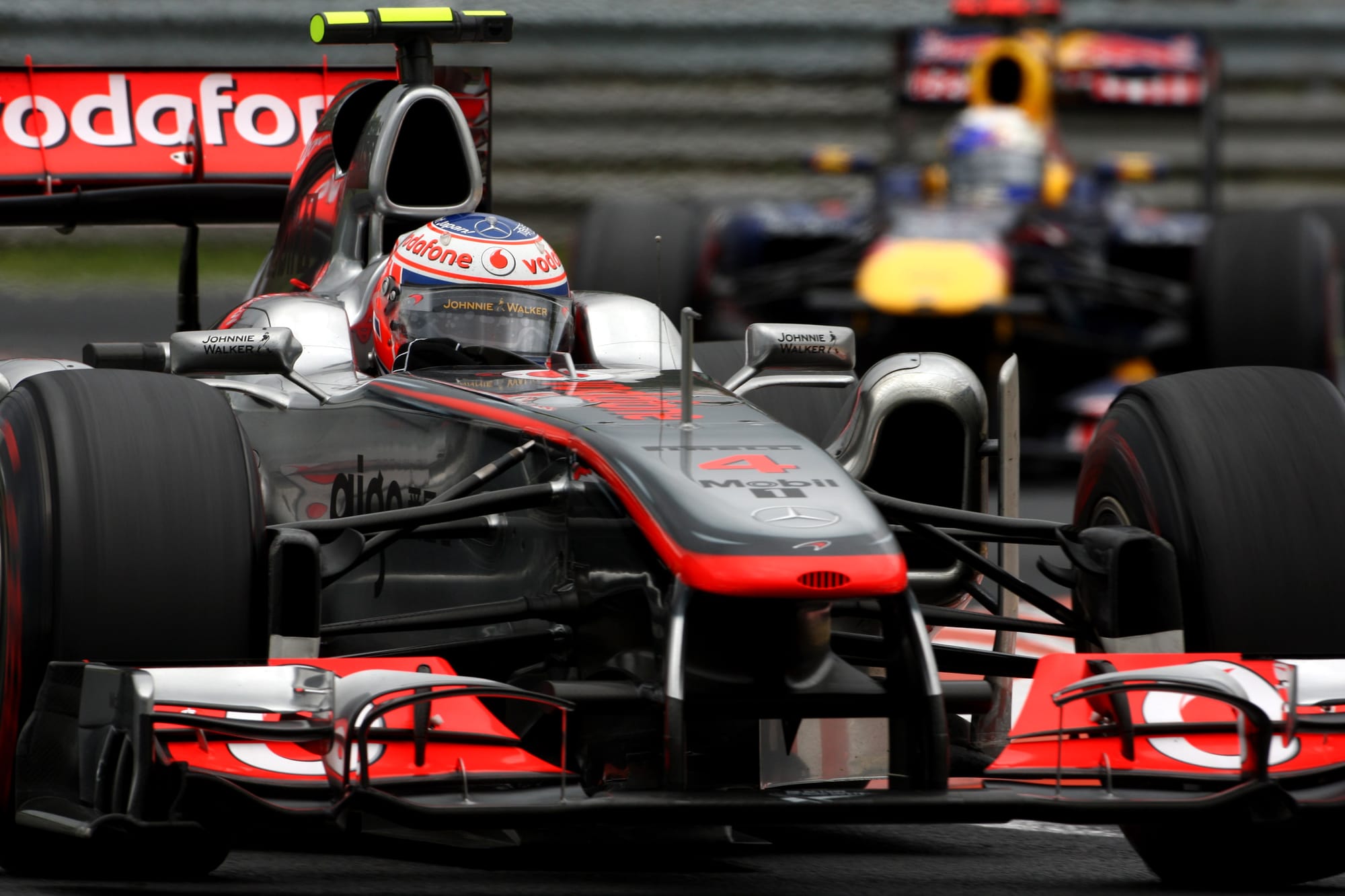
There's arguably no other Formula 1 driver with the reputation for such extraordinary feel for conditions and an ultra-smooth driving style as 2009 world champion Jenson Button.
But that perception of him can be reductive, as his outwardly smooth approach concealed some incredibly interesting techniques.
Tom Stallard, who started as Button's performance engineer at McLaren and later became his race engineer, explained it as such: "Everyone always said Jenson was the smoothest driver in the world, because they couldn't see what his feet were doing. He drove like a duck, and his feet under the surface of the water were doing all kinds of things to keep the car balanced, such that he could be smooth with his hands."
Attempting to describe just what that looked like are Edd Straw and Mark Hughes, who take a closer look at Button in the latest episode of Driving Style Secrets, our exclusive members-only podcast that takes an unapologetically deep dive into the driving techniques of the biggest names in F1.
Here's a taste of what you can expect from the episode, which is available to listen to in full in The Race Members' Club - where you can also find our back catalogue including previous episodes on the likes of Max Verstappen, Lewis Hamilton, Michael Schumacher and Ayrton Senna.
A master of changeable conditions
Whether or not Button's reputation was a simplistic one, it's undeniable that he had a distinctive style; one that allowed him to hit great peaks, but also meant he struggled with set-up sometimes.
Though those peaks could be visually stunning in the dry, it's Button's innate reading of conditions as they changed that set him apart from the rest.
"He basically had a unique way of feeling the car, feeling the front of the car, and he was extremely sensitive to track surface and he could read a track surface brilliantly well - better than anyone," says Hughes.
"And he was able to interlink what was coming at him in his eyes with what that was about to feel like, and when the conditions were changeable, there was no one who could touch him.
"He was pretty good in the wet, but not in an outright really wet circuit where it's just wet everywhere - [there he was] just competitive rather than outstanding. But when it was changeable, when you didn't know what grip you're going to have from one corner to the next, or one lap to the next, he was absolutely outstanding."
Listen to the full episode here!
It's little surprise, then, that seven of Button's 15 wins came in rain-affected races. And while the 2011 Canadian Grand Prix is probably the most famous, arguably his win in Hungary that same year, or in Australia and China the year before, were of greater calibre in terms of the way he felt his way to the front.
But that talent was also obvious to see right from his first season in F1 with Williams.
"Indianapolis 2000, in his rookie year, it was drizzly and he'd had a coming together with [Jarno] Trulli and damaged his wing, so he came in and put the slicks on, just as a gamble," says Hughes.
"And the times he was doing tricked about three quarters of the pitlane into coming in, and they all found, 'We can't do times with these, the track's nowhere near ready for slicks'. But Button was making it look as though it was."
What he was actually doing
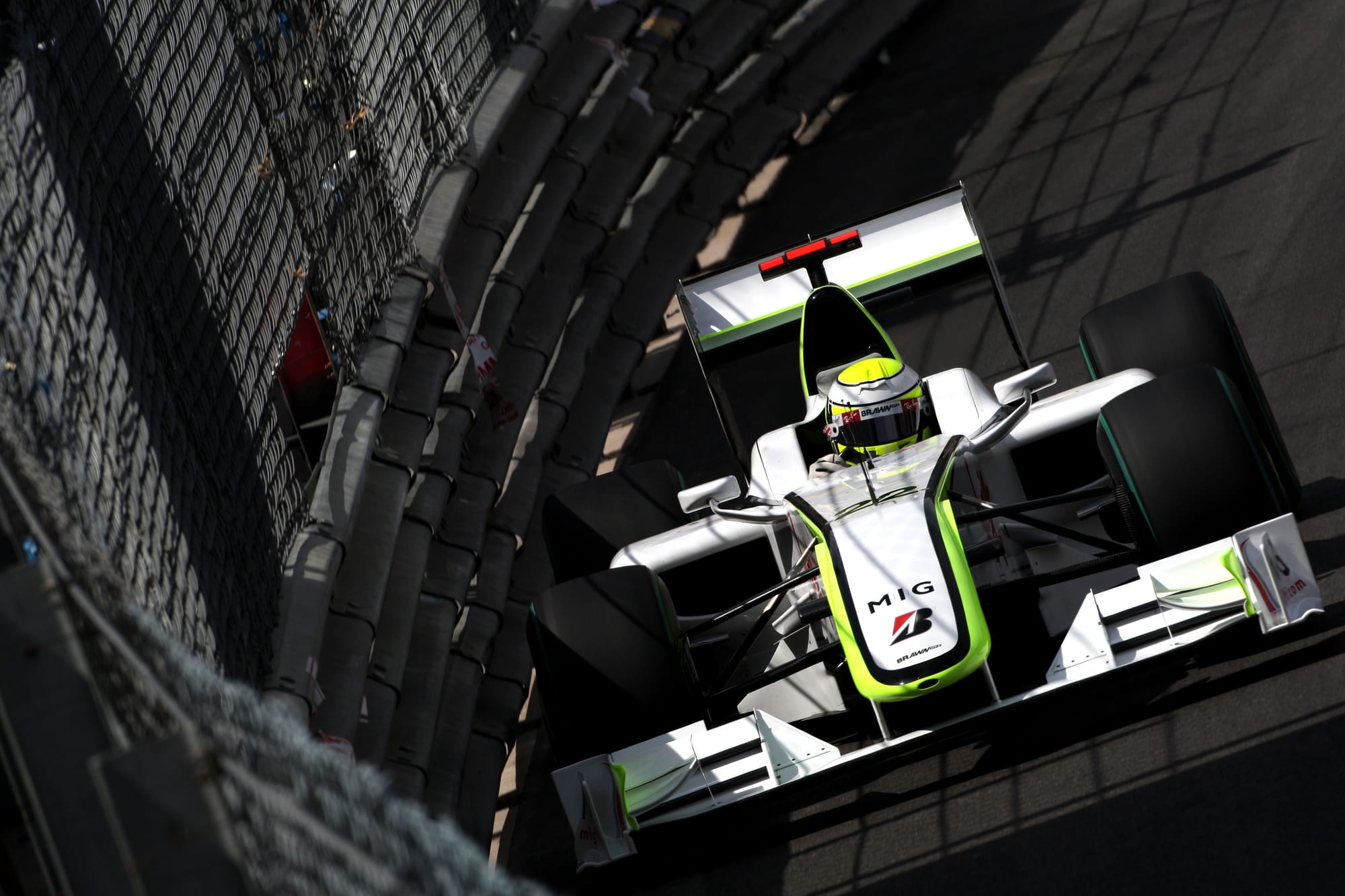
Button stands out probably more than any of the other top drivers in terms of how different his style was.
A "master manipulator" of the car, Button would approach corners with a U-shape - a "beautifully classic style" - by loading the car up with a slightly earlier turn in and smooth inputs.
"Watching him around Monaco in a Brawn or something like that, it was just like poetry in motion," says Hughes.
But while that was the end result, something different was going on unseen inside the monocoque.
"[He was] all about feeling that front end, and high momentum, and using that lovely feeling, that fluency, to maintain big, big momentum. And minimal inputs: you watch him on the steering, [he used] very, very little.
"Also on the throttle: he used to have the very long throttle travel, so he could feel that he could be more precise in that way, and really just match exactly what he's feeling the rear tyres were doing on the surface, to what inputs he was making on the throttle."
Straw, who brought up Stallard's description of Button's style, expands on that further: "We talk about how you use the throttle and the brake to control the platform of the car, to load up the car in different ways. It's a thing that moves in three dimensions and literally, you can give yourself more grip, and drive to that grip when you're doing that.
"So he was actually a master manipulator, and I think sometimes that's underestimated, because people kind of think it was all in the corner approach and entry, and you kind of carry the momentum through. But you carry that momentum through, and that minimum speed, because you can get the rotation and maximise the grip by doing all the stuff he was doing in the footwell, out of sight."
"And he was very, very adept at just moving the weight through the four corners of the car, the four contact patches of the car, and feeling when he needed to move the weight from one side to the other, and one end to the other, and that's what he was doing with all that fancy footwork," adds Hughes.
The limitations
Despite his prowess in changeable conditions, Button wasn't a driver for all seasons (if you'll pardon the expression).
He had a tendency to be oversensitive to the car, spooked by some things that other drivers would barely notice, and front tyre temperatures were among his struggles.
That would manifest itself "very often in qualifying", and often at Silverstone, too. Button never scored a podium at his home race, and that was no coincidence - the track "presented him with things that could trip him up with that sensitivity", says Straw.
Hughes cites the comparison Button made to one of his team-mates: "Even compared to Rubens Barrichello - who wasn't an extreme driver in terms of his style - he [Button] said, 'You look at his telemetry, and when the car has got rear instability, he's got a way of just winding on lots of lock to get the understeer, to sort of tame the oversteer which is going to come'. And he said, 'I lose all reference for the car when I try and do that, I can't do that, I can't keep where I'm at in terms of the rotation'.
"So it did have its limitations, that style, and if the car was at all nervous on the entry phase to a corner, he struggled."
While it was something Button never mastered, it was something he worked on from early on in his career - perhaps quite so explicitly because of the reality check that his 2001 season, when he scored points just once in a recalcitrant Benetton, offered.
"He was, as we said, a driver with a kind of low basement, and by his own admission, he's talked about this a number of times, he wasn't great in a car that didn't work so well, or wasn't [providing] a good balance," says Straw.
"There's an interesting example actually, which tells us a bit more about his learning curve during his career, because he started off with the 2000 Williams, which was quite a nicely balanced car. That was quite good for a rookie, and he turned in some extraordinary performances at times in that year, particularly at the real drivers circuits: Spa, the Esses at Suzuka in particular, where he was astonishing.
"And then he jumped into that Benetton in 2001 that didn't have a great amount of rear grip and instability, all these engine vibrations, and he was absolutely destroyed by Giancarlo Fisichella.
"Not only did he struggle with that aspect of it, but basically from Williams, he'd not really learned how to fettle set-ups and that kind of thing.
"It's the worst year of his career, both in terms of overall results - pretty much overall results, because the car was so bad - but also how he was performing in it, because Fisi had a few highs when he could. But also just in terms of him realising, 'Oh, actually, I need to get really good at the technical side'. Particularly when it comes to the complexities of the aero balance and the aero loading, that's where he really did his clever set-up work."
Check out the full Driving Style Secrets back catalogue here!
Hughes describes this process as Button having to "pull himself off the ground".
"I think he was shocked initially at how poor he was; not just how bad the car was, but how poor he was at dealing with it when he looked across the other side of the garage at Fisichella, who was getting some sort of a tune from it at least.
"And I think that's when he first started to realise that was quite a bit more graft required than he'd been applying. And I think it was already too late to change a lot of perceptions about him, including Flavio Briatore's, but in his second season at Renault alongside Trulli, he'd made a lot of progress.
"He still probably trailed Trulli a little bit, overall, but at least he was fully competitive with him and was occasionally faster, and he was starting to look again like the driver he'd looked in his rookie year at Williams. But I think there was a big information gap there in the first couple of seasons."
The post-title Button
Button's work in that tough spot meant he ended up being a strong technical driver - and, of course, he did go on to lift the world championship in 2009.
But he was accepting of his limitations - even leaning into them, a trait you'd seldom associate with an F1 driver - and that self-awareness is something Straw and Hughes feel was ultimately a strength of Button's.
"I remember interviewing him, it was early in his McLaren stint," says Straw. "And he was quite eloquent on the fact that he's won the world championship, and that was good, and he'd like to win another world championship, but he didn't really care.
"He said, 'For me, it's all about maximising, having those weekends where everything's right'. That almost became the pursuit for him: the pursuit of perfection - not necessarily the best average over everything - and that made him so interesting, because you never knew what you were going to get: one week he'd be on pole and dominant, the next week he'd be qualifying 16th without a specific external problem - just not being able to deal with something."
And that attitude came through the majority of the time.
"I recall once, he was having one of those weekends. We were at the general scrum at McLaren after qualifying and he'd struggled, he'd gone out in Q2 or something like that, and it was to do with...trying to get a good set-up that he wasn't finding, and he was making the rear end nervous," says Hughes.
"I'd been asking him about this, and everybody's tape recorders were there in front of him, and he suddenly, as he's talking, realised that one of them was on play rather than record, and it was mine. And he said, 'That's on play'. And then he just laughed, he said, 'You're asking me about my technical record, my technical abilities, you can't even switch a sound recorder on'.
"It didn't detract from his mood, even when he was struggling, he was always good company."
Want a taste of what to expect from a full episode? Season three of Driving Style Secrets is all about 21st century greats, starting with Fernando Alonso - an episode you can watch in full below!