How 'new' F1 game has included big 2026 quirks
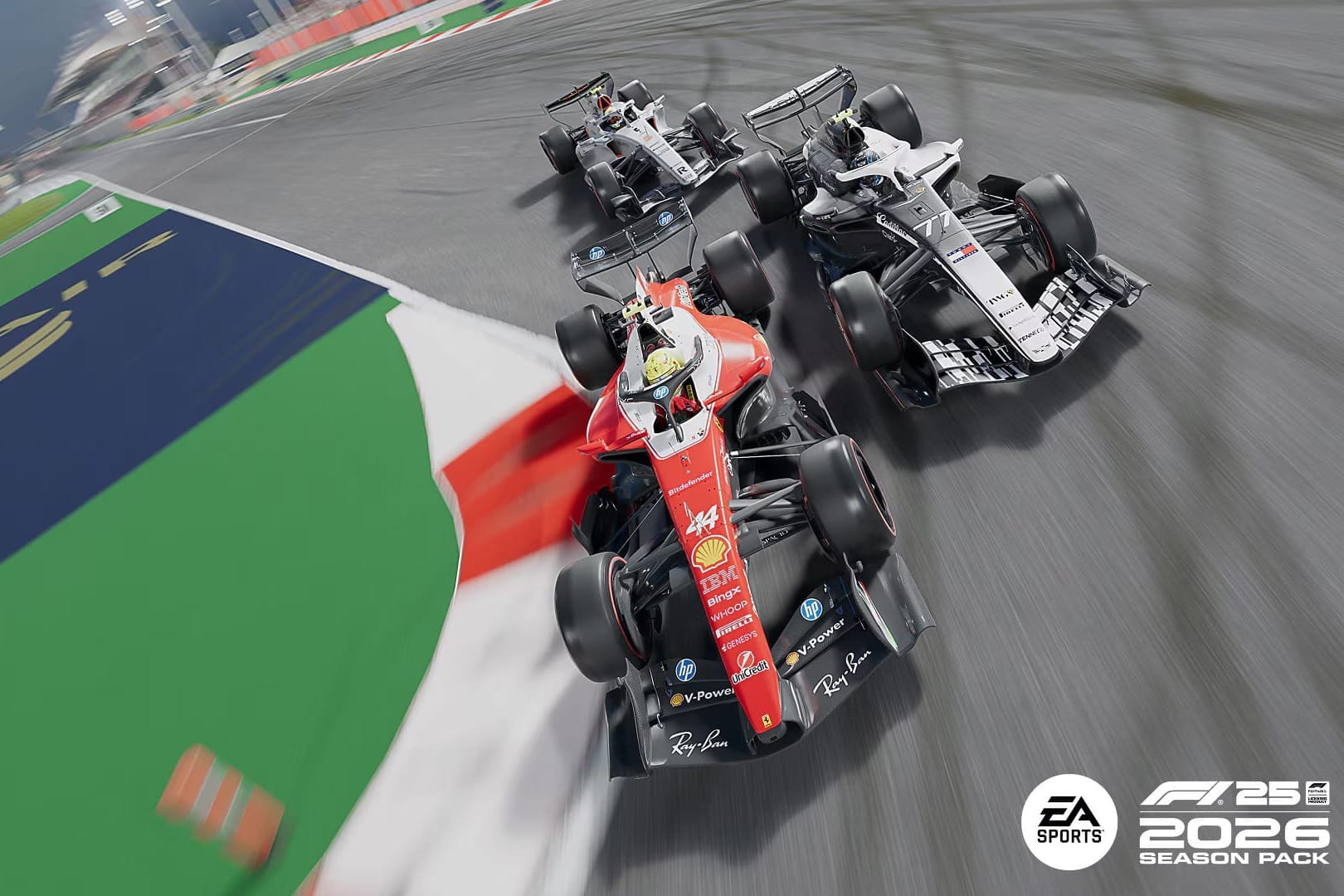
EA and Codemasters have the unenviable task of recreating this year's divisive Formula 1 cars for its 2026 season DLC to F1 25.
We've had a hands-on look at the 2026 season pack ahead of its June 3 launch and can now give our thoughts on how this new generation of cars has been implemented into the game.
To answer what is possibly the biggest question: super clipping is a factor with the 2026 cars in this season pack.
As was seen in real-life at the Japanese Grand Prix, on the run towards Spoon Curve and 130R, the drop-off in speed is noticeable at the end of the straights as energy is harvested and your battery fills up. The drop is severe enough that you lose roughly 20mph rounding 130R while flat-out, and if you're playing with automatic transmission it will decide to change down a gear.
Whatever your opinion on that aspect of F1 in real-life, it is commendable how accurately super clipping has been replicated in the game.
Another new addition is the overtake mode - the de facto replacement for DRS that allows drivers to override the normal energy deployment drop-off to help pass another car if you're within one second of it at the activation zone.
Functionally, this exists in the game as effectively a supercharged version of the pre-existing boost mode to the energy recovery system (ERS). If you have overtake mode then the battery meter on the heads-up display changes from yellow to blue and you'll notice a profound increase in power when you or another driver activate it.
It is not uncommon for the lead car in a pack to be overtaken by multiple cars down a straight in the 2026 season pack, such is the effectiveness of the overtake mode. This includes the start-finish straight at Canada which, given what we saw on track last weekend, shows the overtake mode is more powerful in the game than it is in real life.
Conversely, you will not want to use too much energy as dropping to 0% charge will bring you to a relative crawl and you could be easily overtaken by any cars behind.
When you're within a second of another car and therefore without overtake mode, the ERS functions as it does with the 2025 cars, with the ability to manually use the regular energy boost whenever you want.
As is to be expected with the new power units for this year, energy management is a big part of the driving experience with these 2026 cars. The battery charge fluctuates much more over the course of a lap than it does with last year's cars. However, there is the option to automate the boost and overtake deployments in the assists menu if you'd rather not focus on that while driving.
It's not just about when to activate your electrical energy though as lift-and-coast driving is the optimal approach with these new cars. Although in our experience it is in no way essential to do so if you play the game more casually and without the desire to chase the ultimate laptimes.
No doubt though that all Esports drivers will be optimising their lift-and-coast technique as you are rewarded with more energy and ultimately faster laptimes. For better or for worse, it is a faithful implementation of what has become an increasingly important driving skill in F1.
The other major change with this year's cars is the straight and cornering aero modes. Naturally these have also been implemented and function the same way as DRS did previously.
Cornering mode is active by default, with straight mode activated with a button press when in the zone and automatically deactivated when out of the zone or when you brake. Given how many more times you'll have to activate straight mode than you would DRS, it is convenient that there is an assist to automatically turn on straight mode for those who prefer not to have to deal with it.
But not every aspect of this year's ruleset has been added to the season pack, at least in the preview build we tried out. Most notably when it comes to race starts.
There seems to be no variation between the teams when it comes the speed at which they get off the grid. So driving the Ferrari won't necessarily mean you jump up a few places at the start.
Likewise, the pre-start procedure before the actual start hasn't been included, although since in the context of the game it would only serve to delay the race start it's not a huge loss.
There's also no way to change where on the circuit you use your electrical deployment. Again, not a huge omission but as there have been occasions this year where teams have deployed their energy at different parts of the track it would've been great to include. It could at least be the basis for a new practice programme in career mode for F1 27.
Finally, there's handling changes for this smaller and lighter generation of F1 cars. They also have around 15% less downforce in the game than the 2025 cars do.
Inherently though with this being built on top of F1 25 there's not a huge difference in how the cars feel to drive. In our experience, you'll notice the reduced downforce at some tighter, medium-speed corners, Dunlop Curve at Suzuka being a good example.
The other major addition with the 2026 season pack alongside the new cars is the Madring circuit. Unfortunately that wasn't available for us to try in the preview build - but it will be included when the DLC launches on June 3.