How MotoGP data tech has evolved
Presented by Lenovo
Ducati have established themselves as the dominant force in motorcycle racing in the past years, thanks to the success of the Ducati Lenovo Team in MotoGP as well as their world and domestic superbike projects.
But it hasn’t come as a bolt out of the blue - and a key part of the success the company has delivered is due to the work they’ve done specifically to evolve motorcycle electronics and data capture.
The team is at the forefront of development that has seen the very first rudimentary and crude systems evolve into - thanks to their collaboration with partner Lenovo - something that is at the very forefront of innovation.
With that, the team can trace a direct lineage from the very first Ducati with electronic fuel injection, the 851 superbike, to today’s MotoGP machine.
“At that time,” explains Ducati Lenovo Team manager Davide Tardozzi, “I have to say that Ducati was already ahead of the times with Marco Lucchinelli and the 851. So we immediately recognised that this new system was really helpful and powerful.
“That's why Ducati, I think, since the end of the '80s, was already ahead of its time on technology compared to the other brands.”
However, while it might have been the starting point for what came after, it’s still a long way away from what they’re using these days, according to the team’s head of data analytics, David Attisano.
“At the time, the only thing that was controlled by electronics was the engine,” he told The Race. “In particular, fuel injection.
“But in general, electronics were not so important on the bike. It was the first attempt to make some electronics in the bike. For example, there was no sensor to measure dynamic behaviour.
“So it's very different from the time that we are living in now. The level of data was very, very little, and even the importance of data was very far from now.”
That first started to develop with the debut of Ducati’s most iconic superbike, the 916, and its evolution into first the 996 and then the 998.
Under legendary designer Massimo Tamburini, the Bologna factory started to think more and more about not just electronics, but also aerodynamics, to lay the foundation for today’s MotoGP machines.
“That generation of bikes introduced some sensors and electronics about the dynamic behaviour of the bike,” explained Attisano.
“I think this is the first bike that is going forward to a new era in which electronics change the behaviour of the bike, though this change was only related to the engine and not the dynamical behaviour, so there was no traction control and so on.
“But of course, the rider could give feedback to the engineers, and the engineers could see in the data the effect of some changes in setup. It’s the first time that we have a link between engineers and rider in a certain way. But the amount of data was very little; we talk about some megabytes for every session!”
That soon changed, with the arrival not only of Ducati’s MotoGP project at the start of the four-stroke era, but also with more computing power on hand to process the data that could be captured.
By the time Attisano joined the factory in 2004, he says they were working in a radically different way from only a few years before.
“Between 2005 and 2007 we introduced a lot of engine controls, bike controls, and so on,” he explained.
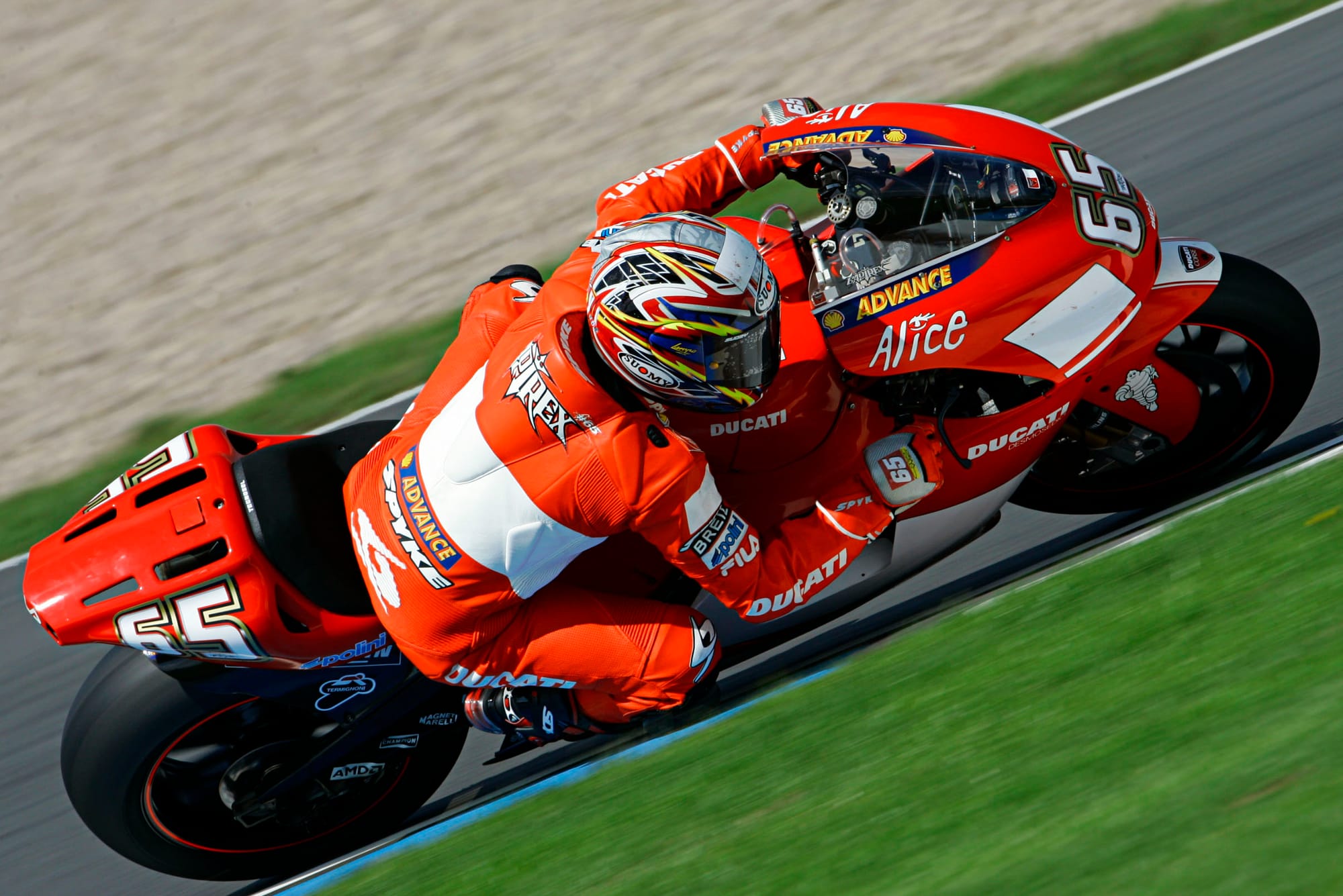
“I joined Ducati in 2004, at the very beginning of the MotoGP programme. I went through all the passage from the first bike that was very user-unfriendly — for temperature, for the comfort of the rider, and so on — step by step.
“In the last bikes of the 990cc era, in 2006, we arrived at a bike that was much more comfortable, although we cannot say comfortable at all, because it’s MotoGP, and the rider could have the aids of the electronics in terms of traction control, wheelie control, and in particular the throttle body that was controlled by electronics and not by the hand of the rider.
“It’s a huge step even for the confidence of the rider. I think it is the first very modern MotoGP bike. In terms of number of sensors and amount of data, it was more than the Superbike and the first MotoGPs, but not so huge. The huge step in this era was connecting the dynamic behaviour to the electronics.”
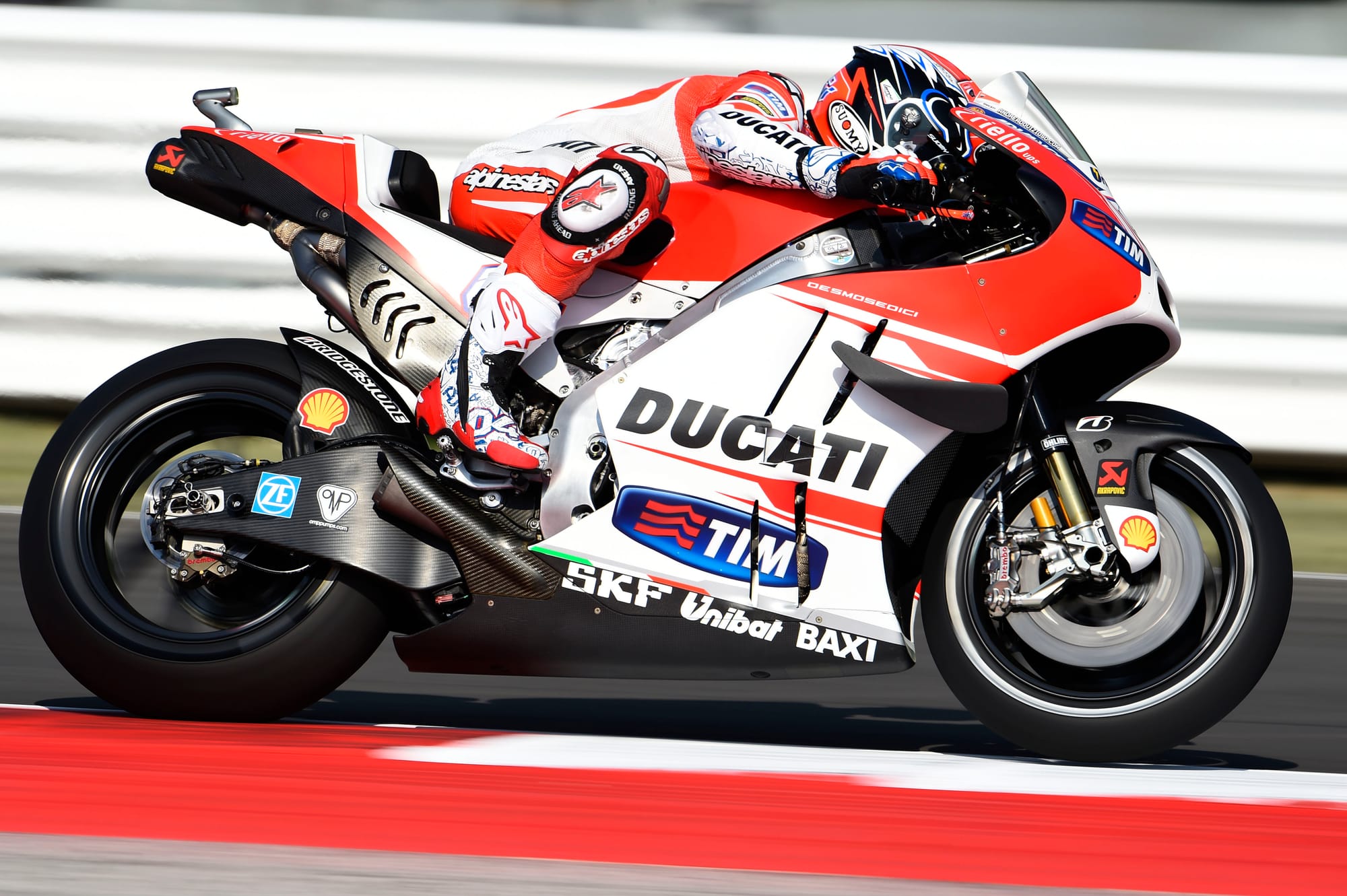
That step arguably peaked with the Desmosedici GP (2015), a bike with the shared characteristics of being both the last MotoGP machine with fully open electronics rules, and the first one built by Ducati Corse boss Gigi Dall’Igna after he joined the company from rivals Aprilia.
The machine that took Ducati back to winning ways after a long absence at the 2015 Austrian Grand Prix in the hands of Andrea Iannone, and the bike that laid the path to today’s dominance, Tardozzi says they knew what they had on their hands as soon as they started testing it.
“The 2015 Desmosedici GP is the bike that Gigi Dall’Igna designed with his engineers,” he said. “The main goal was that we never make revolution, we only make evolution. We were able to keep all the good things of the first bike that was born in a very good way.
“I still remember the first comment of Dovizioso in Sepang 2015. After a couple of laps he came in very serious, took Gigi on the side and said ‘we are ready to win'. The evolution came up every year in a good way.”
However, while it might have been the bike that launches Ducati onto its current winning streak, Attisano admits that the introduction of control software, followed later by the partnership with Lenovo, helped make the current generation of bikes even more advanced.
“We reached some peaks that even nowadays we didn’t reach anymore,” he admitted. “But for our job it was a kind of gate because we changed our approach.
“After the unified control software in 2016 and the change of rules about the tyres, we had to change our mind. We were forced to understand that we can do something even if the software is not our own.
“From that point on, we did a lot of simulation before the races and not during the races, a lot of post-elaboration of the data for offline analysis, and a lot of virtual sensing.
“At the beginning of the change of rules we had these needs about power calculation, but we didn’t have a partnership with Lenovo yet. Now, the partnership with Lenovo gives us the possibility and the capability to do what we could ever imagine before.
“The amount of data became very critical, with all the calculations, virtual sensing, and so on. The partnership with Lenovo in developing our department and our approach to the races became fundamental and crucial for our success in the last years.”
With that partnership now far beyond any sponsorship deal, but instead one that sees Lenovo as a key member of Ducati’s winning team in MotoGP, it means the team can do things that Ducati’s first generation of engineers could only have dreamed of.
“The number of sensors is not very high, around fifty, because the list of additional sensors is limited and deposited at the beginning of the year,” Attisano explained.
“But the dimension of the data has had an incredible increase. Nowadays we produce around one thousand virtual sensors, and with six riders and twelve bikes (six on track at the same time) we produce around one hundred gigabytes of data per weekend.
“That was impossible in the years before without the technology infrastructure that Lenovo supports us to install and maintain. We are scaled about one thousand times the data compared to the first bikes equipped with electronics. You can imagine how much work we have to do to analyse them.”
With a radical new rule change coming in 2027, that will in many ways see bike development set back somewhat in an attempt to slow them down and improve safety, the veteran engineer says that this simply makes the work of the electronics and data department more important than ever.
“I think that from the side of the rules and the bikes it is not a real revolution,” he explained. “There are changes, a step back in some aspects like ride height devices being banned, change of displacement, but in terms of technology the engine is quite at the same level. The impact is not so much.
“But we will have less performance overall, so simulation and calculation are fundamental. We are introducing a lot of technologies that in the past five years were not at our disposal, for example artificial intelligence and machine learning. This is a field in which we are developing a lot. Lots of exciting times ahead.”