Where Red Bull stands in tackling overweight car problem
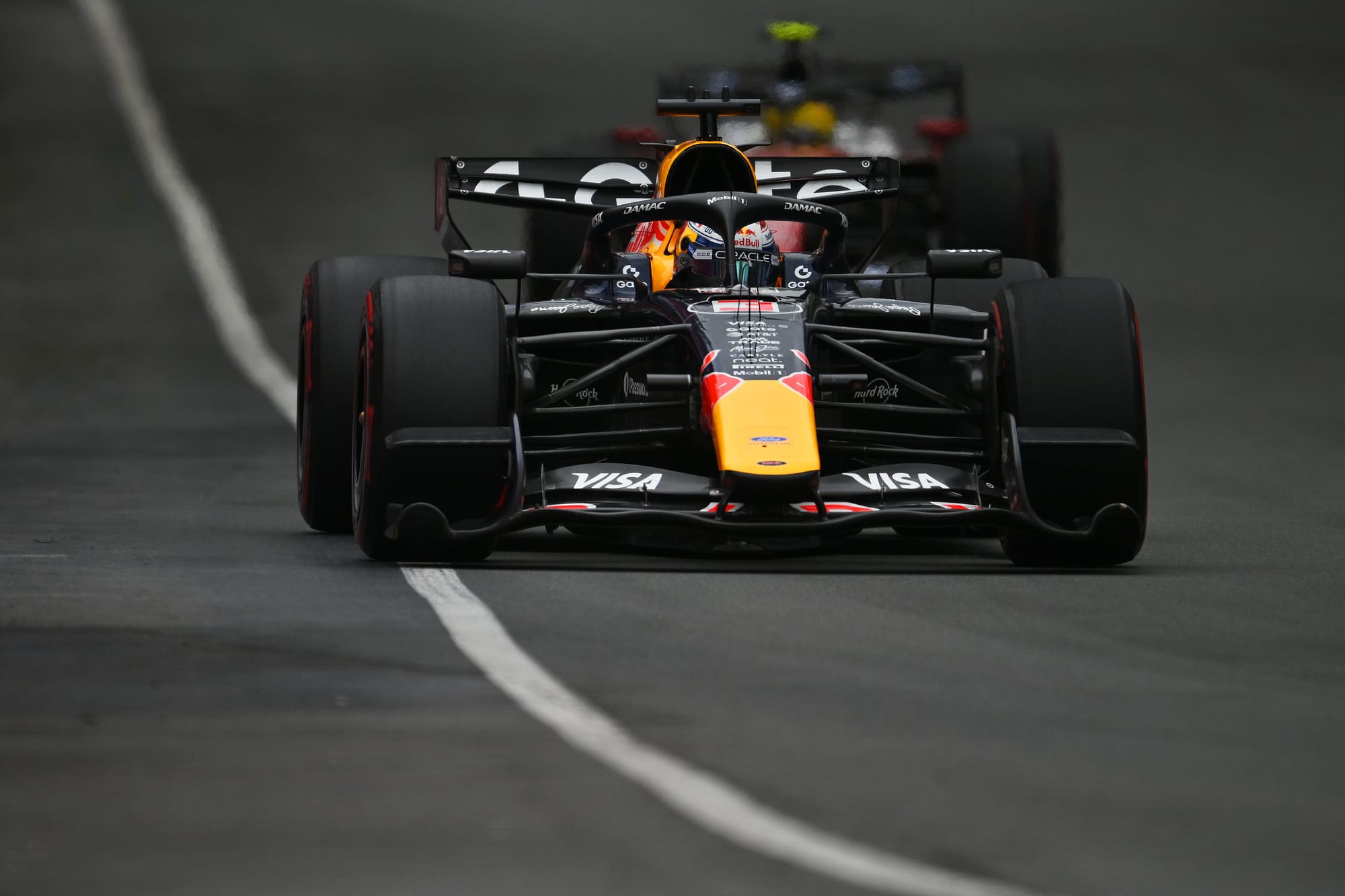
Red Bull may face challenges getting on top of some "complex" problems with its RB22 design, but the quickest route to closing the gap to the front in Formula 1 could be a simpler one.
Max Verstappen and Isack Hadjar have had a tough time on occasion as Red Bull tries to resolve balance and handling difficulties with its 2026 F1 challenger.
Team principal Laurent Mekies admitted earlier this year that the squad was "wrestling" to understand what was happening at times as it focused on tweaks for Miami that would help deliver more of a consistent platform.
But, despite some signs of progress, with Verstappen taking a front-row start in Miami and the team's first podium of the year with his third place in Canada, Red Bull knows that it still needs a lot more before it can think of challenging the dominant Mercedes team.
Sources close to the team have said that the performance profile right now is being clouded by the RB22 being overweight - potentially costing it around two tenths of a second per lap.
While those sources would not reveal exactly how many kilograms too heavy the car is right now, a 0.2s deficit would point to it being somewhere around 6-7kg over the 768kg minimum.
Having started the year believed to be even heavier than it is right now, Red Bull made a big step in Miami in getting some mass off the car - with a further leap expected for its home race in Austria in late-June.
Ending the risk approach
Beyond the pure physics of the deficit a heavier car brings, Red Bull is well aware that if it can get close to or even under the weight limit, then that will bring other performance benefits too.
One tool that teams under the weight limit have is the ability to move car ballast around, which can help with the centre of gravity and the car balance, bringing gains in terms of handling and tyre management.
Another element is that because Red Bull knows it has a car that isn't a match in pure pace terms compared to its main rivals, that at least opens the door for it to take more risks with aggressive set-ups in a bid to punch above its weight.
Sometimes this can work in bringing extra performance but, equally, there are times it backfires and leaves the drivers fighting handling characteristics that they are not happy with.
This is what Mekies suggested happened in Canada, where Verstappen bemoaned handling problems with the car, especially in qualifying.
Speaking about this approach, Mekies said: "We take risks every time we don't feel we are at the right balance, or at the right gap to competition.
"When you do take risks like that, you do explore set-up directions, with both cars.
"Then we improve our understanding of the car, what is working, what is not working, what is bringing something for quali, and what is bringing something for the race."
The hope is that if Red Bull improves the performance of its RB22 and closes the gap to the benchmark Mercedes, it won't need to take as many set-up risks and will reach a more consistent level.
The kerb and bumps issue
While finding a couple of tenths of a second from taking weight off will lift Red Bull up into the chasing pack behind Mercedes, it knows that other elements need to be sorted too.
One aspect that it has historically struggled with - and that flared up in Canada and is likely to be a factor in Monaco this weekend as well - is a difficulty the team has long had with kerbs and bumps.
Mekies admitted that while dialling out problems with bouncing over kerbs was straightforward in itself, the challenge really comes from doing it in a way that does not give up laptime.
"The guys are doing all the analysis in the world back at the factory to try to come up with a solution that not only fix the issues, but fix the issues by bringing lap time," he said.
“It will probably be quite easy to fix the issues, but it would make the car slower. So you want to fix the issues and to bring laptime. It's a complex issue, but we love complex issues.
"We have plenty of them and I have every confidence that in the same way that we have cracked quite fundamental issues since the beginning of the season, we will be managing to do a few more."
Asked if these were things that could be dialled out of this year's car, or whether that was a project for next year and beyond, Mekies said: "There is nothing yet that we are saying cannot be fixed in '26."