Why McLaren is suffering more as a customer under new rules
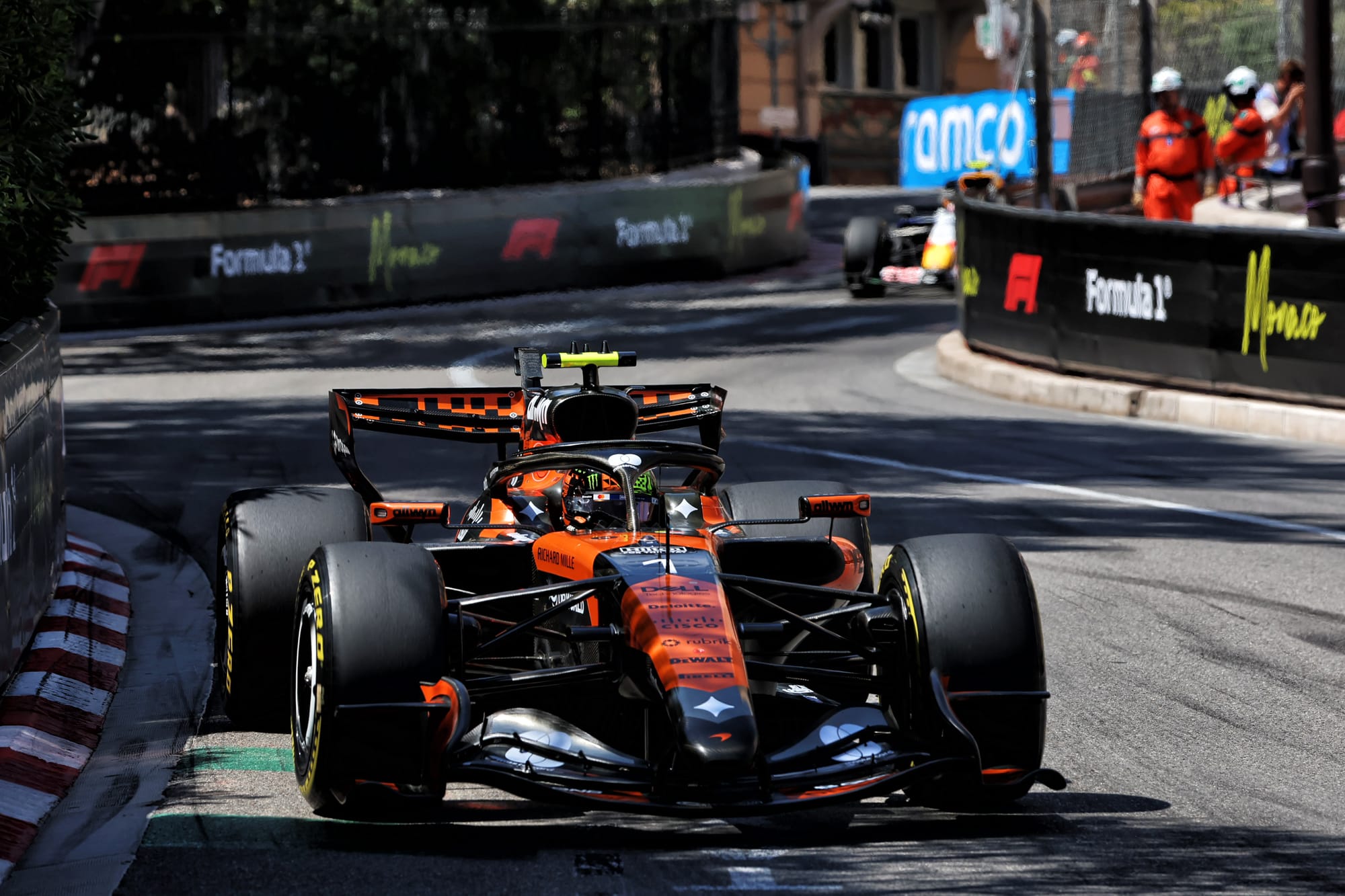
McLaren feels that it is suffering as a customer team for the first time as the consequences of not being Mercedes’ works team become clearer in Formula 1’s new engine era.
Lando Norris retired from the Monaco Grand Prix with an issue related to the power unit, the latest of several technical problems McLaren has endured this year.
After starting the season slightly surprised by how far behind Mercedes it was in understanding how to fully exploit the performance potential of the new engines, McLaren suffered a double pre-race electrical problem in China that meant neither driver could start the grand prix there, and Norris required a new battery in Japan despite only switching to a new component at the start of that event.
Some of the problems have been McLaren’s own doing, like the gearbox problem that forced Norris to stop during the previous race in Canada too, and McLaren team boss Andrea Stella was keen to stress after Monaco that “we have had issues pretty much in all areas of the car”.
He also said that sometimes engine issues arise from installation problems, or how it is integrated with the chassis, so it is not solely the responsibility of Mercedes High Performance Powertrains.
But he conceded the engine side is proving the most important area for reliability and the tough start has led McLaren to conclude this is the first time it has really been on the back foot for being a customer, not a works team.
“We understand these reliability issues in isolation,” said Stella. “We can fix them.
“But obviously, when you have so many issues, it may be symptomatic of the fact that the project is still relatively young.
“Never before we felt that being a customer team has put us on the back foot. And when I say this, and I want to be clear here to avoid any misunderstanding, it's not because you are a lower priority for HPP.
“It's because you have less opportunities to integrate, to stay on the same timeline when it comes to addressing reliability problems or exploitation of the power unit from a performance point of view, combining the efforts when you use the facilities and you have some experiments on the chassis side that you can add to a long run of the power unit when you are a works team.
“There's many reasons why reliability associated to the power unit - or taking advantage of being a works team from a power unit point of view - these reliability issues have made it into 2026, where we had such a large technical regulation change.”
Mercedes HPP is aware its product has not been robust enough for a customer, as there is obviously no intention to provide an engine package that does not work reliably, so this is something that it is trying very hard to understand and improve.
However, McLaren is inevitably behind Mercedes’ own team in the pecking order when it comes to performance and reliability optimisation, because customer teams will always end up second when it comes to using the available time and resources.
And a better package in terms of performance and reliability at the start of brand new engine rules is ultimately the reward Mercedes gets for committing to and funding a full works F1 project.
Will McLaren build its own engine?
McLaren became the first customer team to win a world championship in F1’s hybrid engine era when it won the constructors’ title in 2024, then did the double in 2025.
Prior to that only works engine partnerships had been successful, with Mercedes dominant early in the V6 turbo hybrid era then Red Bull coming to the fore with its works Honda deal.
That success defied many expectations, even those of former McLaren leaders like Ron Dennis, which led to McLaren's ill-fated Honda union from 2015-2017.
McLaren then felt there was no reason to expect it would slip back in a brand new engine rules era in 2026.
However, that success came against the backdrop of a multi-year engine homologation freeze and power units that were vastly well understood, which made customer deals much more favourable and effectively allowed McLaren to operate as a pseudo works team.
McLaren still has a seat at the table to discuss design details with HPP, and describes the working relationship as fantastic.
But the 2026 engines being so complicated, mixed with unforeseen issues arising, means that being the number one priority on communication, collaboration and dyno work may have conferred greater compound gains for Mercedes than McLaren had initially anticipated.
To avoid this longer-term, McLaren could, of course, pursue its own engine deal.
It considered a works partnership with Audi when the German manufacturer was assessing its options to join the grid but opted against that because Audi wanted to own the team.
Rival team Red Bull has now created a blueprint for an independent team to commit to its own engine project entirely, building the Red Bull Powertrains division - which then picked up backing from Ford - to develop its own in-house F1 engine for the first time for this year.
That project has, controversially, been judged as having F1’s best internal combustion engine for the FIA’s additional development and upgrade opportunities system (ADUO), scored its first podium in Canada last month, and qualified on the front row in Monaco last weekend.
Committing to an engine division was a massive undertaking from Red Bull and, similarly, would require enormous investment from McLaren’s shareholders or the buy-in from a third party, as it could collaborate with an automotive manufacturer.
McLaren Racing CEO Zak Brown has never closed to the door to such a deal and admitted in Monaco last week that McLaren will at least conduct a preliminary evaluation of that route whenever F1 commits to its next set of engine rules for 2030 or 2031.
“First of all, I'm very happy with HPP,” said Brown when asked by The Race if McLaren’s priority is to ensure it remains one of Mercedes’ customer teams for the next era or needs to have conversations about a works programme of its own again.
“They've been a great partner. We've won a couple championships with them, even though everyone said that you couldn't win a championship with a customer engine. So I think we've proven that you can.
“Priority one is to stay with Mercedes. They've been a great partner.
“Anytime a new regulation comes out, we'll take a look and see, is it something technically that's interesting? Is it something fiscally that makes sense?
“We'll go through that process when that happens.
“But I think sitting here right now, we're extremely happy with Mercedes and we anticipate continuing with them.”
McLaren has 'long list' to review

In the meantime, McLaren is thoroughly reviewing how it works with HPP to see how it can make processes as robust as possible within a more conventional customer team reality.
Asked by The Race how reliability may be better understood or improved given it was already a priority - for example, by working differently or more intensively with HPP - Stella said: “The great relationship allows us to review item by item, learn from each item and solve it technically.
“But when you don't know what's coming, it's not sufficient to simply address item by item.
“You need to review ultimately the depth and the intensity and the effectiveness of the various meetings, engagement, sharing of information, processes, both from factory to factory, track to track, track to factory and so on.
“So the review that is ongoing is in a way, punctual in terms of each item by item, but it's also a wider review because in 2026, there's so much novelty, there's so many new things.
“We kind of have to operate at a new level of collaboration compared to what we were doing before.
“These conversations have already started for some months now. But like everything in Formula 1, there's always a lead time. It's not like you see the effect the day after you instigate.
“So this is already happening and is relatively wide as a conversation.”
McLaren has also not hidden from the fact that, aside from reliability, its car is simply not as good as Mercedes’ yet.
Its gap to its engine supplier has ebbed and flowed this season but the momentum McLaren had built across Japan, Miami and Canada - where it emerged as Mercedes’ best challenger and even won the Miami sprint race - abruptly ended last weekend in Monaco.
There, its car weaknesses were brutally exposed, and Stella admitted that there must be a “turnaround” in performance as well as reliability if McLaren is to pull itself back into an unlikely championship fight by the end of the season.
Stella described the last two race weekends as providing an “important reality check” for the team, which now needs to replicate its in-season turnaround in 2024 - when it started the season well behind Red Bull but ended it as F1’s best team and managed to win the constructors’ title.
“There's a long list, performance and reliability,” Stella said.
“We remain obviously with the mindset that this could be another 2024 in terms of catching up at the end.
“But in 2024, our trajectory from reliability and performance was more convincing.
“So if we want to stay in the championship, we need to have a turnaround.”