What Hamilton's first Ferrari GP win means for F1 - our verdict
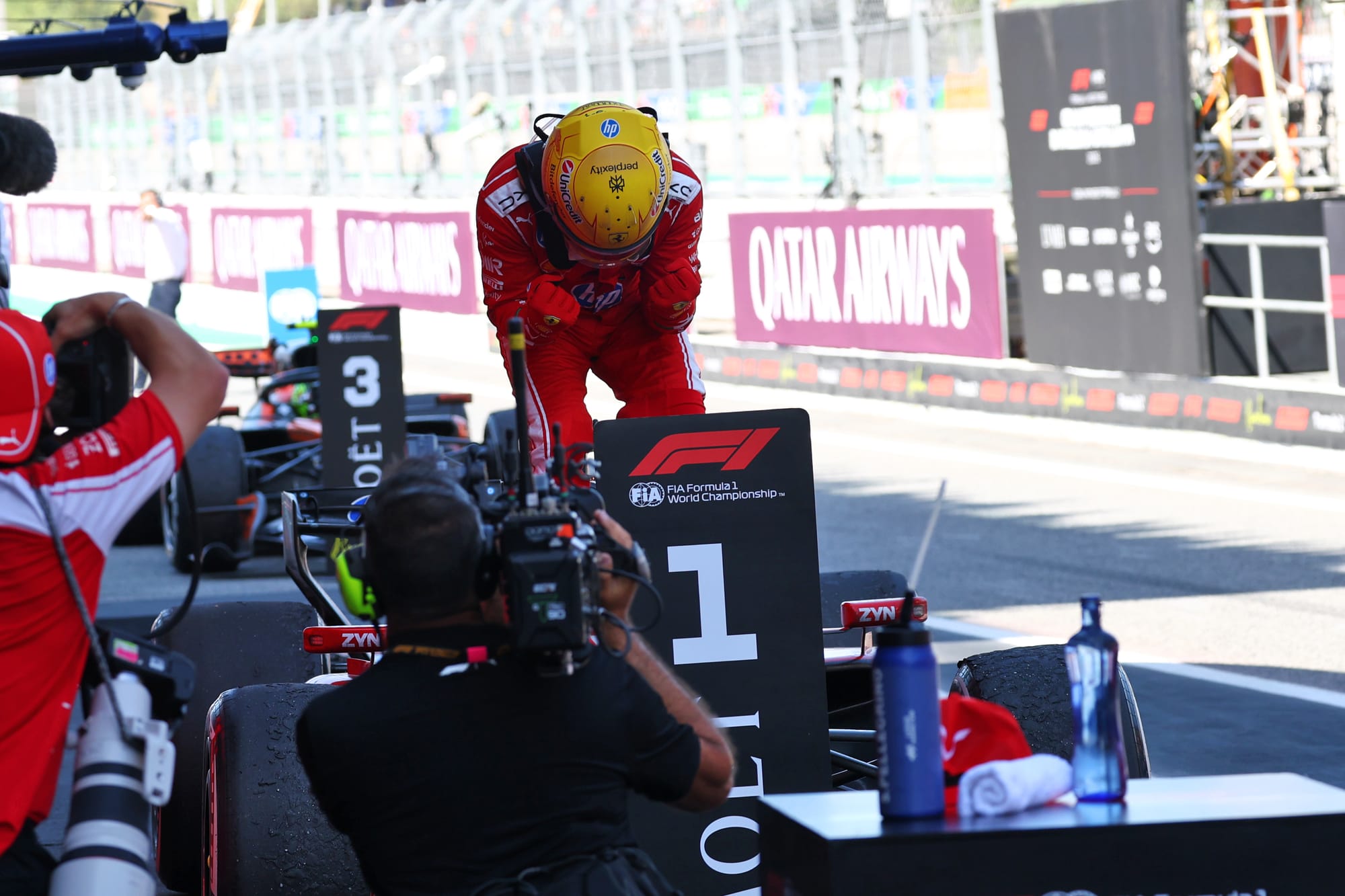
Lewis Hamilton is a Formula 1 grand prix winner for Ferrari - an outcome that seemed for much of their first season together like it was never going to happen, but has felt ever more realistic in recent weeks.
Here's our take on what the Barcelona result means for Hamilton and F1.
Questions have moved from retirement to title contention
Josh Suttill
Another season like 2025 this year would have ended Hamilton's F1 career on a bitter note.
Instead he's proved me - and many others - wrong with a number of impressive weekends this year.
I still have some small caveats; we've had a lot of Hamilton's favourite circuits and a lot of Ferrari team-mate Charles Leclerc's least favourite. Plus Leclerc's been plagued by brake issues.
But they're caveats that can only be applied to the question of whether Hamilton is a title contender. (Plus the obvious: is his Ferrari fast enough?)
The retirement questions should be silenced by the surest sign yet that something closely resembling the Hamilton of old has returned.
His late-braking prowess has finally returned to form in Montreal and here - and that appears to mesh perfectly with the upgraded Ferrari.
A title-winning combo? It's far too early to say. But it's remarkable that it's now become a real possibility.
Hamilton doubled down - and it paid off
Scott Mitchell-Malm
This is an exceptionally good result for F1, especially amid Mercedes' domination. It's packed with emotion - if you can't enjoy wins like this, you need to go out and touch some grass - and there's a great human and sporting story behind it.
At no point after China last year did this union ever look like it was on a trajectory leading to a win. Hamilton had self-doubts, even if he insisted his faith in Ferrari was undimmed.
And the prospect of brand new rules freeing him from limitations specific to the ground-effect era was a hypothesis rooted in hope rather than expectation - even for Hamilton at times.
It's fair to conclude that these rules are kinder to Hamilton than ground effect ever was, and allowing him to perform more consistently at his best. It has to be considered a blot on his copybook for not adapting better previously, but evidently the peak is still pretty high!
Hamilton and Ferrari deserve immense credit for this. They've doubled down rather than wilted under the pressure of making it work. Engineering changes, brake configuration changes, self-analysis: it's all added up to make this possible.
And no matter what happens from here, Hamilton's Ferrari move cannot go down as a failure. It is now at least as good as his last Mercedes chapter and even if this represents the peak, it is still a much more satisfying pay-off than retiring at any point between 2022 and 2024.
Hamilton and Ferrari both proved big points
Gary Anderson
For Hamilton, winning a grand prix for Ferrari is probably even better than any of his other 105 wins.
The other thing is that it was a team win. The Ferrari strategy - which we have questioned on many occasions - was working out well, although the virtual safety car did make things just that bit easier. But that aside, all weekend, and even in the last few races, he has shown signs of getting back to his old ways.
Hamilton said lately he was going to go into each weekend less reliant on any simulator work and just following the path that running the car over the practice session was leading to and developing the set-up around that. It's definitely working for him so I suppose thats brings into question Ferrari's driver-in-the-loop simulator system. Improving that might be another step the team can take.
Ferrari brought quite a few developments to Barcelona and Hamilton paid the team back for its efforts in the best way he could.
Mercedes' safety margin is vanishing
Valentin Khorounzhiy
Across the power unit failure for George Russell in Canada, the horrible unravelling of Russell's Monaco race, and now the Barcelona retirement for Kimi Antonelli, Mercedes has been taking a blowtorch to whatever margin of error it has in F1 this season.
It feels like you win a title brick by brick and you lose it in big chunks. That's not really true but the fact is, it will likely take Antonelli a couple of wins to offset today in the points, and it may well take Russell all season (even if he's much better from here on out) to recover the points blow from his run of difficulties.
Ferrari has brought a serious chassis this year, and the 'ADUO' ranking revealed in the build-up to Barcelona suggests - as expected - that it will get a legislative leg up in terms of engine development this season versus Mercedes.
So there's every chance we have passed the peak of Mercedes' 2026 dominance, but there's another 15 rounds to hang on for. Mercedes and Antonelli are still favourites but you have to wonder whether we'll look back at this stretch of the season a few months on thinking 'they didn't make enough of this early advantage'.
Unhappy ending avoided
Matt Beer
Hamilton joining Ferrari was such a good story. But when he signed that deal there was really no guarantee at all that it was going to be a story with a happy ending.
Hamilton had looked a shadow of himself for so much of the post-2021 period. He was going up against a very well established and ferociously fast Leclerc.
His Ferrari move had a strong chance of falling flat - and until very recently it seemed it would. Shanghai sprint win aside, most of 2025 just looked like the Ferrari stint would be a pretty lacklustre postscript to such an extraordinary career.
From a neutral perspective, it was great that the rise of Max Verstappen and resurgence of Red Bull ended the era of the F1 default being that Hamilton and Mercedes were favourite for every race - that just wasn't much of a narrative. But the 2022-25 woe was not how the Hamilton story deserved to end.
I hate seeing any all-time sporting great's career fizzle out. I'm a big fan of a 'quit while you're on top' approach and feared Hamilton had missed his moment.
Now it's definitely worth him hanging on a little bit longer.
Reminiscent of Vettel's big Ferrari moment
Glenn Freeman
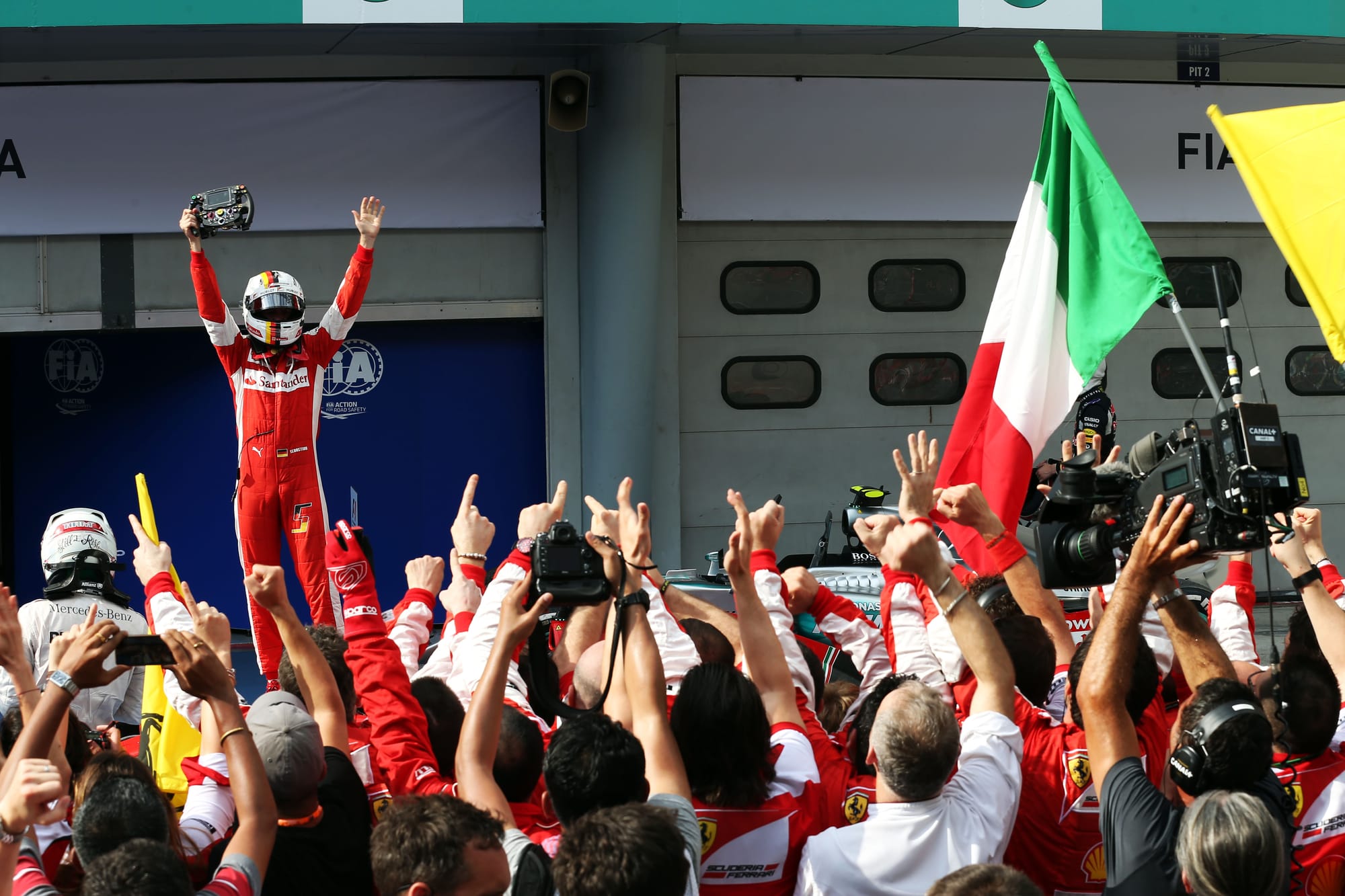
Hamilton's first Ferrari win has a lot in common with his old rival Sebastian Vettel's back in 2015.
Vettel's maiden success in red - which admittedly came a lot sooner than Hamilton's, on just his second start for Ferrari - came against a dominant Mercedes duo that people feared would be unbeatable. But on a hot day in Malaysia that opened up the possibility for strategic variety, Ferrari not only made the right calls on the pitwall, but Vettel then had the pace to keep the Mercedes cars at bay. The same goes for Hamilton.
Could he and Ferrari beat the Mercedes drivers in a straightforward one-stop race where tyres are less of an issue? That's a question that's still to be answered, but in a race where teams had real strategic choices to make and tyres were tough to look after, Hamilton had the Mercedes beat fair and square.
Vettel's 2015 win was a much-needed shot in the arm for F1 early in the hybrid era when Mercedes appeared unstoppable. Hamilton has just done the same.
Russell's strategy opened the door
Ben Anderson
There was a race a couple of years ago here where Oscar Piastri really struggled and at the time couldn't really explain it. It was a typically hot Barcelona race where tyre degradation dominated.
This year we saw something similar, though more extreme, with Piastri again totally unable to live with McLaren team-mate Lando Norris on race day.
George Russell's afternoon ran along similar lines, at least once his car switched from the medium to the hard, Mercedes' preferred race tyre.
Russell didn't look comfortable on either set, so what was it about that compound - or the way his particular car and/or driving style interacted with it - that made things so difficult?
Russell has talked recently about a natural driving style difference between him and Antonelli that has played more into Antonelli's hands at recent circuits.
As Edd Straw explained recently, Russell has a bit of the Piastris about him when it comes to being less comfortable when the car is moving around underneath him in lower-grip situations.
Barcelona's long sweeps were meant to suit Russell better. Up until the end of the first stint of the race that did indeed seem to be the case.
I wonder if the extreme heat combined with the need to extend the final two stints to make Mercedes' preferred two-stop strategy work, after an early stop to ditch the mediums, just turned this into a race of rear tyre overheating and sliding - which is something Russell's style can also worsen.
We also heard him demanded more front wing at one stage, complaining of the front axle being too "weak". If he got his wish at that first pitstop that won't have helped him protect those rear tyres.
This is what opened the door for Hamilton to take that historic win for Ferrari. He deserves credit for a brilliant performance, but it was Russell's struggles that opened the way.