Marquez leads calls for MotoGP extreme heat policy
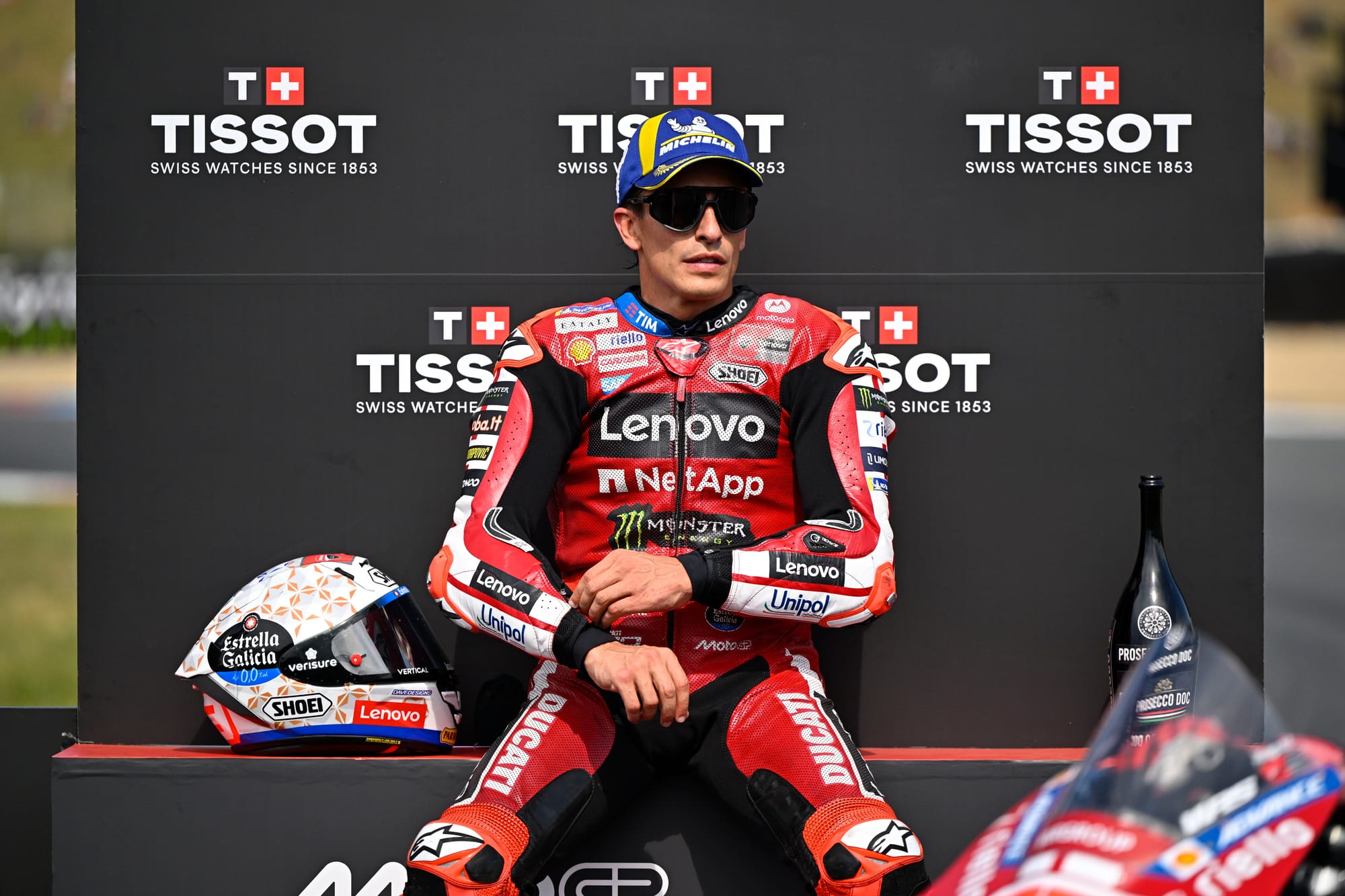
World champion Marc Marquez has led calls for MotoGP to follow Formula 1's lead by introducing some form of extreme weather protocol.
The Ducati racer says he was left feeling drained by the long start procedure before Saturday's sprint race at Brno.
The sprint came at the most extreme moment of the Brno weekend in terms of temperature, with the air temperature reaching 33°C and the track temperature climbing to 57°C just before the start of the race.
With even the sprint race build-up procedure now leaving riders sitting on the grid for 20 minutes with little in the way of shelter, a visibly drained Marquez admitted after finishing third in the race that he is not a fan of the current system.
"I tried to save energy all weekend," he explained, "but then when you are there with 55 degrees in the ground and 35 degrees in the air, waiting there 25 minutes sweating…
"I don't like it. I hate this moment. But it's like this, and I just try to be calm and to save energy."
There have been suggestions multiple times in the past that MotoGP needs to look at F1's extreme weather protocol, introduced in 2023 following a red hot Qatar Grand Prix in which drivers feared passing out.
And the topic was also raised following the sprint by LCR Honda's injury replacement Cal Crutchlow, who says that the physically demanding race conditions need to be addressed.
"It was f***ing hot today," he explained. "It was so hot. And you see all this waiting around. You go to the grid, then you try to come off the grid because it's too hot. It was seriously hot. Like one of the hottest races I've ever done.
"Imagine 20 laps if it was today. And tomorrow is probably going to be the same [temperature].
"In my opinion, they need to start to think about this whole situation a little bit. In other sports, they have weather protocols, they have all these things."
However, Crutchlow says that without a MotoGP equivalent of F1's Grand Prix Drivers' Association, it's going to be hard to find a solution - and the potential for a riders' union remains a sensitive subject in the paddock.
"The problem you have here is the same as always," he continued. "One guy will race, so then everybody will race. And unfortunately the organisation knows this.
"If it was that deep in water, one guy would go out, and even if everybody said ‘we're not going out' then that guy would leave pitlane, then everyone would leave pitlane because they won't stick together.
"Because they don't want somebody to have an advantage or they don't want their manufacturer to say to them, ‘ah, you didn't do that race, so you're not getting paid.' And that's the reality."