The solution to F1's big anti-climax problem
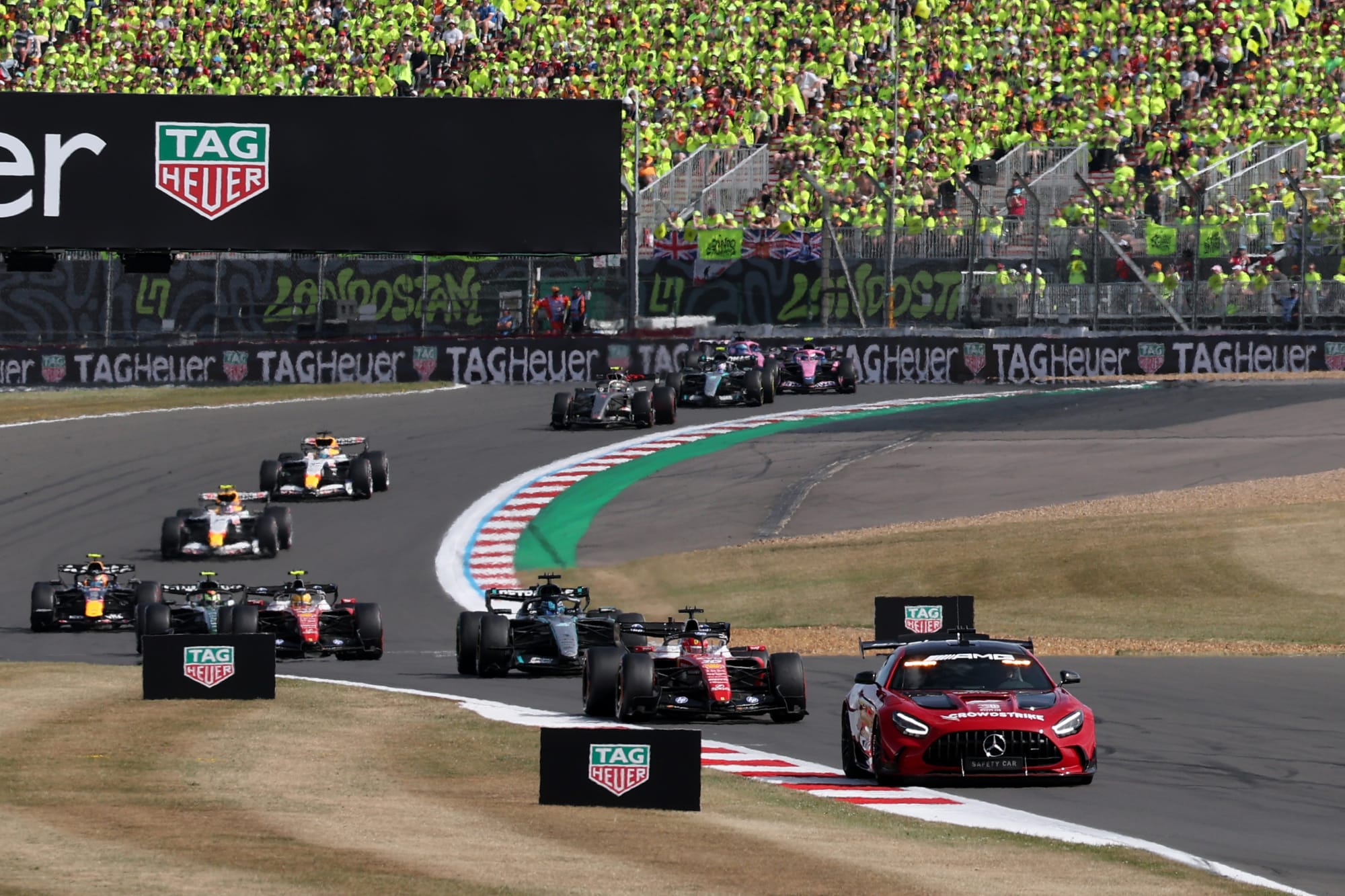
I've always had a fairly uncomplicated view on Formula 1 races ending behind the safety car. If that's what the regulations demand, then so be it.
F1 isn't always supposed to produce a dramatic finish. Sometimes a late accident leaves insufficient time to restart safely within the rules and those circumstances simply deny us one final lap of racing. While it's never satisfying, I've always been comfortable with the thought that sport doesn't owe anyone a Hollywood ending.
To me, F1 has always been a sporting spectacle first and entertainment second. Sometimes the driver who deserves to cross the finish line first doesn't. Sometimes the weather intervenes. Sometimes a mechanical failure decides everything; that's the nature of racing. The moment you start manipulating races to manufacture entertainment, you risk losing what makes F1 worth watching in the first place: pure competition.
But sitting at Club on Sunday at the British Grand Prix changed something. When the safety car was deployed, you could almost see the cogs turning: How many laps remained? Could Max Verstappen's car be recovered quickly enough? Everyone was speculating whether we'll get a single lap of racing to end the race. Then the message appeared on the timing screens: "Safety car in this lap."
The reaction from the crowd was instant. Grandstands that had gone silent suddenly came alive. At least, for a moment. As we watched the safety car come past Club again, what should have been an eruption of cheers was instead replaced by a wave of boos, and the realisation that we would see this race finish under the safety car set in. The atmosphere completely disappeared.
Was the disappointment driven more by the mixed messaging around a potential restart, or by the perception that, from our view, racing could have resumed but the regulations left race control with no way to make it happen? Personally, it was the latter.
People who had spent hundreds of pounds on tickets and travelled across the country (and the world, in some cases) to watch what is always an exciting grand prix at Silverstone from start to finish were instead left watching the field circulate in formation until the chequered flag.
No, I don't suddenly believe that F1 should abandon its integrity. But I believe that F1 has reached a point where it can protect its sporting principles while doing a better job of delivering an actual sporting finish. It's not an argument for gimmicks; it's an argument for removing unnecessary delays that stop racing from restarting.
The obvious answer is the handling of lapped cars. Under the current regulations, allowing backmarkers to overtake the safety car often adds another lap before racing can resume. It's understandable, to an extent, why this rule exists. But it's also incredibly inefficient when only a handful of laps remain. Ultimately, it means prioritising backmarkers over both the leaders and the fan experience.
It's hardly a revolutionary concept, but could those cars instead be directed through the pitlane? They would still rejoin behind the lead-lap runners, the order would still be corrected and, while those lapped cars wouldn't have the opportunity to unlap themselves and bring themselves back into contention, it could be argued that those cars have effectively driven themselves into that disadvantage by being lapped. Valuable time could be saved and it would give race control every possible opportunity to restart the race without creating artificial drama.
I'm sure purists would argue that this is entertainment taking priority over sport, but being in the crowd at Silverstone made me realise that perhaps we've been treating these outcomes as unavoidable when they're increasingly a product of procedure.
We don't need to choose between sport and spectacle; we don't need to settle for anti-climaxes, not if F1 can give itself every possible chance to deliver both with a practical solution.