Mercedes makes software fix after Spa problems
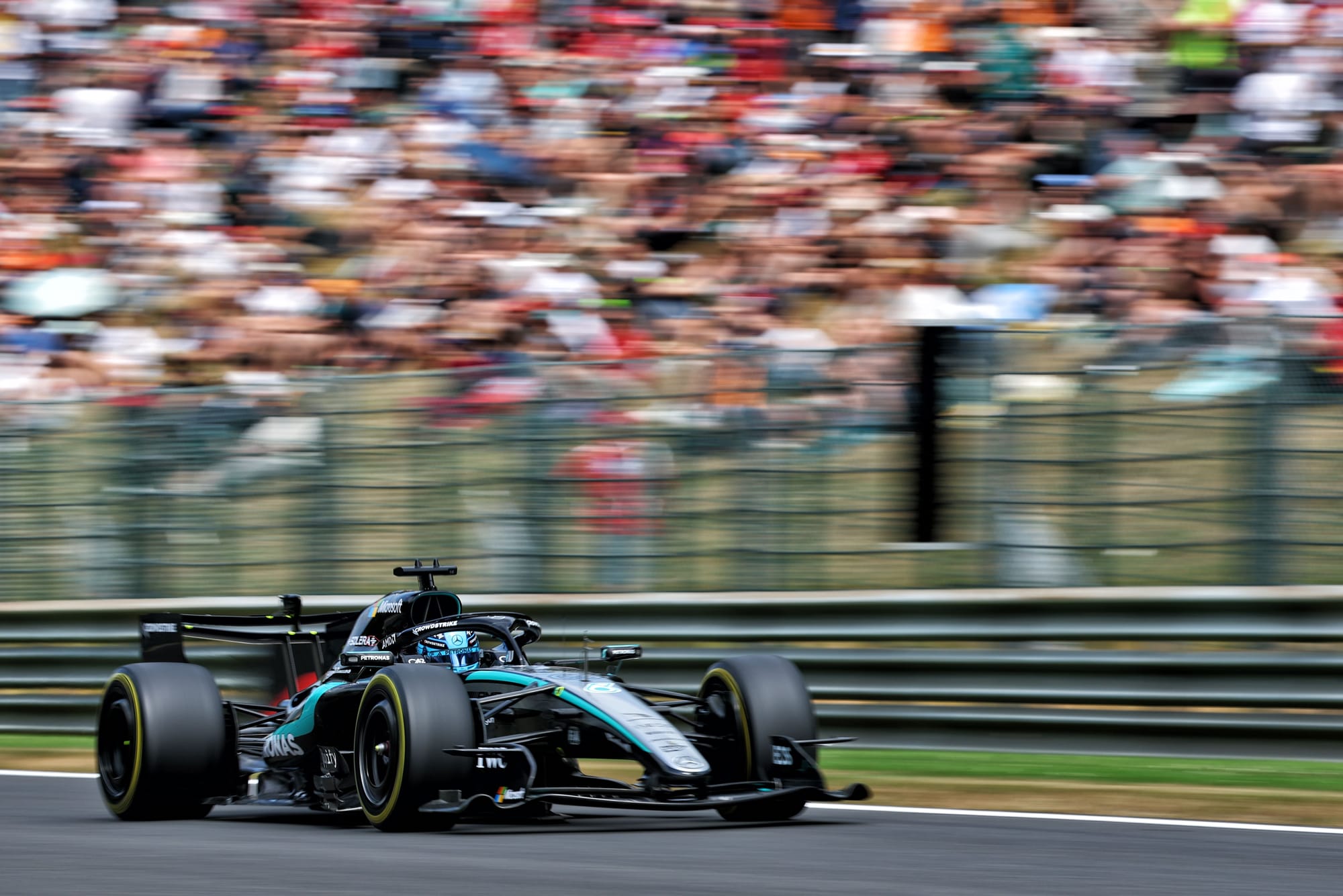
The Mercedes Formula 1 team has made deployment software modifications ahead of this weekend’s Hungarian Grand Prix to help address a problem it found deep in the code on George Russell’s car in Belgium.
Russell’s Spa weekend was overshadowed by him struggling for a lack of straightline speed compared to team-mate Kimi Antonelli, which was costing him several tenths of a second per lap in qualifying.
The cause of this was that he was running out of battery power earlier on the run to the final chicane – although there was no obvious answer as to why he was suffering more there.
Russell’s frustrations about deployment then boiled over in the race when a lack of power coming out of Raidillon on the opening lap led to him getting swallowed up by the chasing pack.
This helped contribute to his tangle with Lewis Hamilton at Les Combes.
In an angry radio message as he sat in the gravel trap after his early retirement, Russell had labelled what he faced all weekend as “unacceptable”.
Speaking after the race, Mercedes team principal Toto Wolff had explained that analysis by the team had uncovered an unspecified problem on Russell’s engine that had contributed to a lack of deployment on the final run.
Wolff suggested that this problem accounted for around half the deficit to his team-mate – with a different driving style also having an impact.
Ahead of the Hungarian GP, more details of what Mercedes found have emerged – as well as a more detailed explanation of what went wrong on lap one.
The problem that Russell faced in qualifying was related to an element deep in the code on his power unit that meant his deployment was being front-loaded around the lap.
This meant that, as part of the adjustments that are made by the algorithms to manage energy around the lap, it was more biased to using extra energy on the run to Les Combes.
This, allied to some differences in how he and Antonelli then impacted harvesting and battery usage around the middle sector, meant he was short of power for the run to the final chicane.
Having uncovered the issue in the code that got exposed in Belgium, Mercedes has put countermeasures in place from this weekend to try to make sure that there are no repeat problems.
Deployment should also not be too big a factor in Hungary as it is a much more energy-rich circuit layout.
The lap one issue
Mercedes has also got to the bottom of what went wrong on the opening lap as well, with both Russell and Antonelli lacking deployment on the run to Les Combes.
The issue was triggered by a software error, meaning that neither car harvested as much energy as anticipated on the entry to La Source.
Then, with extra battery power being drained on the way out of the hairpin to help fill in a gap for turbo lag, it meant neither driver had the energy they had hoped for on the run down the Kemmel Straight.
With F1’s regulations restricting the ramp down rate for both drivers when batteries are being deployed, this meant that neither had the kind of extra kiloWatts available they had expected when hitting the boost button.
But the outcome for both drivers was not the same because they had taken Eau Rouge differently, which meant they were not in the same energy restricted modes.
Russell had taken Eau Rouge flat, which meant that he was locked into a ramp down rate that left him stuck at a speed of 308km/h (191mph) for a time.
Antonelli, meanwhile, had to lift off the throttle through Eau Rouge after Max Verstappen had overtaken him, which put him into a slightly different engine mode with a bit more power available.
While still down on what Mercedes had hoped for, he got locked into ramp down slightly later, so was at a higher top speed compared to Russell – which was enough to allow him to draft past Verstappen for the lead.