Gary Anderson's verdict on Aston Martin's 'B-spec' F1 car
Aston Martin's major Formula 1 upgrade package effectively makes the Hungarian Grand Prix, the 11th round of the year, the real start of it and Honda's season.
The combination of the car upgrades, and the Honda power unit step that's to come after the August break, must add up to a big performance gain.
The team has admitted the car was overweight, so that’s been a priority to fix because extra weight is a time penalty and makes everything worse - braking, cornering forces, acceleration, tyre degradation, the lot - and that costs you significant laptime.
The question is: what has Aston Martin learned from its dismal start to 2026? Delaying the update to late July has given it the chance to study the directions taken by other teams, and that shows up in some of the upgrades.
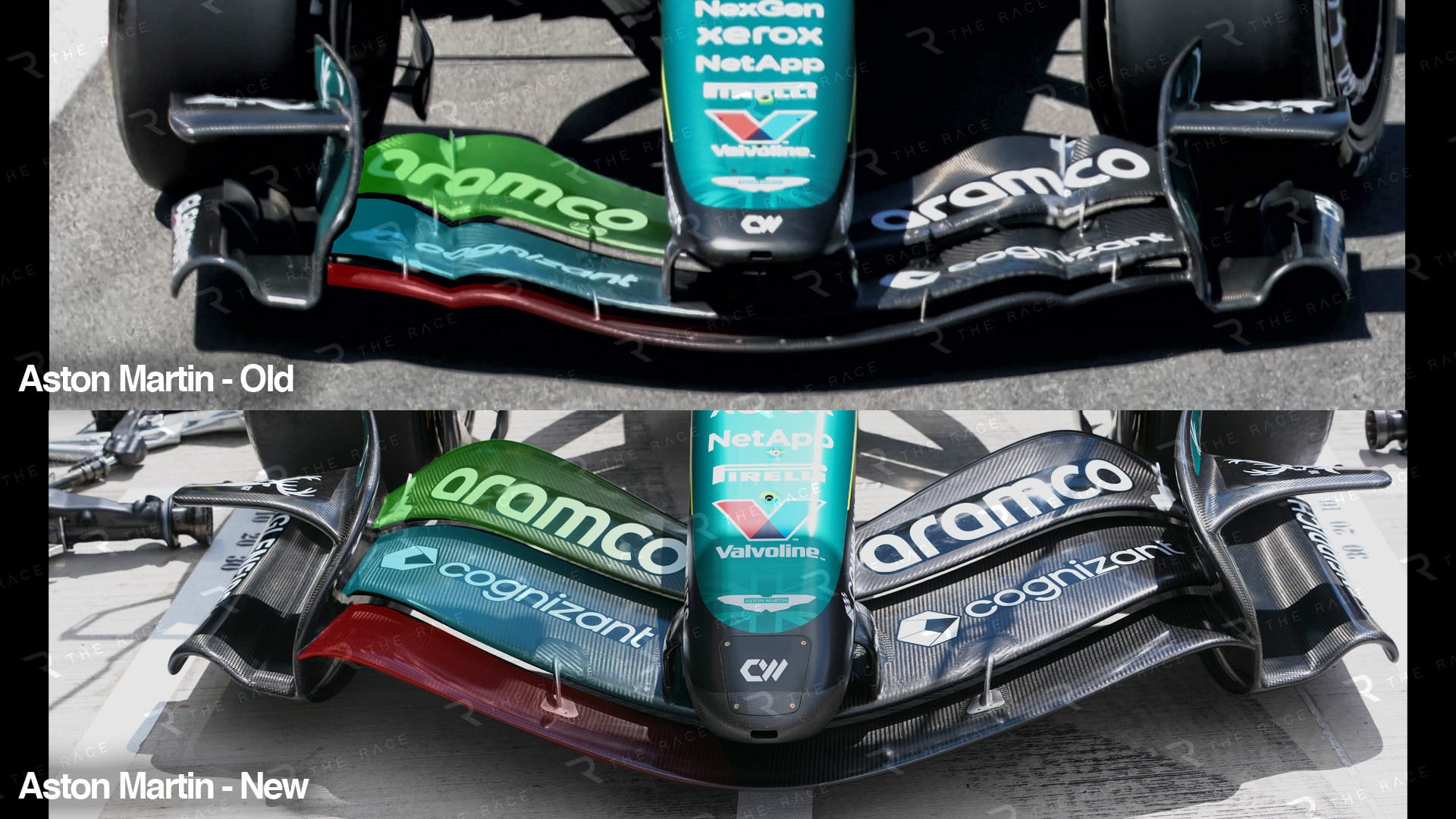
The front wing is the first thing that creates the airflow structure that the rest of the car has to work with. Aston Martin has paid a lot of attention to this area. It is actually a very different concept, with very different loading across its span and through the three permissible elements.
The pictures are from a different angle, but it does look like the chord length of the front element is shorter, the chord length of the second element longer, and the third element is similar to the previous package.
The V-section just inside the front tyre inner face has been replaced with more of a crowned profile. This is the area that will alter the airflow structure significantly.
Increasing the airflow under the wing will mean more flow is pulled around the inside of the front tyre. However, across its span the airflow will be more uniform, so its velocity, which is what the rest of the car has to work with, will also be more uniform and therefore less sensitive to wind direction and turbulence when following another car. That should be a positive given the front wing airflow separation problems that Aston Martin suffered with the old version of the car.
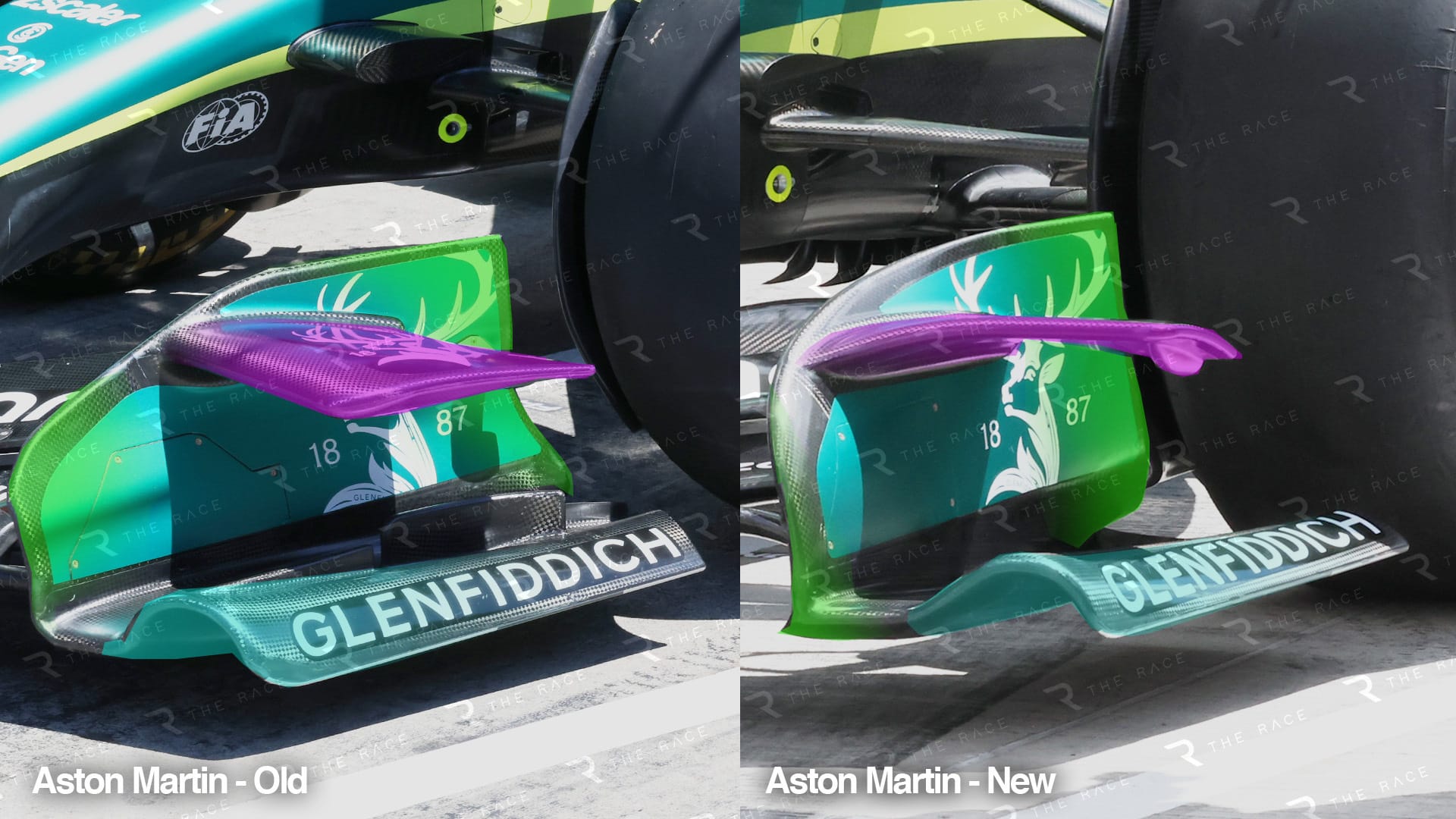
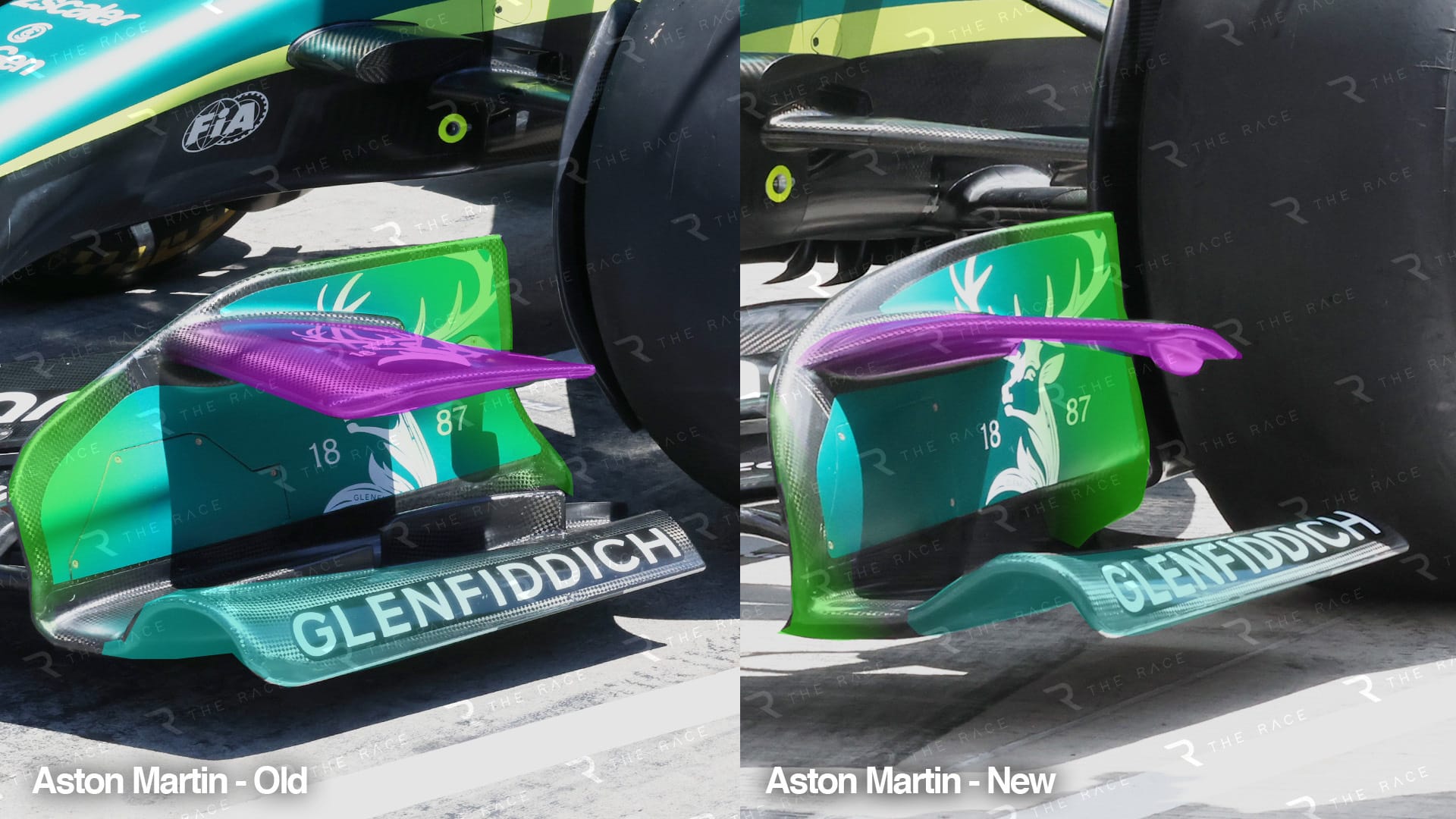
The endplates have also been revised. The horizontal outer vane has been moved forward, requiring the upper endplate edge profile to be altered. This repositioning and reprofiling are intended to exert greater influence on the airflow that is being directed downwards towards the outer-tyre squish. If possible, you want to maximise this to minimise the negative effect that inner-tyre squish has on the following downforce producing devices.
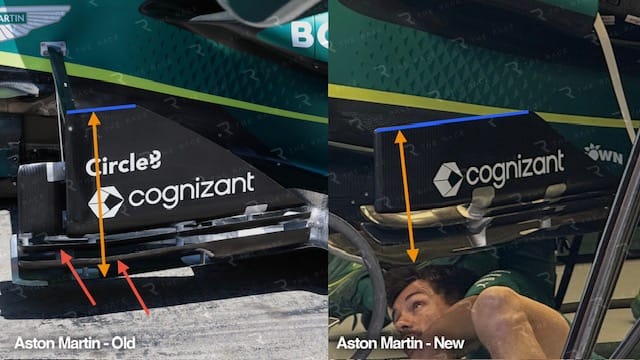
The bargeboards are about small detail changes. The overall height, highlighted with the blue line, has been reduced. The double-ended orange arrow shows this, so it is a significant difference.
Also, the two horizontal flaps highlighted with the red lines are now less aggressive at the trailing edge. They still retain their chord curvature further rearwards, so in effect are still doing the same job on that front corner of the floor just further rearward.
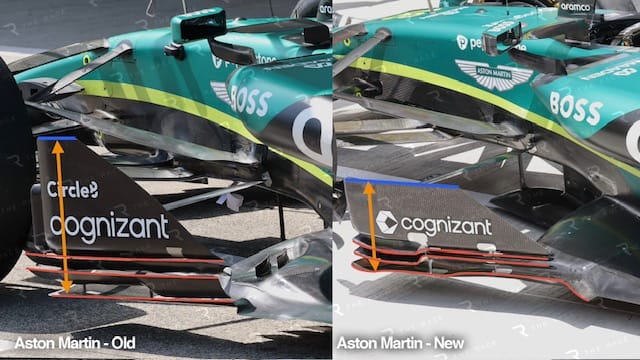
However, by starting further rearward, they have less effect on the airflow that is created by tyre squirt coming around the inside of the front tyre. This will have less of a detrimental effect on the mass airflow coming through between the inside of the front tyres and the chassis sides, which is the airflow that the underfloor has to work with.
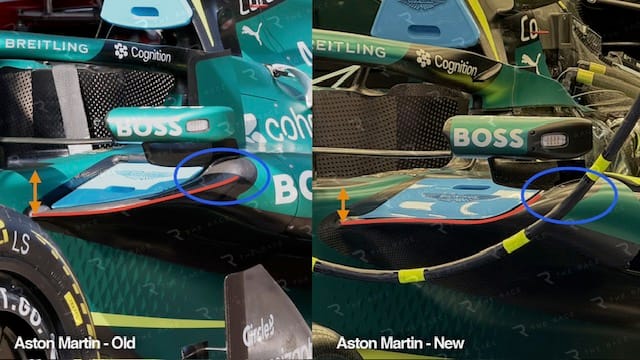
The radiator sidepod inlet has been reprofiled. The outer corner leading to the outer sidepod top corner radius has been 'blended' more, and the inlet split line profile highlighted with the red line has also been altered. The inlet itself looks slightly smaller on the inboard side, as the orange double-ended arrow from the top of the chassis looks shorter on the new version.
All of those modifications will lead to Aston Martin's approach to the 'double floor' arrangement.
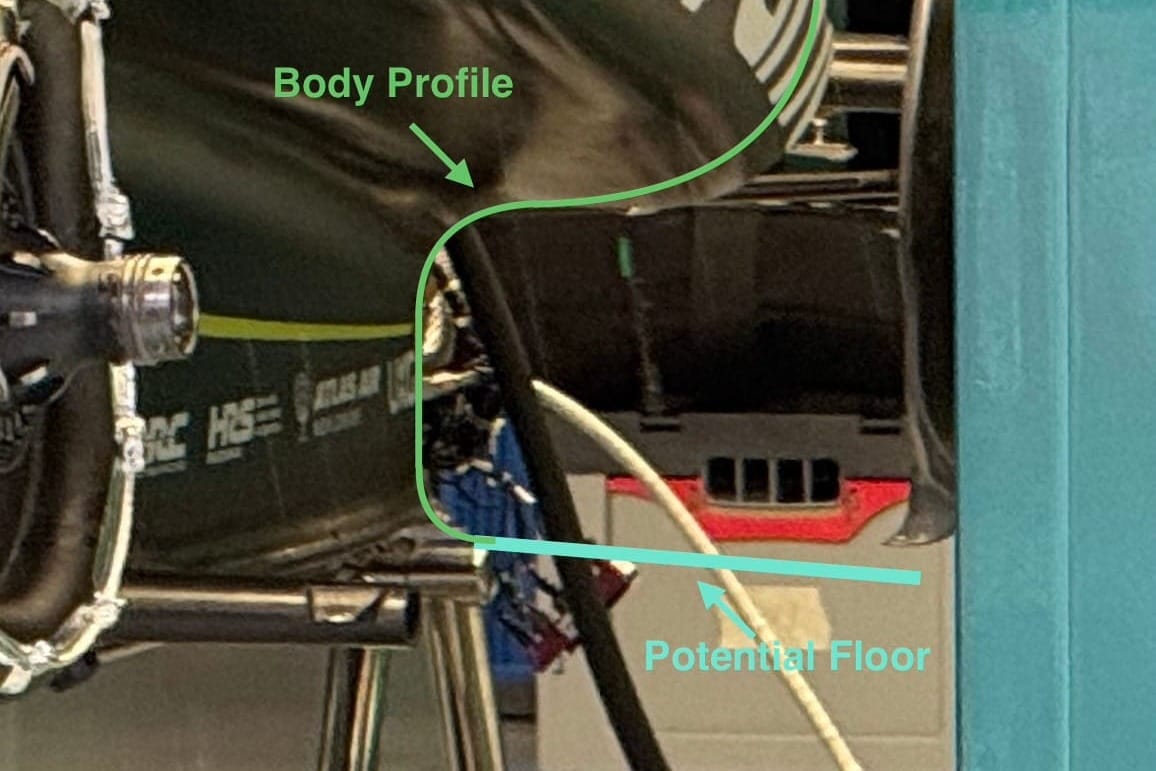
Above is the new version of the body profile, and below is the pre-Hungary version.
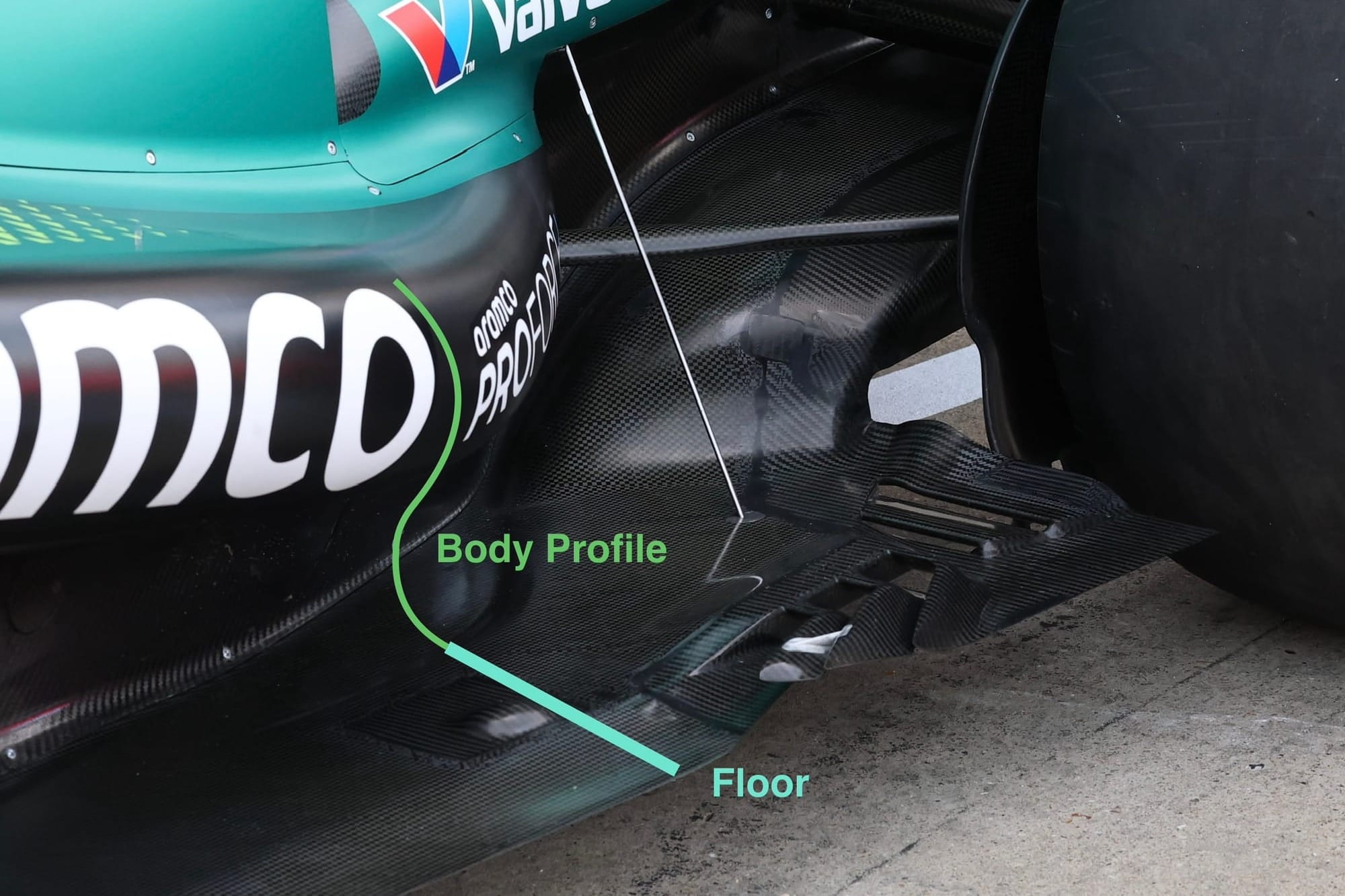
From these pictures, the only thing I can see is that it looks like Aston Martin has gone for an even more aggressive double floor package. The light blue line is to represent the floor, the green line is to represent the body profile. Yes, again, the pictures are at very different angles, but I think the differences are enough to highlight there is a change in this area.
The aim of generating greater mass airflow through this area is to improve the performance of the diffuser. That will improve the performance of the rear of the car as a whole, meaning the diffuser, beam wing and rear wing.
With these cars being what is loosely called flat-bottom cars, all these components at the rear of the car will work best if the mass airflow to them is maximised and that looks like what Aston Martin is focusing on.
It will also be interesting to see how this develops considering Newey's old Red Bull philosophy of high rake on his flat-bottomed cars. Aston Martin started the season using that concept but others seemed to adopt a more flat approach to rake. However, we know Adrian is pretty confident in his vision.
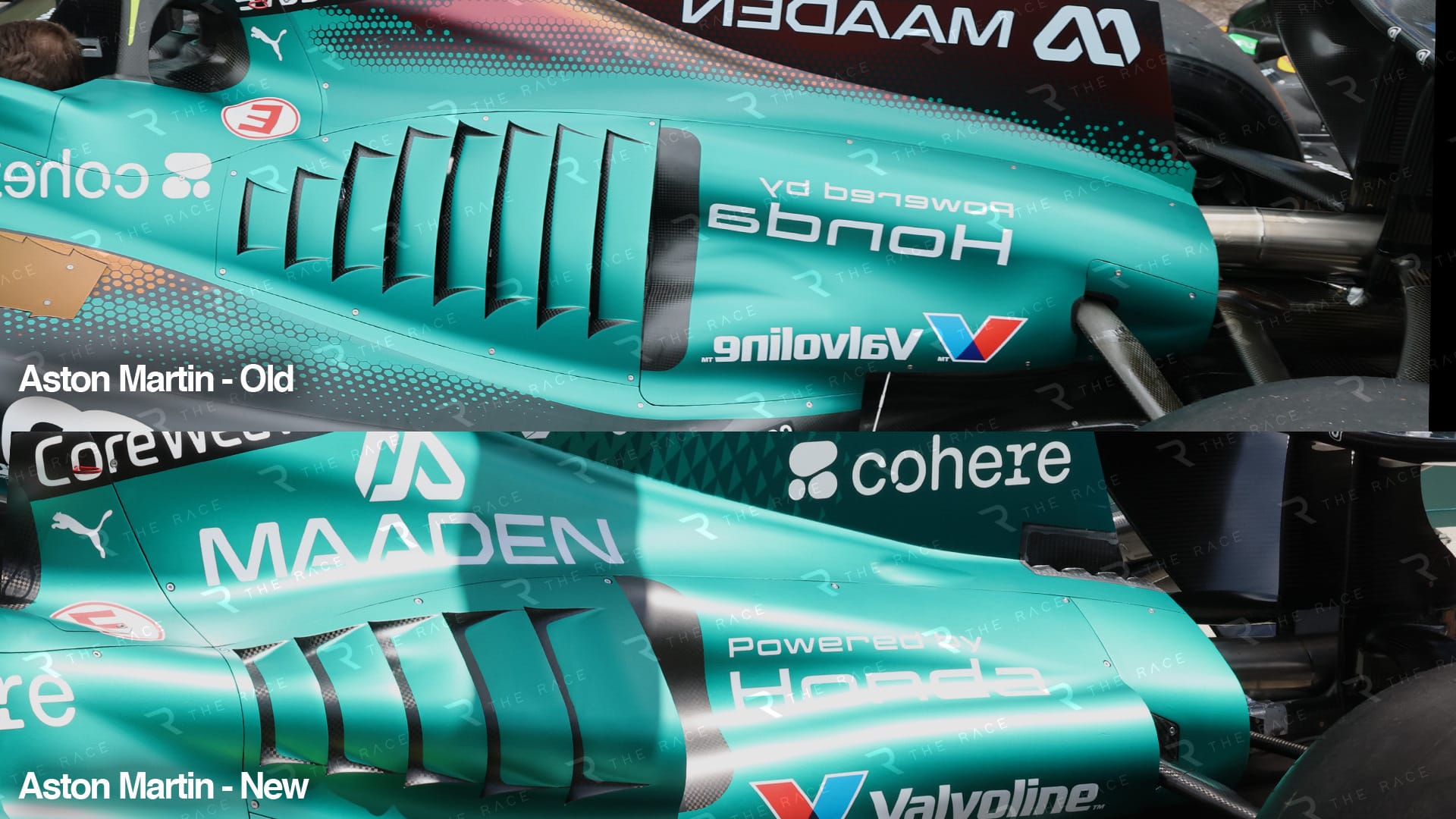
The package also includes a revised engine cover and cooling outlets. It's always difficult to comment on whether it's a development or simply to suit the circuit requirements, but in Aston Martin's case I'm sure it's a bit of both.
On the new system, these are slightly repositioned to fit in with the new engine cover and sidepod profiles. There are fewer louvres but they are bigger - in particular the outlet of the last one.
In general, more cooling equals more drag, so it's the efficiency of the overall cooling package that is critical to overall performance.
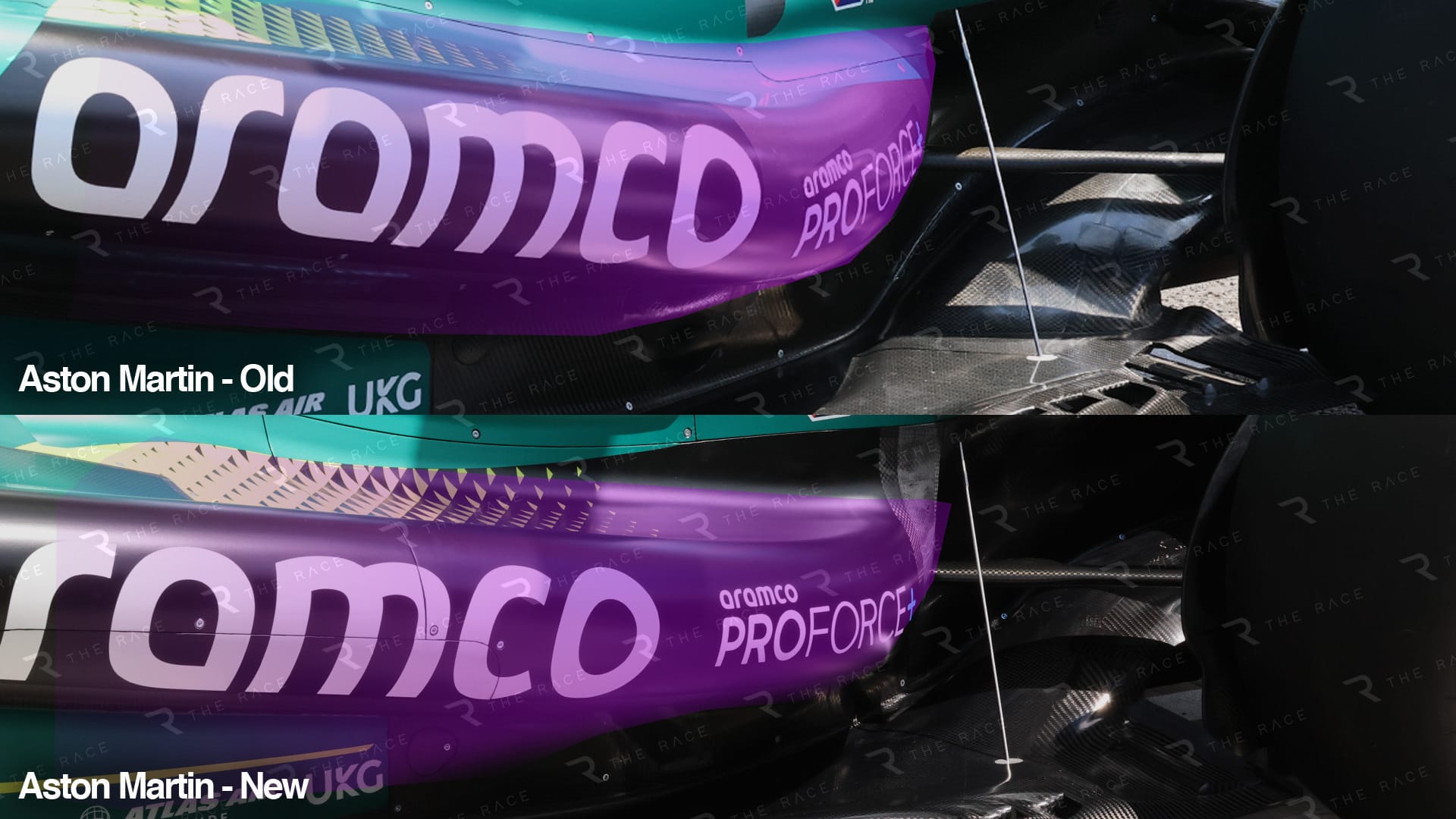
This sidepod comparison doesn't really show in great detail what I have highlighted when it comes to the double floor concept, which I believe to be one of the prime movers in this development package. However, it shows that the undercut below the decals looks deeper.
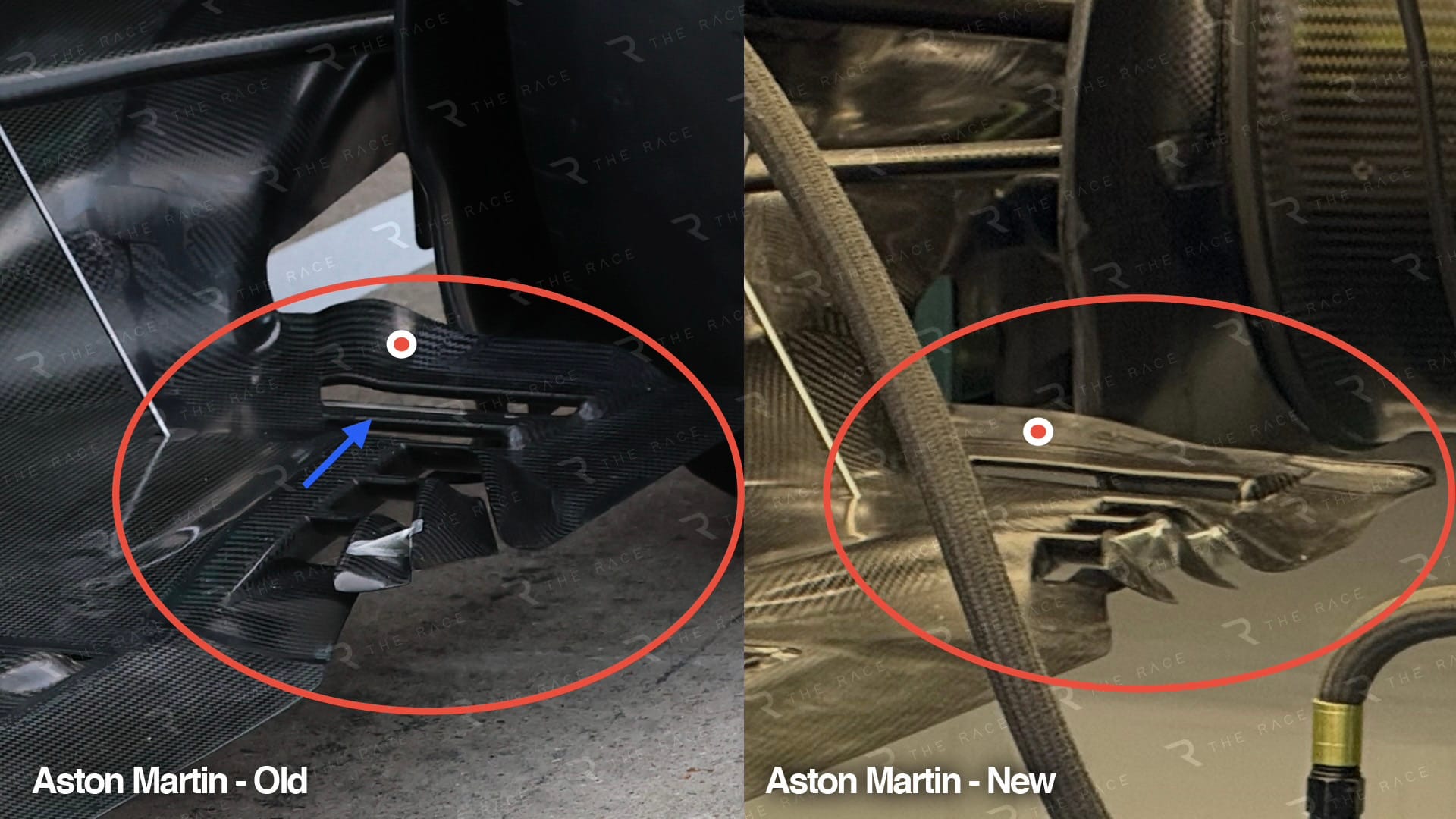
The detail in front of the rear tyre highlighted with the red ellipse has also been revised. I would describe it as coming from the same family of thinking, but it is now less aggressive.
The white circle highlighting the rear flap in this area is less cambered and its trailing-edge profile is reducing the level of inner tyre squirt from the earlier design. Aston Martin has also removed the second element highlighted with the blue arrow.
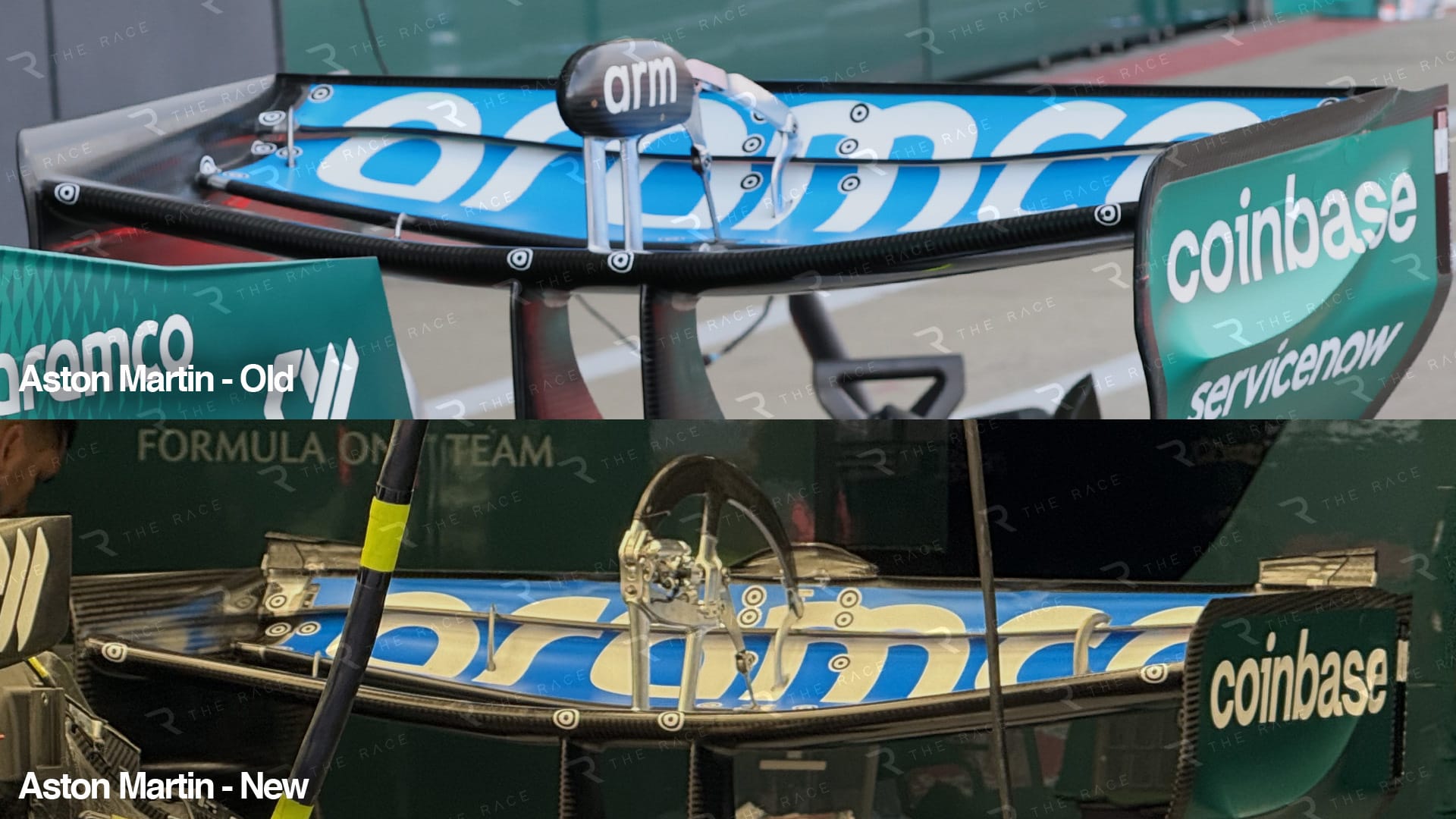
The rear wing actuator has also been revised. Some of that might be for weight reduction and we will have to see what style of actuation it will use, but from these pictures with the new one minus its aerodynamic shroud I would expect it would retain the previous operating system, similar to the outdated DRS larger slot gap that most teams have stuck with.
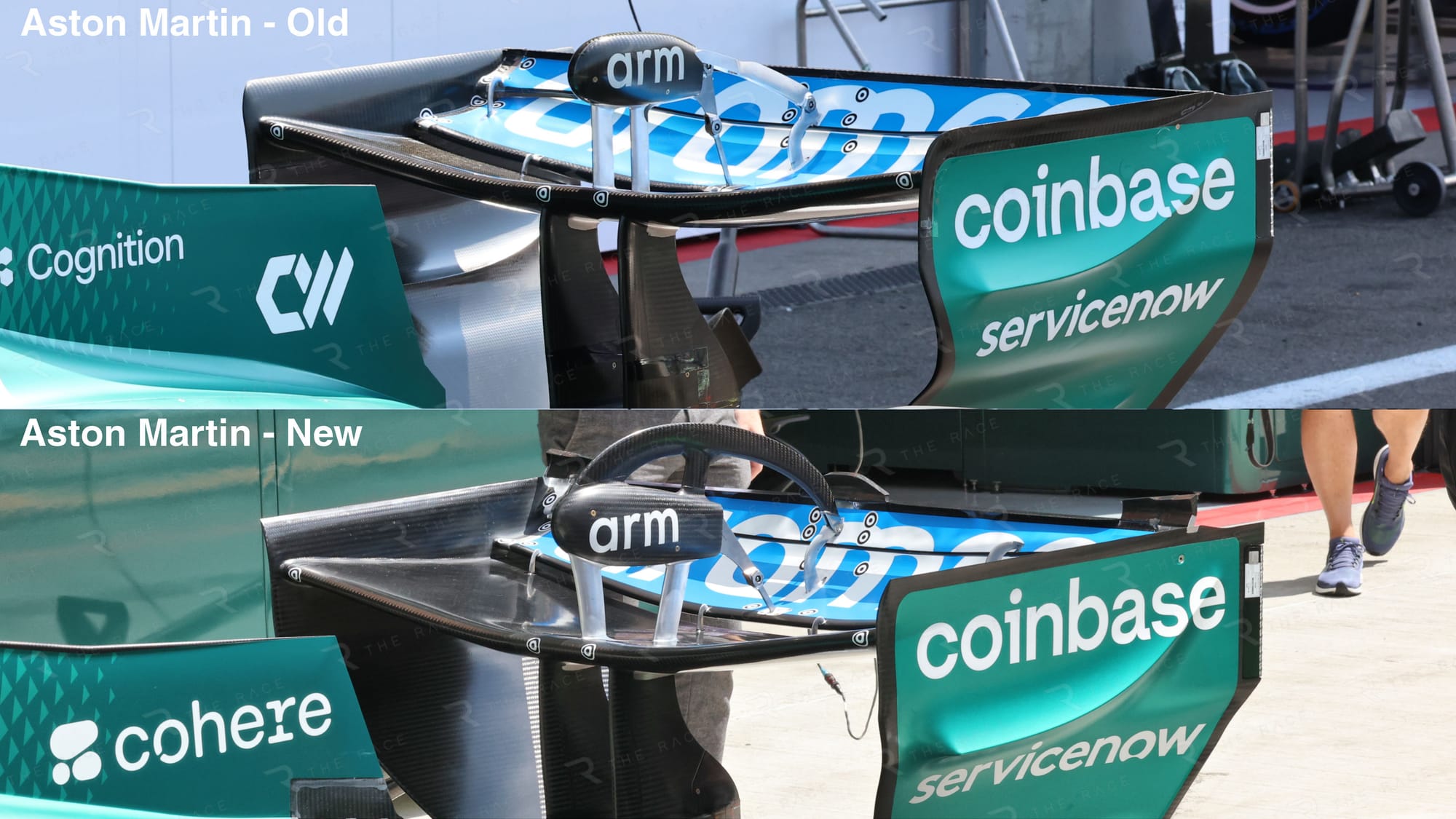
As with the front wing, the rear wing element profiles and chord lengths have been altered. Either it is part of Aston Martin's development package, or optimised to suit this higher-downforce circuit. Either way it is different.
The forward element has a shorter chord over its span. The second element has a longer chord outboard and the third element a slightly longer chord over its span. These changes will alter the chord-wide loading across its span and in some areas improve the performance of the diffuser; getting the upper wing airflow to talk to the diffuser is very powerful.
However, more importantly it should help with the downforce recovery across its span as the wing goes from straight mode to cornering mode.
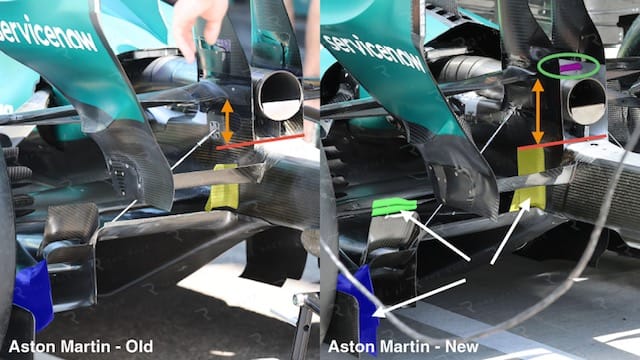
The rear of the car has also been revised. The white arrows point to modified parts, added parts or more powerful parts. However, one of the main changes is the rear suspension geometry and, with that, inner pick-up positions.
The rear leg inboard pick-up point, which had been uniquely mounted on the rear wing pillars, has been moved upwards. This will increase the anti-lift on the rear suspension and also reduce the camber change between low and high speed. It will also probably raise the rear roll centre.
I'm not sure which of these would be the primary motivation, but for me it would probably be the roll centre and anti-lift, and the camber change would be a consequence of those changes.
However, nothing comes for free. That inboard point is mounted higher on the wing pillars. This is highlighted with the double-ended orange arrows coming up from the top of the crashbox, which is highlighted with the red line. This brings the potential for more flexing in that area.
To counter this, Aston Martin has added a small horizontal strut between the wing pillars, highlighted in purple inside the green ellipse. This strut goes across the gap, basically connecting them both together.
This will help when the load is equal across the upper wishbone under acceleration and possibly braking, but that seldom happens when the car is in a corner and it is then that the loads are at their highest.
Overall, this major upgrade should be a step forward, but that will mainly come from the weight reduction. Yes, what we are seeing aerodynamically is also a step in the right direction, but the problem there is that the others are also taking race-by-race steps.
With these regulations being so restrictive, long gone are the days of introducing something aerodynamic that gives you seconds as opposed to tenths if you're lucky. Usually it actually ends up being hundredths.
I'm not really seeing any major differences compared to when the car was first introduced at Barcelona back in late-January. Yes, aerodynamically it is different - Aston Martin has had time to optimised its package around the same concept - but the front suspension that I questioned at the time in terms of how much anti-dive it has remains, which suggests Aston Martin either believes in it or found it too difficult to change mid-season.
Aerodynamically, the airflow structure coming off the front wing is quite different, and this will lead to the developments we are seeing further downstream. There is also plenty of time to relearn what these new regulations require, while on top of that if Aston Martin has reduced the weight significantly then that is simply free laptime.
I would expect Aston Martin to leapfrog the new-for-2026 Cadillac team, maybe Williams and perhaps the Haas team, which seems to be struggling this season. But after that, the next step or next steps become much more difficult.