F1's logic for no battery graphics is absurd
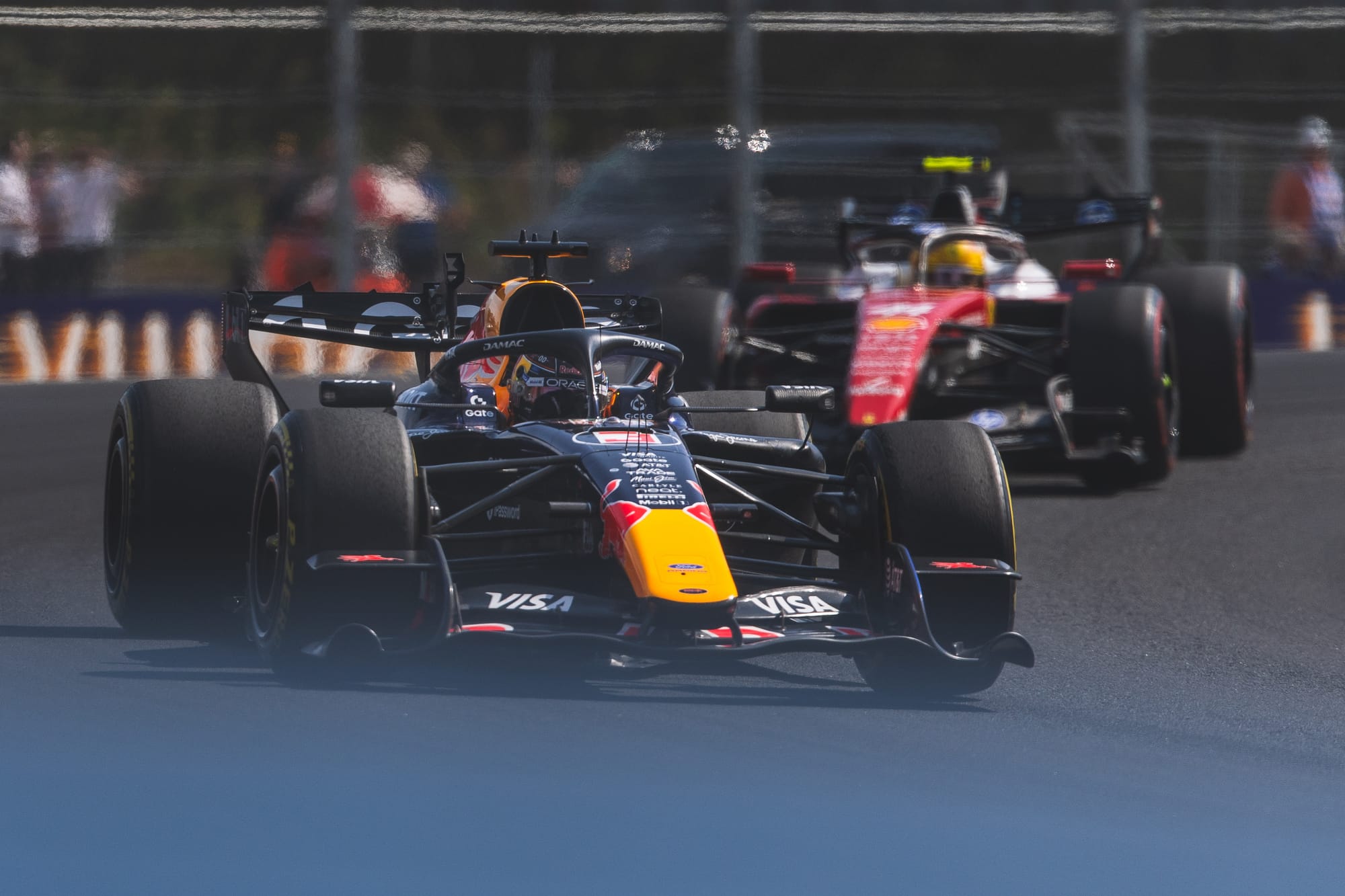
One of the most persistent questions we receive for our Sunday night grand prix review podcasts is what happened to the on-screen battery graphics that turned up in Formula 1’s live coverage early in the season.
It is an absurd shortcoming given how crucial the state of charge is to understanding not only the moment of the overtake, but the context around it in the build-up and aftermath.
F1 is rightly targeting further growth in the American market. This is a mature, demanding audience that demands a data-rich viewing experience, yet it’s being poorly served by omitting this crucial information. It doesn’t need to be there for every car throughout the race, but it’s essential when tracking close battles and therefore absurd that it's neglected.
I put this to F1 boss Stefano Domenicali this week: “As you say, the races have been fascinating this year with the way the regulations are, but one thing that has often been missing has been battery state-of-charge information. I don't mean for all cars live, but for selected battles when it's important context. Why is this not being pushed as much as it should, particularly considering the desire to grow in the USA, where there is a very clear demand and trend for data-rich viewing experiences, because that would seem to be inhibiting your own product.”
Domenicali’s response followed the previous pattern of arguing that the majority of those watching the coverage are not interested in this. “The truth is exactly the other way around, because no one is interested in how you drive your car,” said Domenicali.
“People are interested if you're overtaking or not. That's the vast majority of the people. I agree with you that certain people are focused on this thing that is very important. It's like when you were opening the DRS, people were not interested in what was the [cause of] the pass.
“I had an incredible and interesting discussion with [Star Wars creator] George Lucas on Saturday. He was in Hungary and gave me an incredible view on how the new fans are watching Formula 1, and he gave us [an] incredible [perspective] to see how we can really simplify things because the new fans are not understanding the truth [of] what is behind the scenes. They are fascinated by the fact that there is a lot of action.
“There is definitely the need for the ones that are so focused on that to have the right information, but for the vast majority of the people, trust me, they just want to see what is happening on the track. [They are] not interested in the angle of throttle or the brake pressure in how you can overtake.
“If you think [of] an incredible overtake of Max [Verstappen] and Lewis [Hamilton], at Turn 1 in Hungary, this is a piece of art that people just want to see, and [is] just connected to the quality of the drivers.
“At the end of the day, this is a scheme that the driver can have on how you can maximise the performance of your car, no matter if it's braking, accelerating power that is done by the electrification. That's what I think is happening. Of course, for a niche of our fans, this data is relevant and of course it is available. But as I said, for the vast majority, that's what we receive as information.”
Lucas’s argument is the right one for a filmmaker, but it is not what I want to see from sporting coverage. Domenicali argues he has the data to support his position, and F1 may very well have that, yet this line of reasoning doesn’t seem to apply to other aspects of F1.
After all, this is something F1 generally excels at with its F1 TV offering, the live feed and social media output. There’s great depth of graphical visualisations, telemetry data, F1 Insights with AWS content such as the newly launched strategy insight you’ll have seen in Hungary.
Why does all of this matter, but the battery data doesn’t? Why do viewers want to know these other details, but not the parameter that is critical to performance and facilitating overtakes - the battery?
Those watching can decide whether or not they want to absorb the data or not. It’s true there is only so much real estate on the screen and it would be a mistake to overly-clutter it, but this data is at the heart of everything. Some watching won’t want to see how the sausage is made, but plenty of others will.
What’s more, there’s no better way to convert your more casual fans than to hook them in by showing these hidden depths, which will make them engage with F1 even more often. That can only be good for business, and to showcase it in the TV coverage would show confidence in the product.
Perhaps the inconvenient truth is that F1 is all too aware of the negatives of illusory overtaking moves when they are achieved by a power offset of hundreds of horsepower?