Don't expect Williams's upgrade to make it competitive
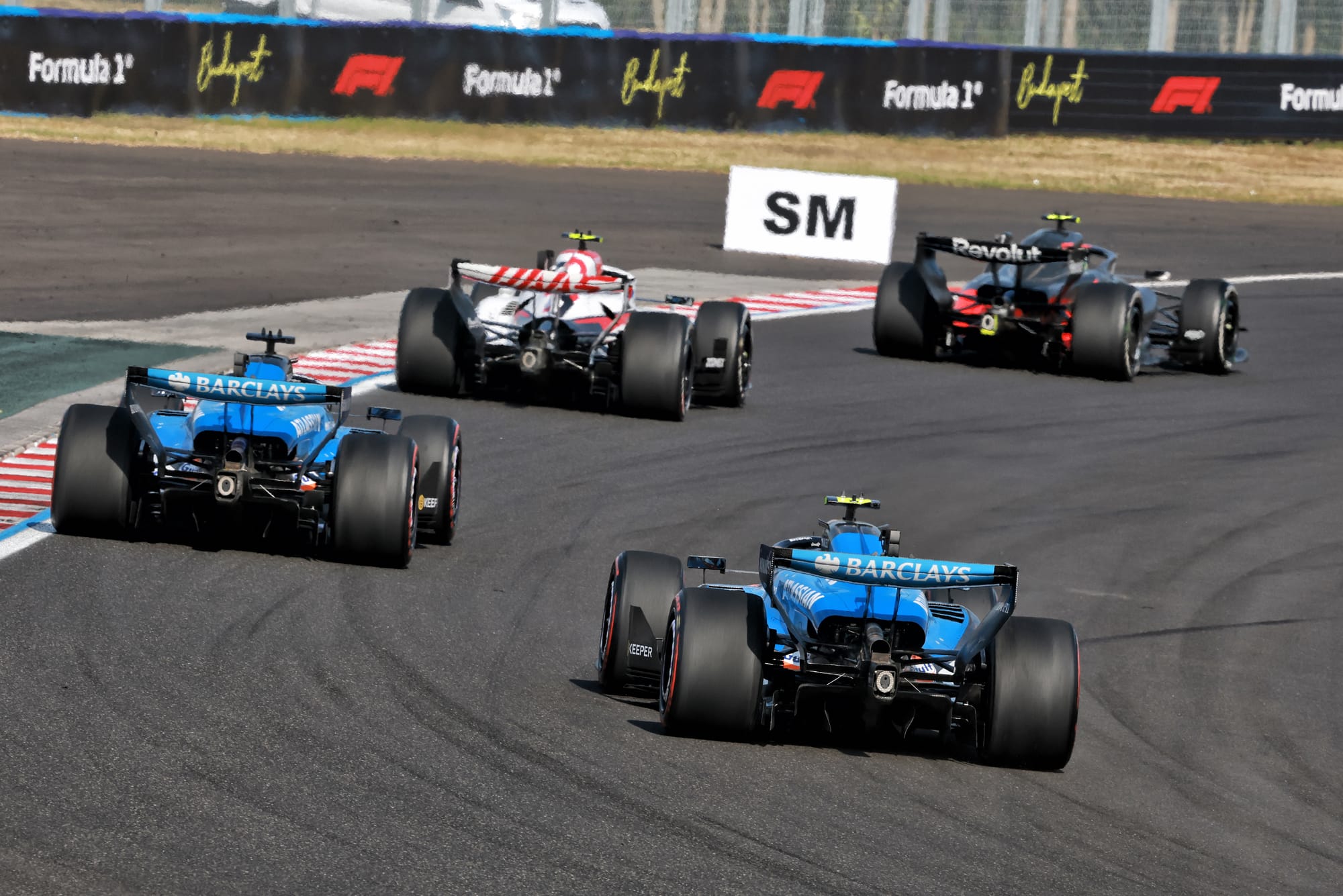
It's hard to know whether the Formula 1 summer break comes as welcome relief to Williams, or is simply four weeks away from the track that only prolongs its pain.
Williams surely heads into this gap in the worst mood of any team.
Cadillac, though now on its own at the back, has made an assured fist of its first half-season in F1; Aston Martin is far from out of the woods but boy did its Hungarian Grand Prix upgrade provide a boost; and Haas, or at least whichever of the VF-26s that team can get working on any given weekend, does have the measure of what’s now its closest rival.
This team is not where it wants to be, that is plain to see. It would be tempting to conclude that the picture is exacerbated by the taunting that the Hungaroring's long, 180-degree corners seem to expose multiple generations of Williams cars to; see the common complaint of the car "three-wheeling", which reared its head throughout that weekend.
Don't be tempted by that narrative. This is a humbling season that might've long since passed its competitive peak.
Because Williams didn't just have its worst weekend of the season (an "awfully painful" one, in the words of team principal James Vowles) relative to the front in Hungary, where it was 4.422% off the leaders using supertimes - the fastest lap set on a weekend expressed as a percentage of the fastest time overall.
It made big admissions about the state of play for the rest of the year that even suggest its current baseline might be its new reality.
This seemed to dawn in real time last weekend. Aston Martin's leap, which had plenty of midfield rivals running scared, also served to underline just how far behind Williams is.
Witness Alex Albon's fatigue as the weekend wore on.
While accepting that the pace of the upgraded Aston Martin meant "Q1 is going to be challenging", he was resolute on Friday that "Aston are ones that we need to try to beat".
The way that particular contest was settled, convincingly in Fernando Alonso's favour, offered a reality check. "We could only dream of an upgrade like that," said Albon. "It's eye-opening because, also for us, we know what our Baku upgrade is. It's not that."
And by Sunday, the tone was as beleaguered as it was accepting. "If it's cured [Williams’s weaknesses] by Baku, I doubt it. I think a lot of the Baku stuff has happened; that upgrade was planned quite a long time ago," he said. "A lot of what we're really, unfortunately, biting into is making sure next year's car doesn't have these traits. Yeah. Frustrating."
It was much the same post-weekend from Vowles. He acknowledged that as Williams has "focused on really undoing some of the harm that happened this winter" - the car arriving late, and overweight, to testing - and turning attention to 2027, "we've fallen behind our competitors".
"And in part, I think that we have to improve, full stop, the rate that we're bringing performance to the track, i.e. [the] time it takes for the idea, to actually bring it," he added.
"But just the idea rate that we're having behind the scenes is not at the right level. And what's happening in and around us is a number of competitors are showing us that they have higher levels than we can achieve today."
What optimism did exist centred around the Azerbaijan GP upgrade that Albon referred to, described overtly by Vowles previously as a B-spec car: a sizeable revision, with a redesigned chassis and other parts, that should take weight out of the FW48 and cure some of its aerodynamic deficit and the vices Albon and Carlos Sainz are experiencing.
But the modicum of positivity surrounding that seems to have vanished.
"Aston obviously brought a very large upgrade in the form of a much lighter car, and a car that's been aerodynamically upgraded," said Vowles.
"We have a package, but it's not coming until later in the year. And more importantly, it's more about [the] focus on getting the foundations right for next year to be upgraded."
So, the tone has shifted. What does that mean from a competitive standpoint?
"What I can say is the Baku upgrade will not be enough to put us in a points-scoring position regularly," added Vowles. "And that's what we need to review and understand what else we can do this season."
In this, the first year of a new F1 rules cycle where packages can regularly offer multiple tenths of a second, that feels like a damning indictment of Williams's competitive prospects.
In describing the September upgrade as a B-spec, back at Silverstone at the start of July, Vowles said the British GP would set the baseline for the car's performance; that Williams had to, "as a business, prove to ourselves that we can do the engineering to the right level of quality and build a car to the right level of quality in a season".
There's no two ways about this: that referred to development in the here and now, and on that score Williams is failing badly.
None of this is to underestimate that challenge; Vowles compared that to "flying the plane and rebuilding it at the same time".
It's just that right now, it's hard to argue that's being achieved. And when competitively that resets expectations back to zero, that's when any positive spin begins to wear thin.