Gary Anderson on Cadillac's underwhelming F1 car development so far
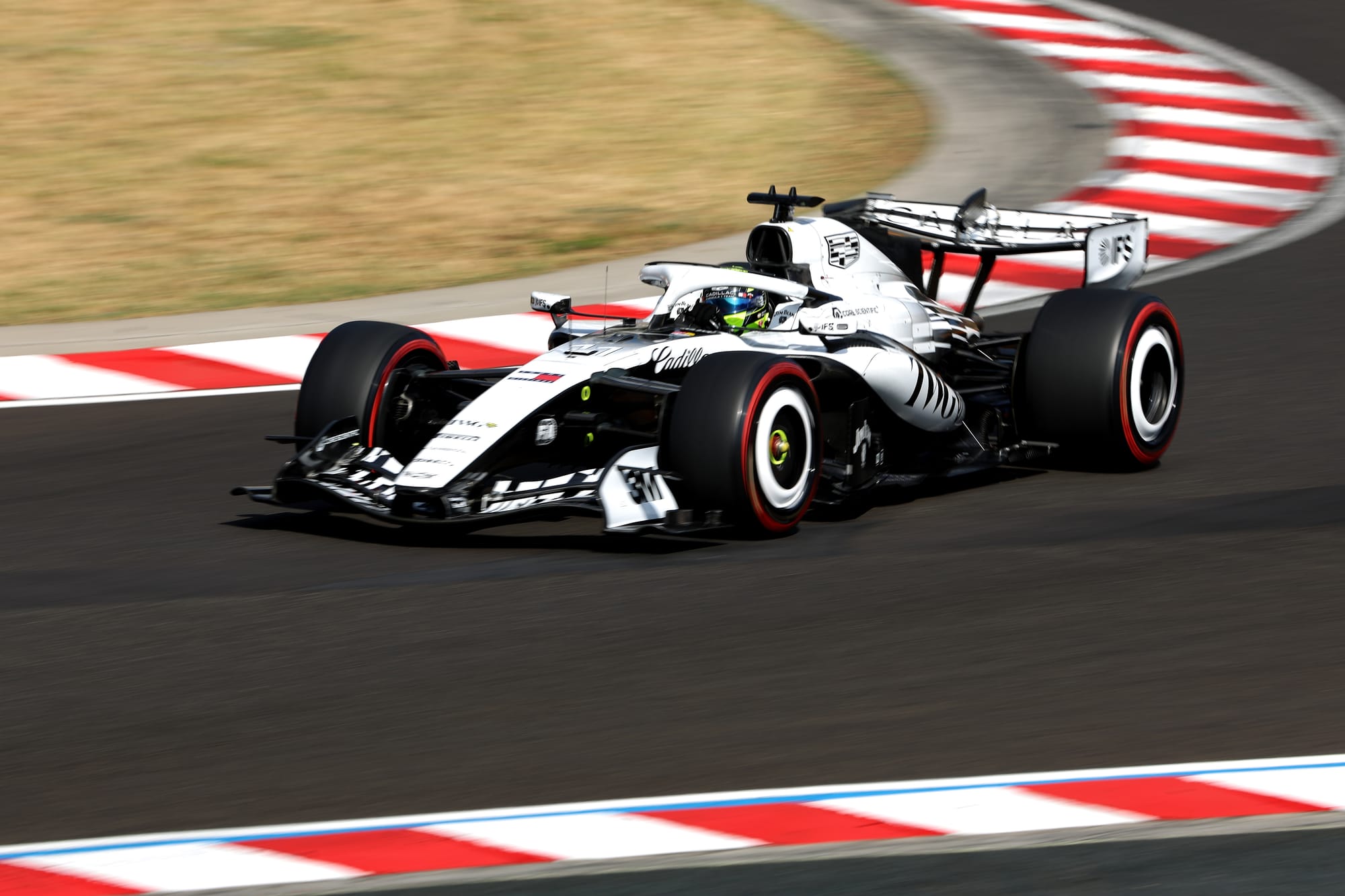
As the newest team on the block, Cadillac has got a lot of ground to make up. Yes, it's the team's first season in Formula 1, but I'm sure deep down more was expected. It's a big challenge for new team boss Marcin Budkowski and perhaps partly explains Graeme Lowdon's shock exit.
Not only has Cadillac's overall performance been at the rear end of the field (other than beating Aston Martin on a few occasions), its main weakness has been front brake cooling. On too many occasions it's had to retire cars when the front brakes caught fire.
Anyway, let's have a look at how the season's developments from Cadillac have changed the look of the car and what areas it has been focusing on - as usual, by starting at the front and moving rearwards as the actual airflow does, passing across the car's body surfaces.
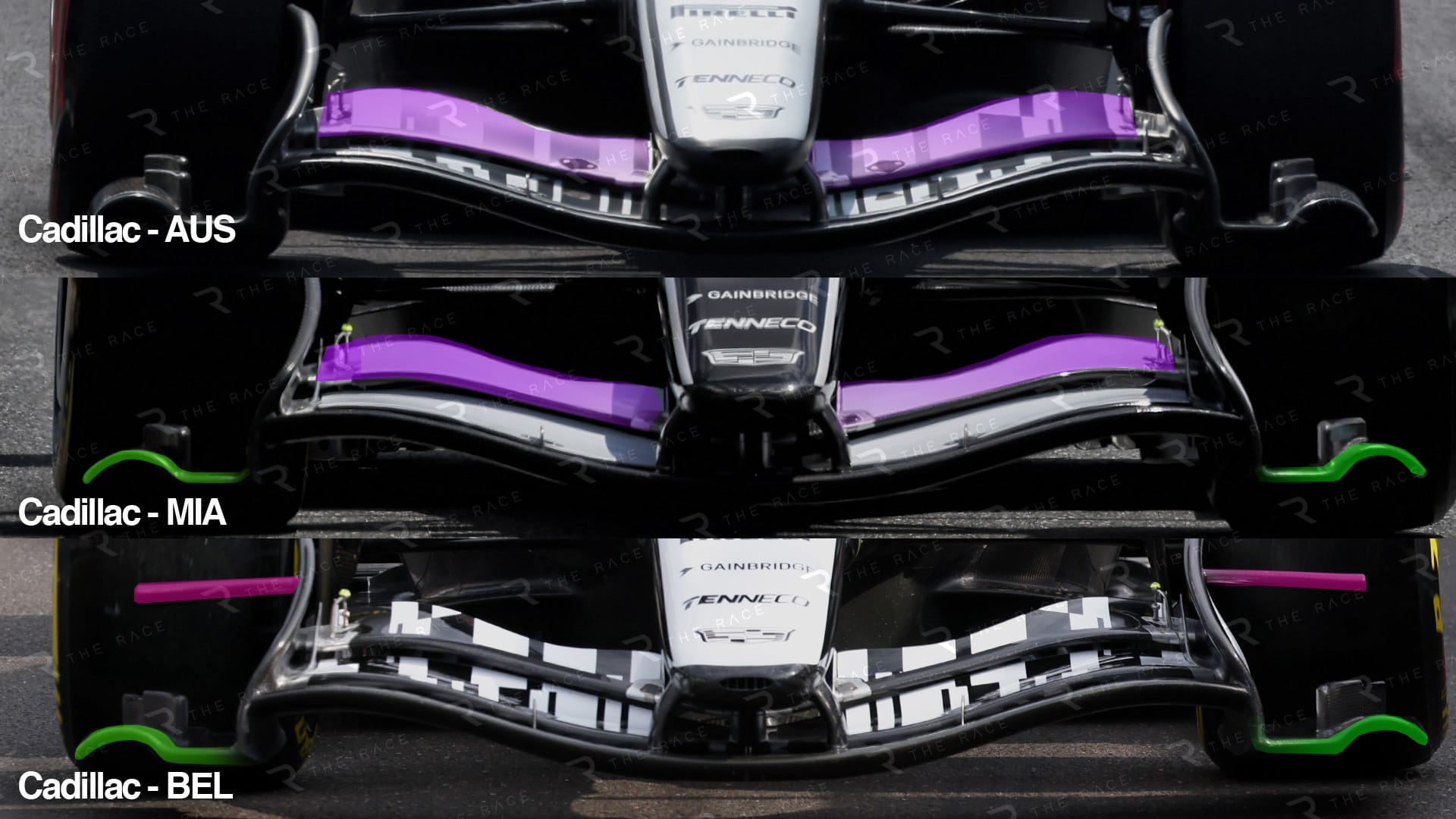
These are versions of its front wing from Australia, Miami and Belgium. To be honest, I'm not seeing anything to get excited about.
The trim line on the trailing edge of the rear flap is slightly different but looks like it is from the same family of thinking, so there hasn't been a great airflow structure eureka moment. That could simply be a modification to achieve the required circuit-specific downforce level.
Cadillac still retains the very high outer mainplane to endplate intersection. Personally, I'd like it to be more integrated with the footplate of the endplate as we see on some (but not all) cars.
At Spa, Cadillac added the now customary horizontal vane on the outboard surface of the endplate (pinkish highlight) and altered the detail of the footplate tunnel (green highlight).
With that, it has also altered the detail and positioning of the small vertical vanes on the upper surface of footplate. This would be to optimise the outwash.
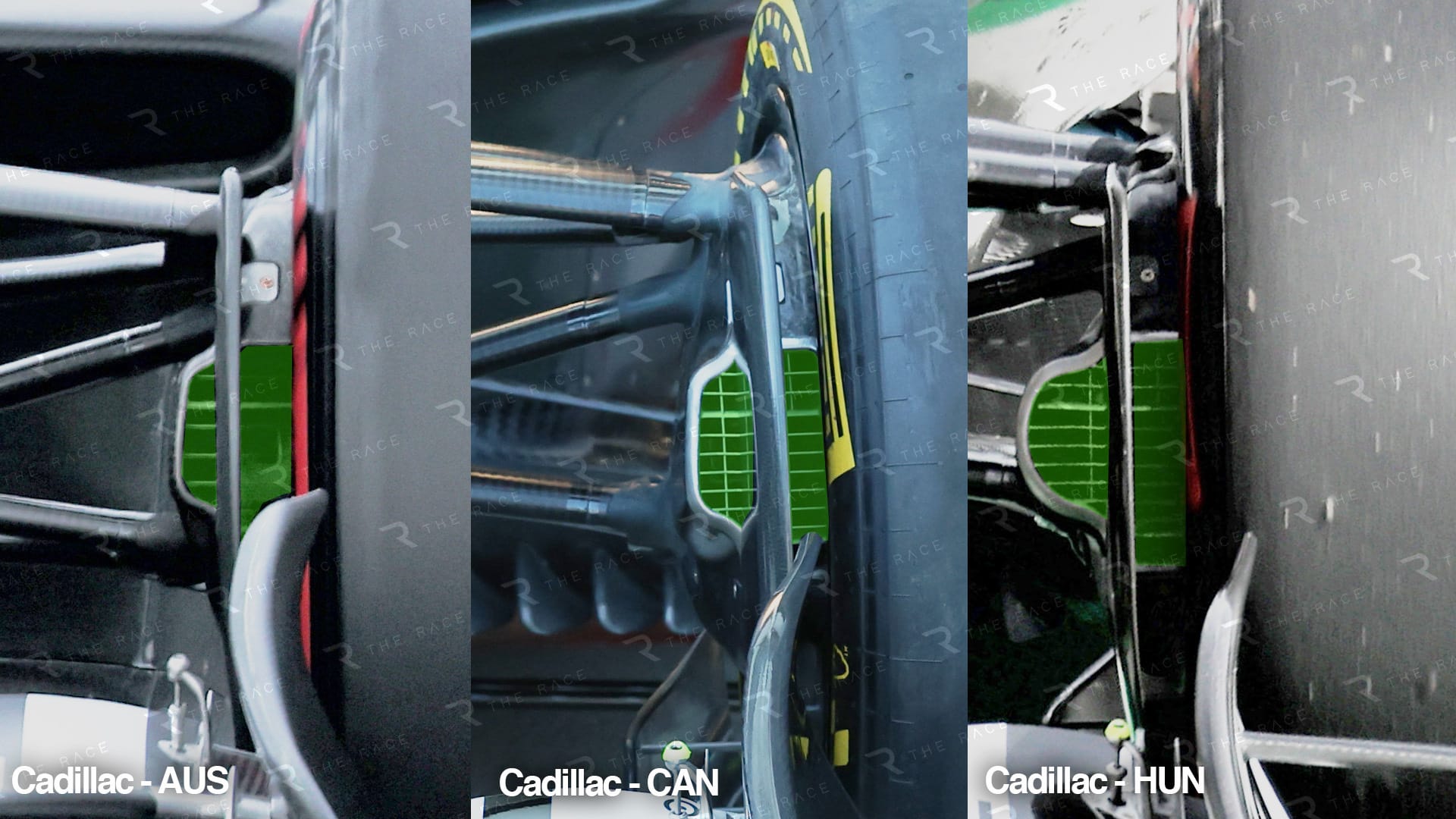
And now for Cadillac's most glaring problem: the front brakes that have caught fire through lack of cooling. As you can see, as the season has progressed, it has altered the size of the inlet for the front brakes. However, even with the largest version for Hungary, Valtteri Bottas still had to drive into the crash barrier just to stop the car after the front brakes caught fire once again in the race.
Cooling the brakes is not easy and it's not just about a bigger inlet opening. For a given speed, there is a positive pressure on that opening. So, yes, a bigger opening theoretically gives more flow, but it's what's happening behind that opening that is critical.
The exit needs to be matched to that opening to get a decent pressure drop across the duct system; that exit needs to be in a low-pressure area. Out the back of the duct and low down is a reasonable place to allow the low-pressure area behind the front tyre to generate that exit low-pressure area.
The exit also needs to be approximately three times the size of the inlet otherwise, as the speed increases, the duct system just blocks up and you don't get an increase in the flow going through the system. Then all the things internally - brake discs, brake pads and callipers - all need to have their own percentage of that mass flow; the internal ducting on these cars is a design feat in its own right.
Yes, cooling the front brakes is a performance compromise; however, them catching fire regularly is even worse.
Now ex-team principal Lowdon explained: "We've had a number of DNFs [nine] all fundamentally focused around things to do with cooling on brakes, and that is a really, really, really difficult area of a Formula 1 car to develop.
"It's an area where know-how and intangible IP is really important. And we're not allowed to get that from anywhere else, we can't take someone else's brake duct design.
"People have in the past, but you're not allowed to do it. You have to do that learning and you have to do it in public as well with a few hundred million people watching, so the task's not easy. I think the team has done a spectacular job."
My thoughts on that comment is that Pat Symonds, Cadillac's technical consultant, is by no means a new kid on the block, and Cadillac has various other staff members who have been with other teams, so their experience is there to tap into.
CFD is the ideal tool for optimising brake ducts; it is basically a closed duct with an inlet and an outlet and lots of brake bits in between that need decent airflow. Once you have modelled what you have (which is not easy), then increasing or decreasing the mass airflow or the percentage of what goes where is relatively simple.
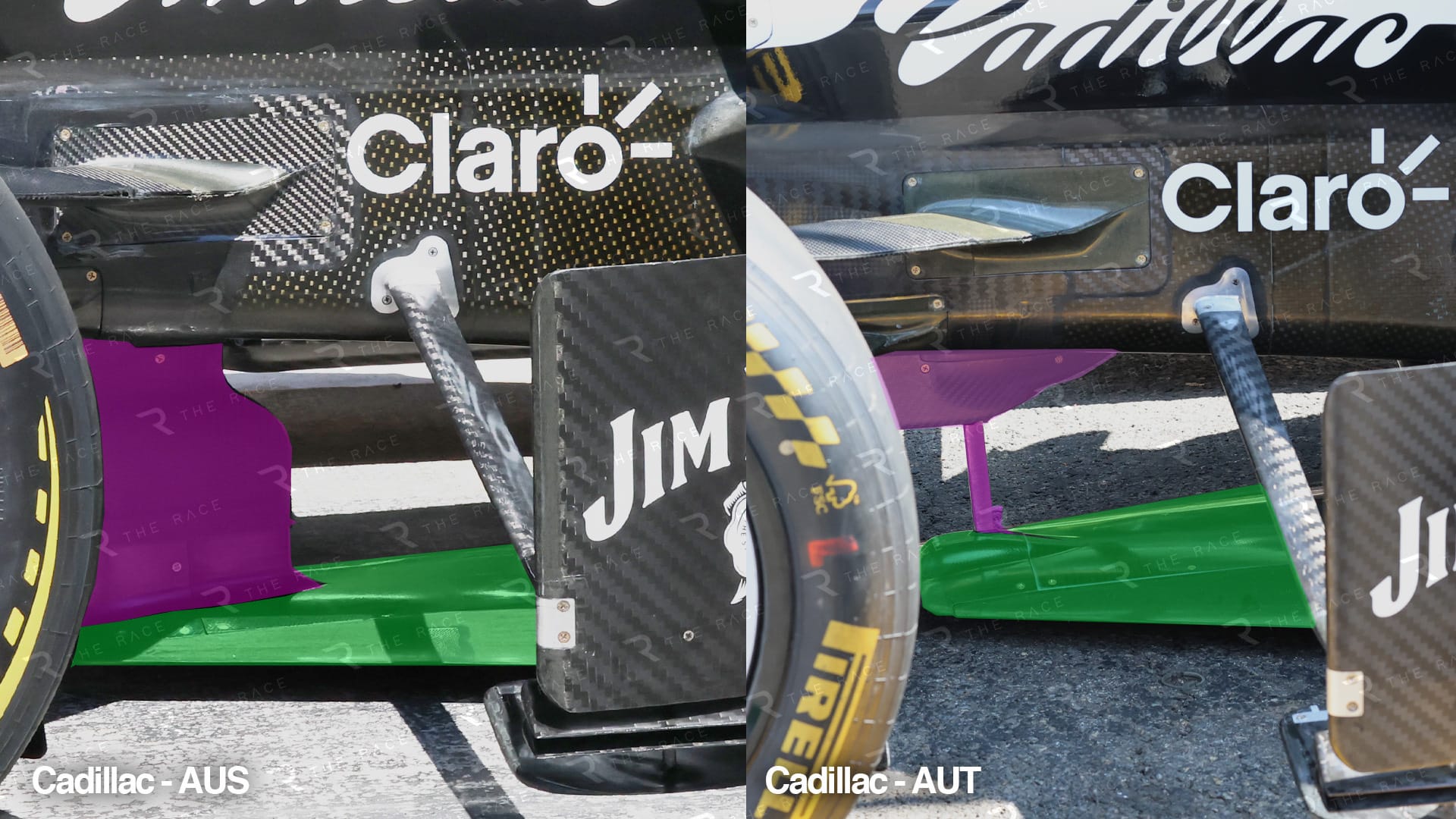
Now we come to the leading edge of the central section of the underfloor. The main change here is the reduction of the volume of the floor tray (green highlight) support (magenta highlight).
Reducing this will allow for a simpler deflection mechanism, which is there to allow the floor tray to move upwards above a certain FIA test load to reduce the risk of chassis damage when the driver goes over kerbs.
It will also allow the airflow that is coming in through the gap created by the raised chassis to distribute itself to the left or right of the chassis bow as required by the suction levels created by the diffuser.
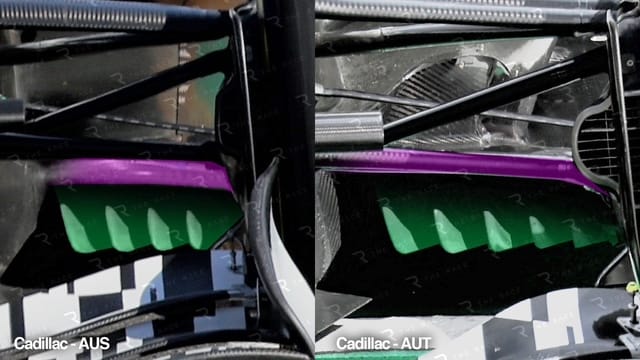
Further outboard on the floor sidepod leading edge, Cadillac has also revised the positioning of the small vertical-ish splitters. It has also gone from a four-pack to a five-pack; we all like a six-pack, perhaps that's next on the list?
Dividing the leading edge of the underfloor into smaller sections gives the opportunity to increase the outwash on the front corner of the floor. Having this area 'aerodynamically talking' to the bargeboard footplate allows this area to act like its own small diffuser.
This in turn means the main diffuser at the rear of the car is mainly focused on the airflow nearer the centre line of the car, which is coming in over that earlier tray section of the floor.
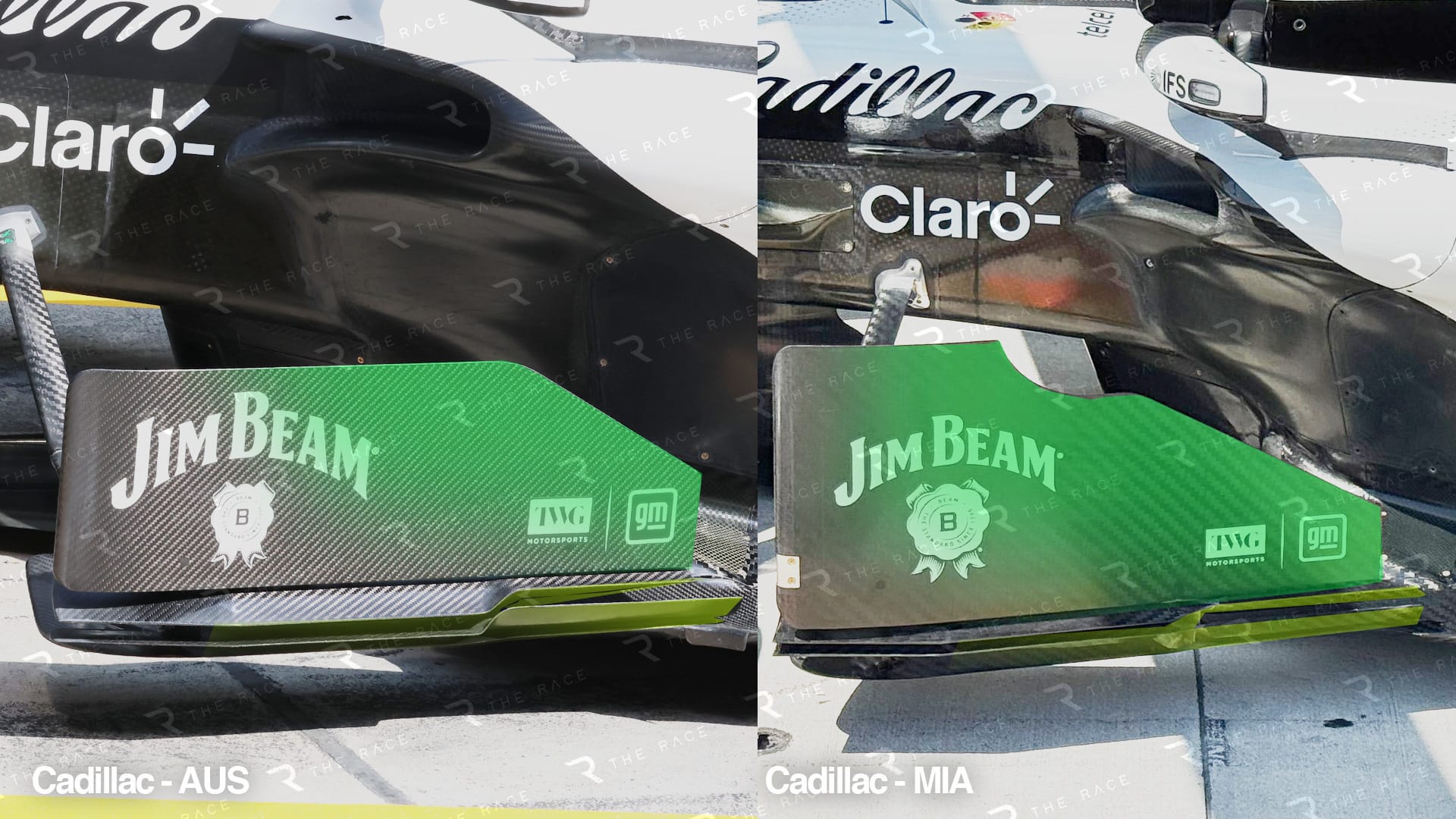
Then we get to the bargeboards and their footplate. The upper edge profile of the bargeboards (green highlight) has changed - not dramatically, but by being taller it will have more effect on tidying up the turbulent wake trying to fill that void behind the front tyre.
The horizontal vanes on the bargeboard footplate (yellow-ish highlight) have also been altered slightly, just through small profile and angle of attack changes to work more efficiently with the vertical vanes under the leading edge of the floor.
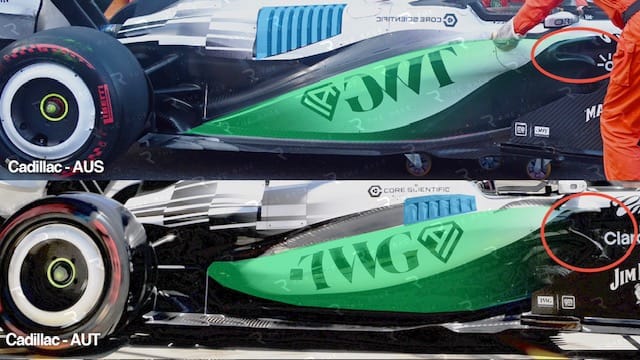
Now we move on to the sidepods. Again, Cadillac has had to increase the cooling inlet (red ellipse above and below), which, combined with the repositioning of the exit louvres (light blue highlight above) closer to the radiator cores, will make them more efficient.
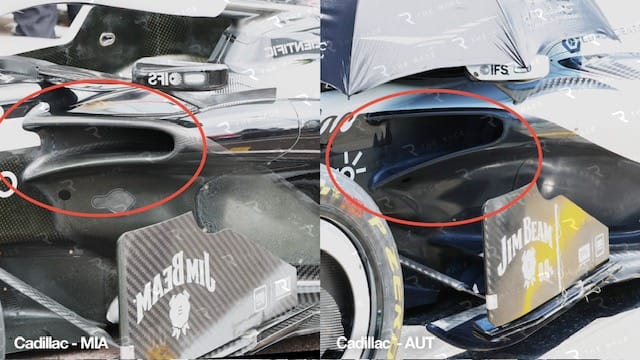
It shows the team probably underestimated the cooling requirements around the complete car. It's not surprising as it's a new team, and I have done that myself; speaking from that experience, I would advise them to overdo the cooling. Getting to the finish line without too many compromises is all that can be expected from a team in its first year.
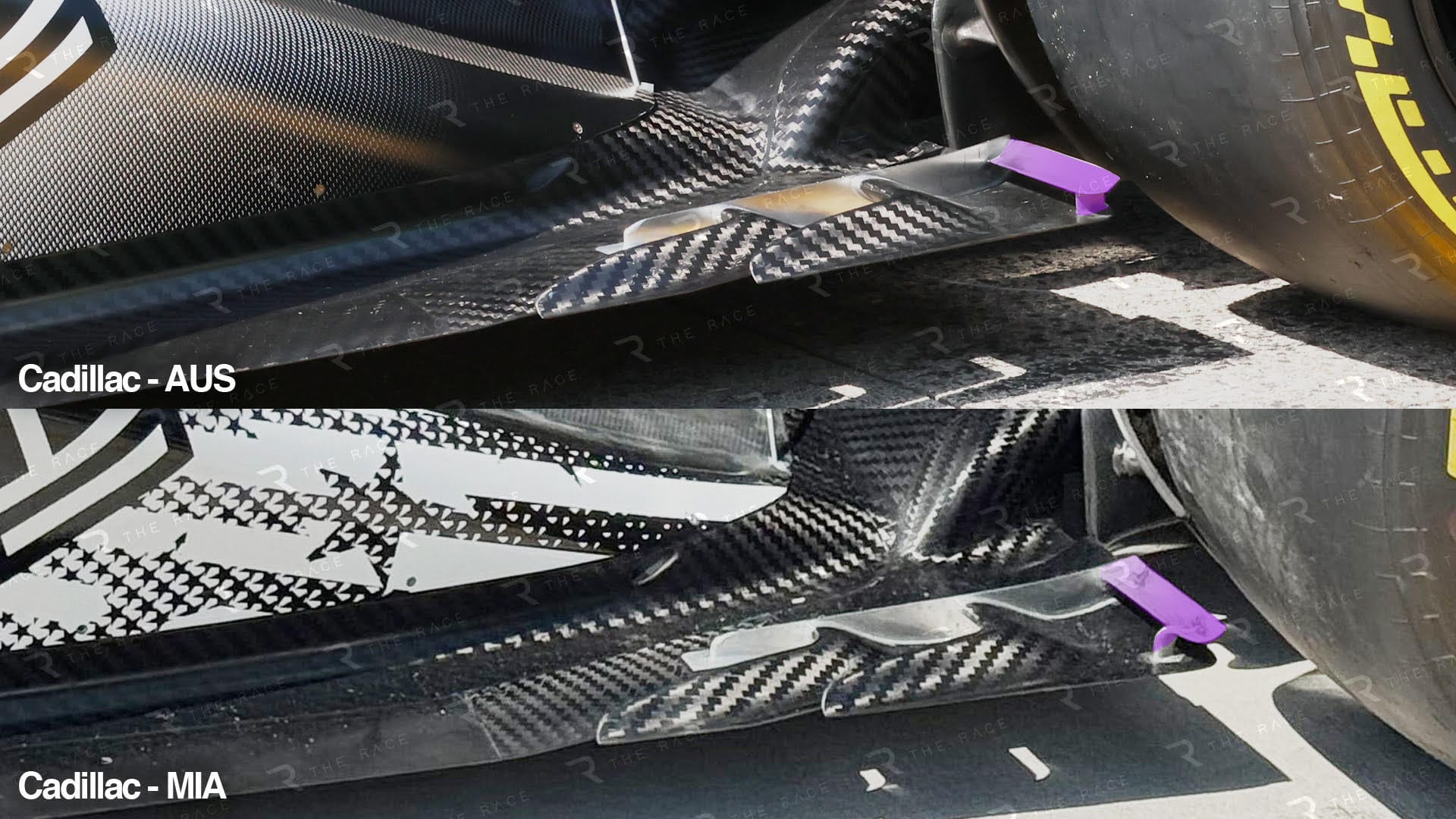
We then move on to the area just in front of the rear tyre contact patch. This area is important to how efficiently you can make the floor side sealing system work.
Basically, you are trying to reduce the amount of airflow that is being either forced under the floor by the rear tyre rotating onto the track surface and/or pulled in under the floor by the diffuser in this area.
The small horizontal turning vane (magenta highlight) in front of the rear tyre contact patch has had its angle of attack altered slightly. Also, its support is now further forward; the vanes in front of that area also look like they have been altered slightly.
I wouldn't get excited about either of these changes. Some of them may have just been for manufacturing and structural requirements.
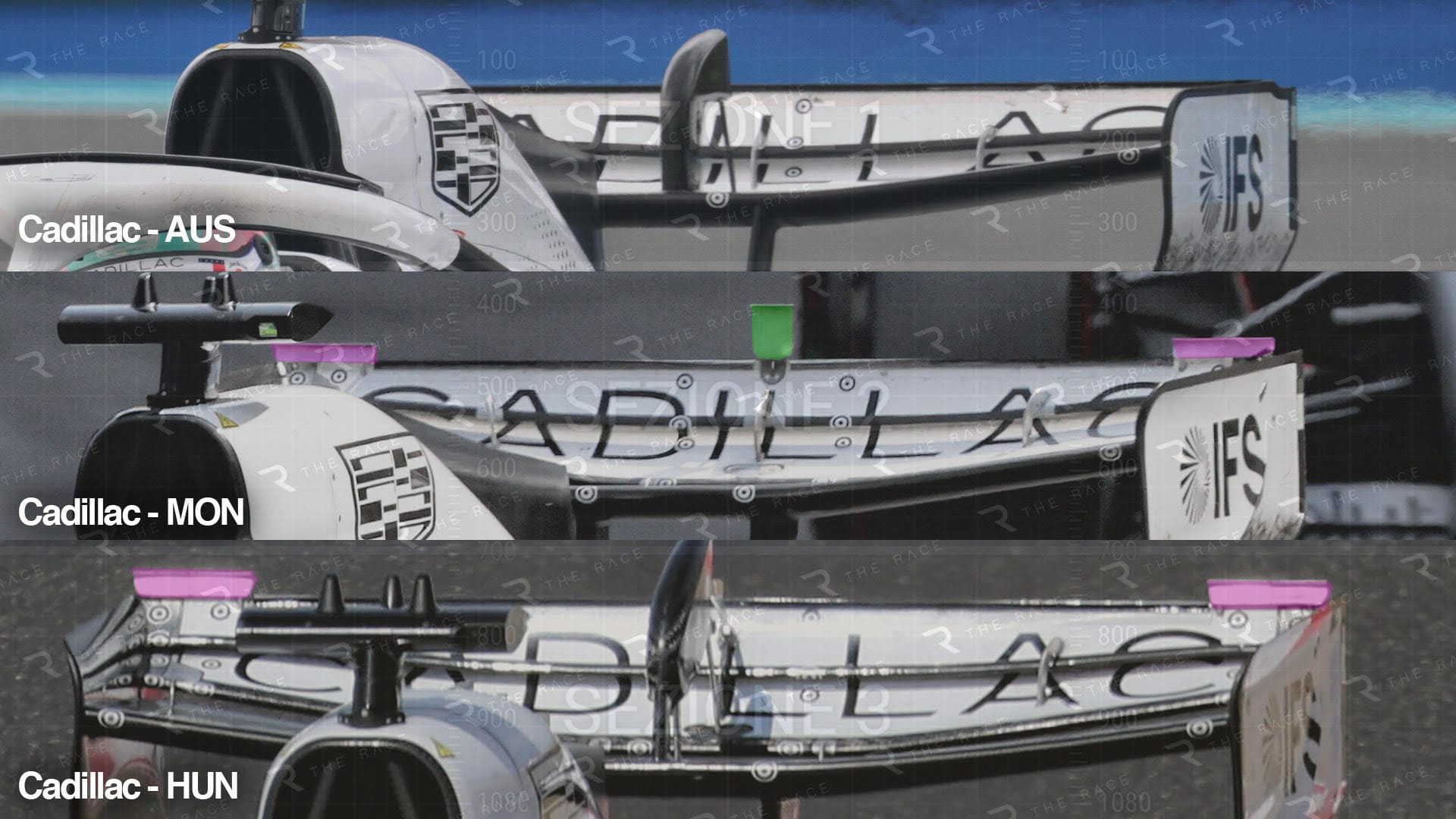
Then we get to the rear wing packages, an area more to do with different circuit requirements.
Cadillac started the season with a fairly simple solution - nothing groundbreaking - and from that it added the small outer rear flap extension (magenta highlight) for Monaco where the teams were not allowed to use an active wing configuration.
It added a small extension to the rear flap in the area that is allowed for the active aero mechanism, and for the following races and Hungary that extension was gone and the active aero mechanism was refitted.
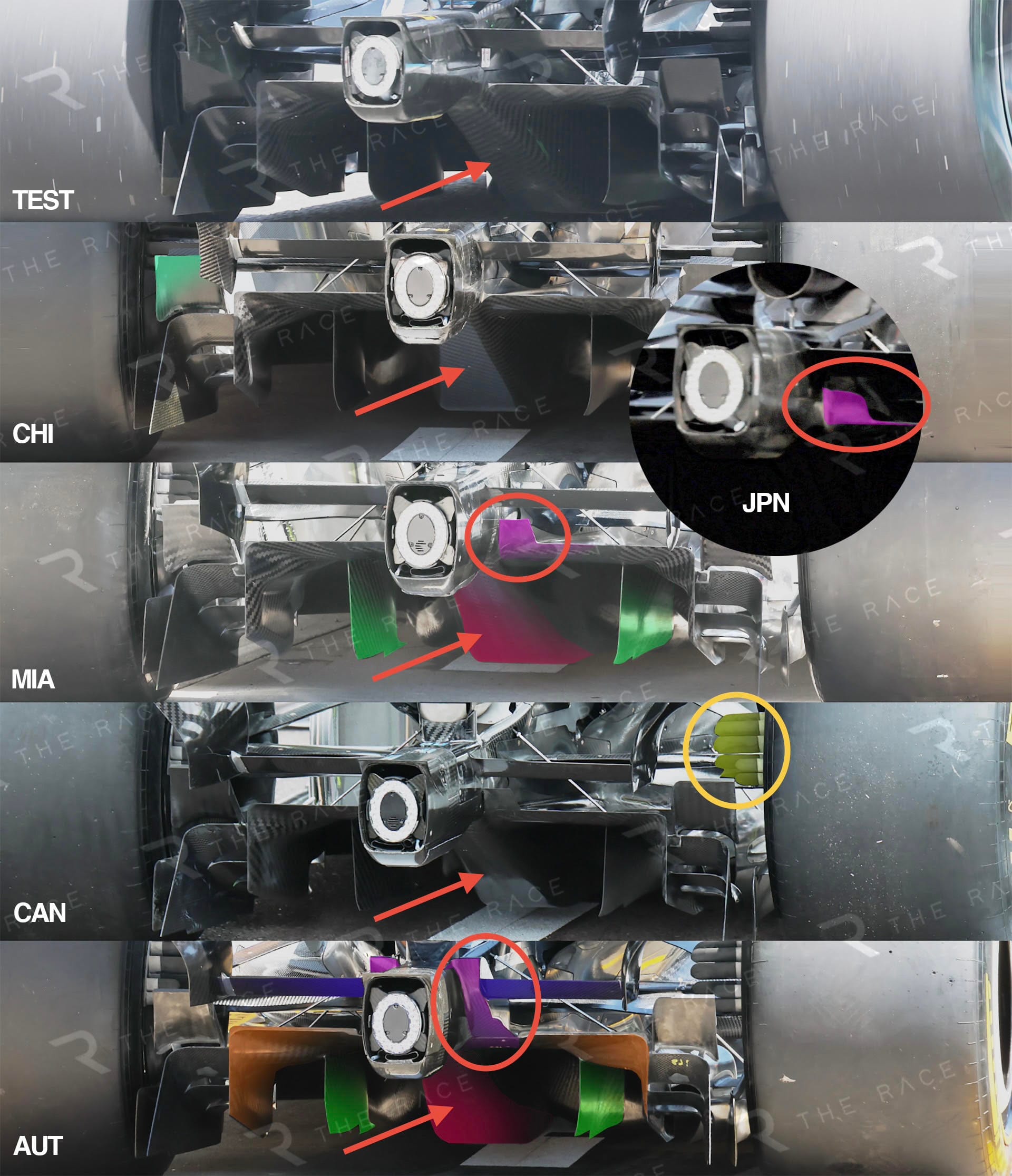
From the rear we can have a look at the various diffuser configurations. It's always difficult to really see in detail from one single shot, but it looks like there are quite a few small changes in this area.
The rear section of the gearbox shroud (highlighted with the red arrows) looks like it may have changed angle slightly, now longer at the floor section and more upright.
Cadillac has also added the small extensions on the sides of the rear crash structure (magenta highlight) and as the races have progressed through the season these extensions have got bigger.
The splitters, which are shaded in green, could be slightly different, as could the sides of the diffuser, which is shaded in orange. But as I have said before, from one shot it's difficult to see by how much or go into great detail.
Underwhelming development?
So summing up, for a team in its first season I'm a little disappointed in what I am seeing. When you come in from the cold there should be more opportunities to exploit. What I'm seeing is simply what could be classified as small race-to-race developments, and in reality there should be a few eureka moments to exploit once all the other cars have shown their dirty laundry in public.
I don't want to be overcritical, and these cars are exceptionally complex. But the last new team, Haas, started its first campaign in 2016 on a much stronger footing. Both have a relationship with Ferrari and even though Haas took far more Ferrari components for its debut, I still expected more in-season progression from Cadillac.
Cadillac's season so far doesn't show much relative progress; in order of the races, this is the percentage gap to pole, with the team's lead qualifying position in brackets, and worst and best bolded.
Australia, 5.20% (18th)
China, 4.26% (20th)
Japan, 3.86% (19th)
Miami, 4.36% (17th)
Canada, 3.92% (20th)
Monaco, 3.74% (18th)
Barcelona, 3.83% (19th)
Austria, 4.28% (19th)
Silverstone, 3.53% (18th)
Spa, 3.31% (19th)
Hungary, 4.76% (21st)
As you can see, as far as percentage from pole is concerned, Hungary, the 11th race, was not too different to Australia, which was the first race of the season.
As far as the Lowdon-Budkowski swap goes, heads are going to roll when the ultimate performance or progress isn't there. Yes, this could mean more experienced people coming in, but it can also mean disruption.
For upper management, patience can run out. Promises run thin and Lowdon has paid the price for that given CEO of TWG Motorsports Dan Towriss said: "It wasn't a mutual decision. The process started a few months ago: really thinking about what the next phase for Cadillac Formula 1 looks like, what's the right timing, how would that look, and then the capabilities of the various folks out there."
Adding to and strengthening the management structure would have been a better solution, so perhaps he should have remembered the old saying: 'Patience is a virtue, possess it if you can'.
Let's see how Cadillac's patience holds up in the second half of 2026.