The warning for Mercedes in its Zandvoort data
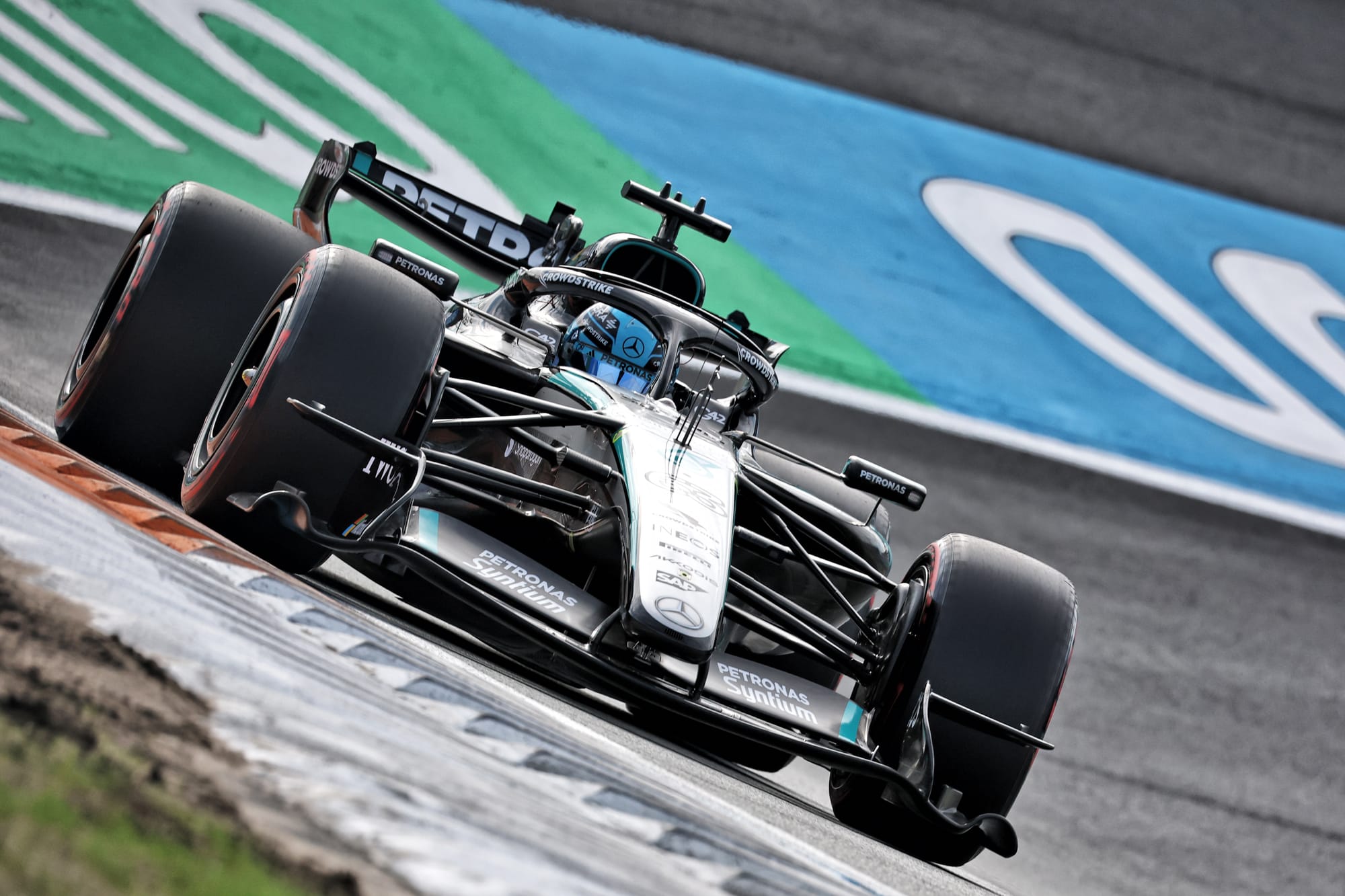
George Russell's sprint pole position at Formula 1's Dutch Grand Prix provided relief for Mercedes that its strategy of holding fire on upgrades had not yet dropped it into the pack.
While Ferrari and McLaren have been aggressive in bringing development packages to their cars – with latest updates from both appearing at Zandvoort – Mercedes has been playing the long game.
Having selectively had just one major spec change at the Canadian GP in May, it is saving its development spending for an end of season splurge when it hopes the coffers of its rivals are empty.
But despite Russell's form in edging out Lando Norris's McLaren showing that the W17 is still very strong, tucked away in the data is a clear warning signal that Mercedes may not be able to wait much longer before needing to bring more.
Russell's advantage over Norris to take pole was a slim 0.041 seconds, but there was a very topsy turvy nature to how they achieved their laps – with big variability between sectors.
SECTOR 1 SECTOR 2 SECTOR 3
RUSSELL 24.381s 25.434s 21.752s
NORRIS 24.622s 24.983s 22.003s
There was nearly half a second of difference between them in the middle sector, with Kimi Antonelli similarly adrift to show that this was a Mercedes trend.
Under F1's 2026 rules, such variability is not uncommon and often comes from different deployment strategies – where one driver will use more energy on one straight compared to another.
Some of the difference between Norris and Russell can be explained from this, with there being a big speed difference for example as they run to end the lap.
As Russell's Mercedes keeps accelerating to 317km/h (197mph) in the chase to the timing line, Norris's McLaren peaks at around 307km/h (191mph) before falling away.
But the Mercedes advantage here does not seem to be the upside to it having deliberately not used energy elsewhere, as the only real difference in top speeds between them is when McLaren appeared to have used more at the start of the lap.
In fact, digging into the telemetry of their best SQ3 efforts, the poor middle sector of Russell's was nothing to do with saving energy on the straights – it was performance through the corners.
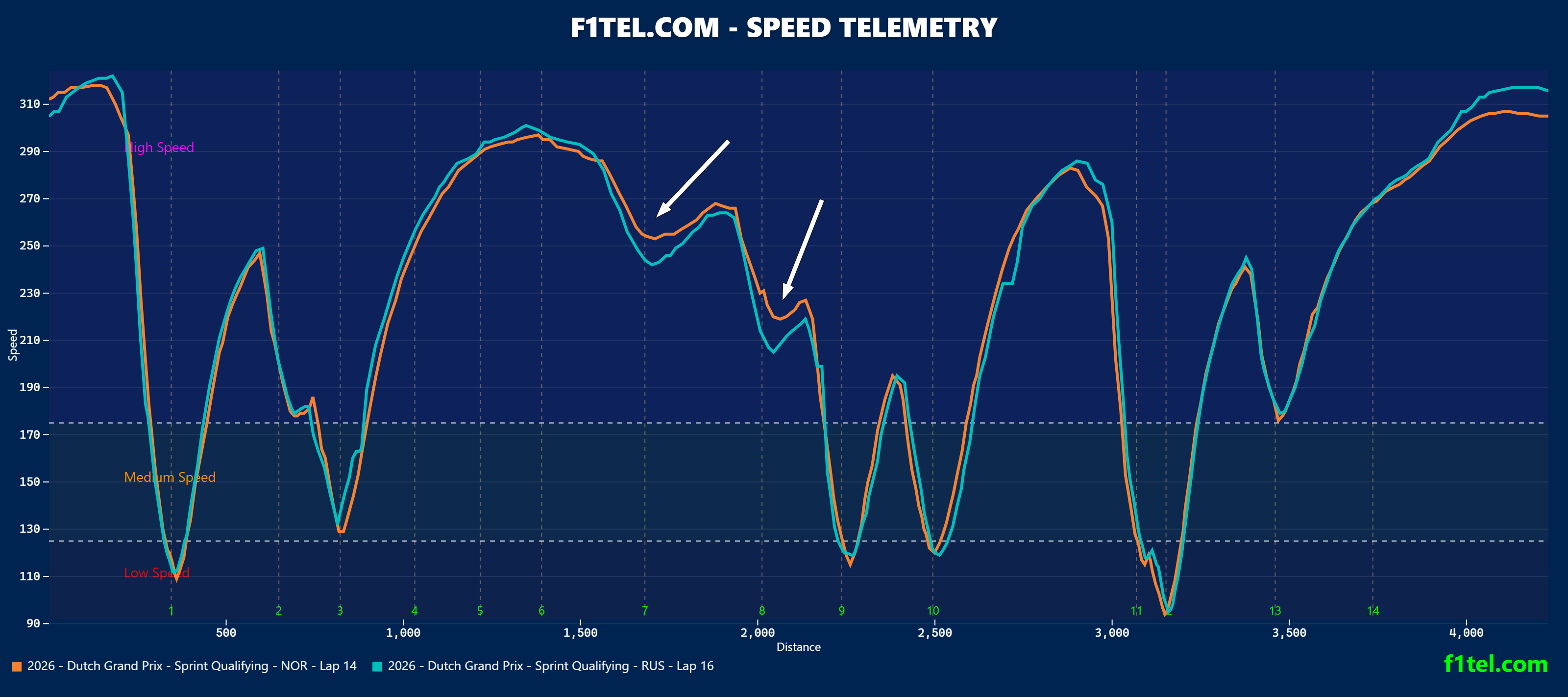
As the data above shows, which we have used from F1tel.com shows, Mercedes has been struggling compared to McLaren and Ferrari in the high-speed Turns 7 and 8 – which neither Russell nor Kimi Antonelli can take anywhere near as fast as McLaren and Ferrari.
While McLaren's upgrade has helped Norris keep his minimum speed up at 253km/h (157mph) through Turn 7 and 219km/h (136mph) at Turn 8, Russell drops to 242km/h (150mph) and 205km/h (127mph).
Those differences pull Norris back from two tenths of a second adrift at the time, to back on par with Russell.
The performance through these two high-speed corners points to McLaren having made a clear step with its most recent upgrade – as it is in contrast to what we have seen in turns with such a speed range earlier in the year.
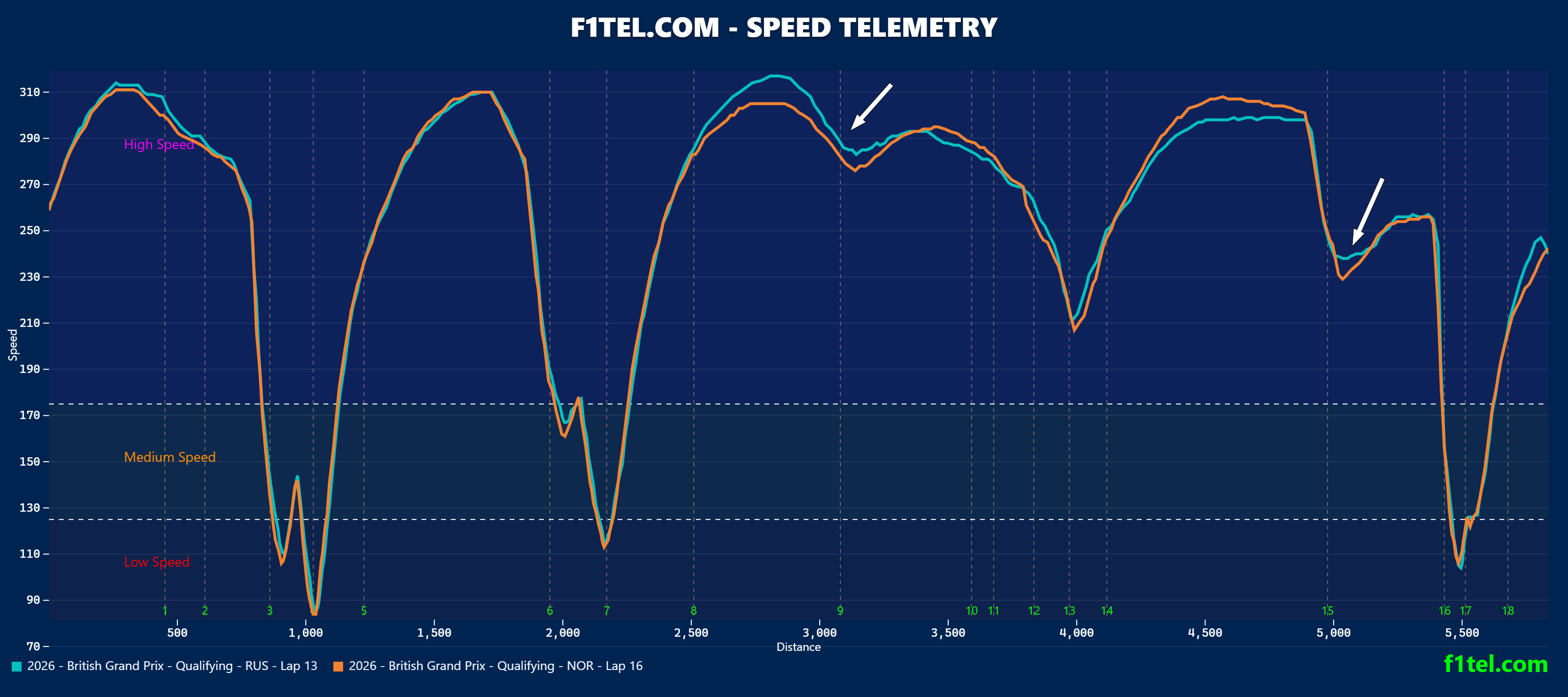
At Silverstone, for example, Norris was 7km/h (4.3mph) slower than Russell through Copse (283km/h vs 276km/h), and a similar speed adrift at Stowe (238km/h vs 231km/h).
What Mercedes now needs to understand is whether that speed offset through Turns 7/8 at Zandvoort is a sign that it has genuinely fallen back in high-speed corners so needs to respond with some car improvements, or if there is some set-up or driving approach issue that has left it exposed.
A clearer answer for that will come when Mercedes has another go at qualifying on Saturday afternoon.