The sad demise of MotoGP's MotoE experiment
"I think it's not the right decision to delete this category, but we can't do nothing."
After seven seasons crowning six different champions, with a mid-stream change of manufacturers and upgrade to full FIM world championship status, MotoE was rather unceremoniously parked at the conclusion of its 2025 campaign.
The timing of the announcement - September, just as the grid was gearing up for the penultimate round of the season - was a surprise. The announcement itself - not so much.
Series promoter Dorna described it as the series going "on hiatus" but didn't sugarcoat the reasons as to why. "MotoE has not been able to gain sufficient traction within our fanbase," it was said.
"In fact, and despite all the best efforts to promote this innovative category together with Dorna, the truth is that we haven’t reached our objectives, nor has the industry associated with performance electric bikes," FIM president Jorge Viegas was quoted as saying.
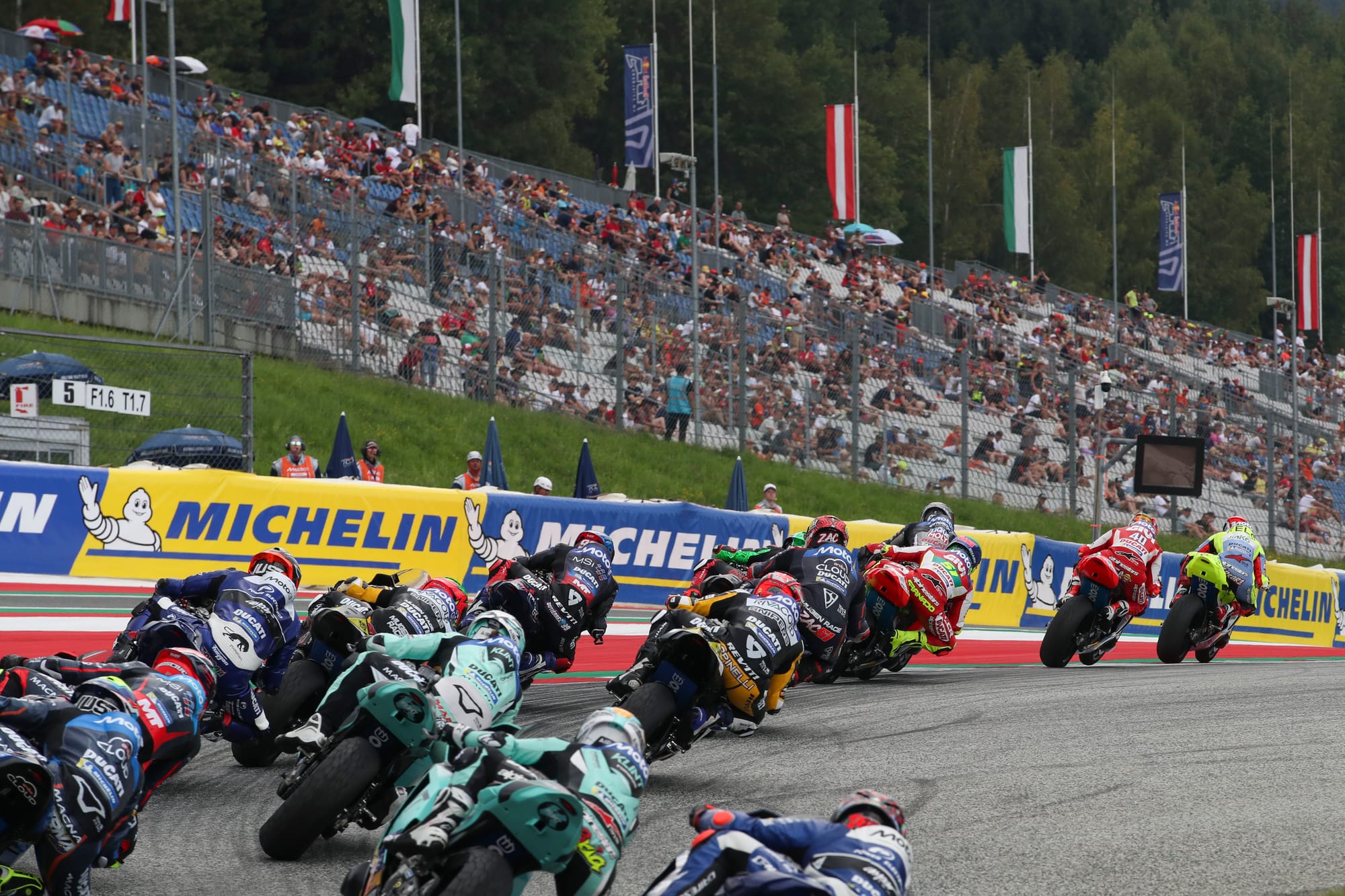
Despite Ducati's arrival and world championship status, the series came to feel as increasingly vestigial and insular. Both races of the two-race weekends were now squeezed onto the same day, and even before that they felt ill-fitting in the established MotoGP weekend rhythm of MotoGP/Moto2/Moto3.
Star power frittered away from the grid. The inaugural season featured Sete Gibernau, Bradley Smith, Randy de Puniet, Alex de Angelis - none at the peak of their powers but all MotoGP podium finishers (and in Gibernau's case, a genuine frontrunner).
MotoGP starts are not the only metric of a rider's fame - far, far from it - but it was reflective of a trend that by 2025 the only rider on the grid with MotoGP priors on his CV was 38-year-old Jordi Torres, whose premier-class stint amounted to five races of injury relief on a two-year-old Ducati.
For now, the story is over after 78 races. Only one rider - Matteo Ferrari, the inaugural champion - did all 78. He probably has a solid claim to being MotoE's 'GOAT', but you would not know it seeing him in the MotoGP media centre at the conclusion of his championship, blending into the crowd in civilian clothes.
The series' last champion, Alessandro Zaccone, was there for 58 of the races. Both he and Ferrari spent a big chunk of their 20s racing these bikes in a series that now becomes a historical footnote.
Speaking to media after his coronation in Portugal, Zaccone admitted the realisation that it was potentially now-or-never to tick off the MotoE title was at the back of his mind - and that being the last champion, for now, "for sure is something special".
But he also felt it's "something crazy" that MotoE is stopping.
"I think it's a category that can give a lot to this sport," he lamented. "Because there is a lot of development that they can do.
"For sure, it's something new because not everybody likes the electric. I'm the first that doesn't like the electric - but I have to say that the bike is really fun to ride.
"I think the people need time to understand the category. It's like when in MotoGP they passed from two-stroke to four-stroke. At the beginning everybody hated the four-stroke, but look now. The technology is super high, the bike is so-so fast. So... well, I think the people are not ready to understand this technology."
The affable Italian always makes it clear he himself is a motorsport traditionalist - tinkering with cars and bikes at home as a mechanic, and admitting he probably isn't going to go out and buy an electric bike.
"But as I say to everybody, when you ride it, you feel something different. It's something that you have to try to understand."
The original MotoE bike - the Energica Ego Corsa - served the series for four campaigns, a credible outcome given the entire fleet of bikes was initially wiped out in a fire during testing.
It was a competitive bit of kit but bulky, heavy, something for riders to adjust to (among other things, they found the lack of sound from rival machines around them unfamiliar in combat) and something that added an element of unease to the kind of sprint racing that defined the series.
Zaccone will know it better than most. In 2021, he highsided in the season finale at Misano and was unavoidably slammed into - in fact, actively run over - by Hikari Okubo.
He had been seven points clear at the top when the crash happened, but he ended up with serious injuries - pelvis and vertebrae fractures.
Following a fruitless year in Moto2, he returned to the electric paddock - now with Ducati as supplier of a faster, leaner bike - struggled for a bit, then got a title over the line just as the series stopped.
"For sure when Ducati came to the championship, they did a huge step," Zaccone recalled.
"Also the Energica was super-fun to ride, super-super fun. But it was more basic, more of a road bike. Ducati made a prototype.
"We know that Ducati, wherever they enter, they do a super bike, a very good bike.
"I said to everybody that, all the amateur riders, if they try the MotoE, they will enjoy it much more than trying a Superbike or something like this."
Zaccone will be a bit biased - he remains a Ducati rider this upcoming year - but the bike 'looked' fun. The racing it produced was, unquestionably, good.
Average gap between first and second, 2025
MotoE - 0.387s
Moto3 - 1.178s
MotoGP sprints - 1.335s
Moto2 - 1.793s
MotoGP - 3.335s
It's easier to put on closer racing than fellow series when the races are so much shorter, yes. But that was part of the unique selling point. MotoE promised and routinely delivered a burst of action.
But motorsport shows over and over again that the quality of racing does not determine a championship's success and its resonance. It always needs this virtuous circle of buy-in from as many people as possible creating competitive prestige, creating stakes, then creating drama. If a race was decided by an 0.005s photo finish but nobody is too bothered by who the winner was, it might as well not have happened.
Zaccone clearly feels like the series was hung out to dry in recent years. He's even wondered whether the decision to slowly 'sunset' MotoE was already made a while back.
"As a championship, I don't know if there was really development. Because at the beginning they pushed it quite a lot, the championship, but then, I don't know why, they stopped pushing it.
"We did a big step as a technology package, but they decided to do a step back of visibility of MotoE. I don't know why, for me was a bad decision because everybody saw, the races are good, are beautiful, there are many-many fights. But maybe they decided a few years ago to stop it, and we learned it only in Misano..."
It's clear MotoE had been deprioritised. It's also clear that it just hadn't resonated, and ultimately you cannot guarantee resonance by force-feeding it to people. You can only make a bet as to how hard to push, and then see it succeed or fail.
And given this is a traditionalist sport, in which noise is such an essential component, perhaps failure was always going to be the likeliest outcome.
For Zaccone the MotoE suspension was like "a cold shower", though he's found a solid alternative in an Althea Ducati ride in World Superport.
But he hopes to see the series back one day, and - whether he would then return or not - it feels like that would make a surprising bit of difference.
If MotoE is done-done, he will stand as its last champion, which is a historical curio but ultimately not worth that much.
But if he is right in his hypothesis and it was simply 'too early' for MotoE, it could return and matter one day - and then its champions would retroactively matter more, too.
That would be nice. I feel that way, in any case - you might not.
However, there is another, smaller side to the legacy of the serise that is inalienable regardless of whether it's ever restarted or not. Two MotoE full-timers used the series as a springboard to actual MotoGP careers.
OK, Lorenzo Savadori - part of the inaugural season in 2019 - has mostly been around as a MotoGP tester and replacement rider, though has clearly had a substantial impact on Aprilia's recent progress.
But MotoE was also the introduction to the grand prix paddock for one Fermin Aldeguer, who had only just turned 16 when he lined up on the grid for the 2021 MotoE season opener.
Whatever happens in the future, the people behind MotoE can always say their series helped bring a new winner to MotoGP.