Suzuka challenge 'gone' as F1 drivers are 'handcuffed'
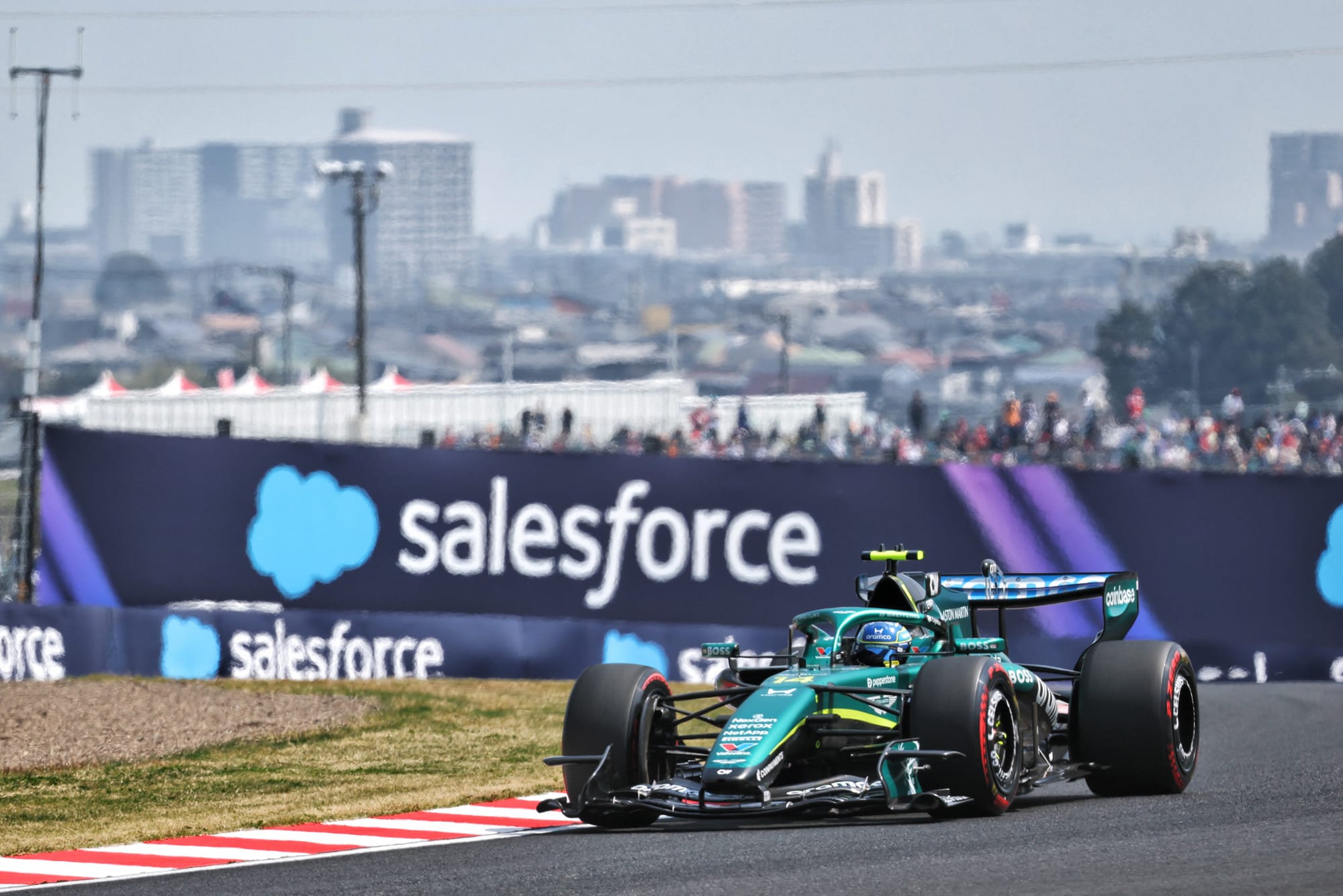
Fernando Alonso has complained that the driving challenge of Suzuka has “gone” thanks to Formula 1’s 2026 regulations making the cars too easy to drive, being under the limit in fast corners.
The Aston Martin driver, who qualified 21st for the Japanese Grand Prix with a deficit of almost 3.9% to pole position - the team’s biggest of the year - has criticised the diminishing challenge of driving these cars in fast corners since pre-season testing. This is primarily a consequence of often being forced to drive well within the limit of grip in faster corners.
High-speed Suzuka, regarded as one of the best circuits on the F1 calendar, has exposed this more than the previously used 2026 tracks, where Alonso has also highlighted the problem. That’s despite the FIA dropping the permitted harvesting level on a qualifying lap from 9MJ to 8MJ this weekend.
“It’s gone,” said Alonso when asked by The Race about Suzuka as a driving challenge this year.
“I told you in Bahrain the chef could drive the car now. Maybe not the chef, but 50% of the team members I think, at least, can drive in Suzuka, because as I said a few times already the high-speed corners now became the charging station for the car.
“So you go slow there, you charge the battery in the high speed and then you have the full power on the straight. So the driver's skill is not really needed anymore.
"You just need to back off the throttle or turn down the battery and you charge the thing. So no more challenge in the high speed.”
While Alonso is hardly motivated to enjoy these regulations given the dire straits Aston Martin finds itself in, there have been criticisms up and down the grid. Even Kimi Antonelli, who took his second consecutive pole position, highlighted the problem.
He was asked about the driving challenge of qualifying at Suzuka in the post-qualifying press conference having taken pole position. While he was largely positive, he also referenced being limited by the energy demands.
"Obviously, there are parts of the track where you're a little bit limited, a bit handcuffed on driving because of energy,” said Antonelli.
“But I think still the esses are pretty good fun, because at the end of the day the car on the chassis side, it's very good fun. And the esses in qualifying were getting pretty quick, so it was good fun.
“Of course, there's still work to do around these big tracks with the energy, how to find a solution that allows us to push even more and drive without thinking too much, especially in certain places. But overall, I think it was good fun, qualifying, because at the end also you look at the lap times and they're not so far off from last year.”
Reigning champion Lando Norris reckons it "hurts your soul" seeing the speed "dropping so muych, 56km/h down the straight" as the reigning champion weighed in.
Haas driver Ollie Bearman, who had a difficult qualifying and was eliminated in Q1 after a software-related power unit problem compromised his first run, also pointed to the negative impact of the regulations.
“It’s a lot less rewarding to do a good lap in Suzuka - not that I did one - than it was last year,” said Bearman. “The amount of management that you have to do is a bit frustrating, but that's our new reality.”
Alex Albon, who qualified 17th for Williams, supported what Bearman said after a session in which he was frustrated that gaining speed in the corners had cost him more time on the straights.
“The corners are good, but the corners can be good around here,” said Albon. “I just listened to what Ollie was saying at the end of his interview, and it's very true: you can be quicker in every corner and you can finish the lap slower because obviously there's a penalty to be applied. So, it is frustrating."
During the qualifying session, Ferrari driver Charles Leclerc was also critical of the impact of the regulations on qualifying over the radio.
“I honestly can’t stand these new rules in qualifying, it’s a f**king joke,” he said. “I go faster in corners, I go on throttle earlier, for f**k’s sake I'm losing everything in the straight!".
He later explained his position after a qualifying session in which he was frustrated because adjusting his throttle to correct a moment impacted his deployment and cost him what he claimed to be two-and-a-half tenths.
“Every time you go a little bit over the limit, any time you have a bit of a snap, this is costing energy on the power unit side and then you pay the price more,” said Leclerc.
“I feel like at the moment consistency is paying off more than being brave and going to take something that you've never tried before, which is a shame and which makes qualifying a little bit less challenging and this is something that we need to work on.
“It's a known issue, it's not that the FIA or the teams are just accepting the situation as it is. There's a lot of work behind the scene and I hope that we can find a solution as soon as possible.”
Team-mate Lewis Hamilton, who has been positive about how raceable this generation of cars is, was another to highlight the problem. Although he felt he could push early in the iconic esses section that runs from Turn 3 to Turn 7, the need to save energy set in later in the sequence.
“It’s pretty on the limit, particularly through the first section,” said Hamilton. “But then once you get to Turn 6, you can't be on the limit really as much through there, you have to save battery power.
“So definitely one of the least enjoyable in that respect of having full power through the whole lap. That element I don't think is really a great part of the racing.”